This portrait, painted in about 1620, is of Emma Dolben, daughter of John Dolben of Cae Gwyniau, Denbighshire. In 1630 Emma married the Reverend Hugh Williams, Rector of Llanrhyddlad and Llantrisant, Anglesey. Their eldest son, Sir William Williams of Wynnstay became Solicitor General and Speaker of the House of Commons in 1684. Emma’s great grand-daughter, Margaret, married Hugh Owen of Penrhos. Among the possessions she took to her new home at Holyhead was the portrait of Emma Dolben.
Their only daughter, Margaret Owen, married Sir John Thomas Stanley of Alderley in 1763, thus forging the link between Penrhos and the Stanley family. Over the years the family flourished such that the modest Tudor house at Penrhos was replaced by a handsome mansion. The portrait of Emma continued to hold pride of place at the house and a legend grew in the family that bad luck would befall the Stanleys if it ever left Penrhos.
Plas Penrhos – the home of the Stanley Family
In 1939, at the commencement of WW2, the house was taken over by the military and the portrait was removed from Penrhos. It is said that the Stanley family did indeed suffer a number of sad tragedies following this. Their connection with Holyhead ended and the mansion was allowed to crumble to a sad ruin.
The 300 acre Penrhos Estate was sold in the late 1960’s for the building of Anglesey Aluminium Metals Ltd. The start-up of the aluminium smelter did not go smoothly and there were concerns that the venture could fail. However, in 1972 The Honourable Mrs Adelaide Lubbock, daughter of the 5th Lord Stanley of Alderley, returned the portrait of Emma Dolben to Penrhos. It was placed on indefinite loan at Anglesey Aluminium and was hung in the company Board Room. Those with a superstitious mind considered that this coincided with the turnaround of the plant and the dramatic improvements that ensued.
Anglesey Aluminium built on the Penrhos Estate.
After well over three decades the portrait left Penrhos to be returned to the Stanley family. Not long after this production of aluminium ceased at the smelter. Forklore, superstition, fact or fiction?
From research undertaken by Peter Scott Roberts
Photograph of Plas Penrhos from ‘Hen Gaergybi Old Holyhead’ by D I Rendall and J C Davies
Image of the painting of Emma Dolben from a leaflet produced by AAM Ltd.
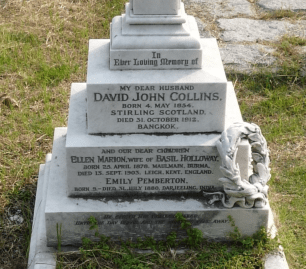
One of the many interesting gravestones at Holyhead’s Maeshyfryd Cemetery is that of John Collins who died in the town in 1904, aged 76. The gravestone mentions his army service at the Crimean War and also the Indian Mutiny.
John Collins’ Gravestone at Maeshyfryd Cemetery, Holyhead
John Collins was born at Tralee, Kerry, Ireland in 1827. In 1845 he joined the 82ndRegimentof Foot at Tralee, aged 17. He married Ellen Frawley, widow of Private John Frawley, at Devonport in 1850 and took on her two children, Mary Ann and George Frawley. The regiment moved from Portsmouth to Salford in 1852 and George died there in the same year, aged 5. The 82nd Foot then moved north to Stirling in 1854 and a son, David John Collins, was born there in the same year. Mary Ann Frawley died at Portsea in 1861, aged about 11.
The regiment left for the Crimea in early 1855 and arrived at Balaclava via Corfu in early September to participate in the Fall of Sebastopol. This brought the Crimean War to a close and the regiment returned to the UK the following year. During this time it is assumed that his wife and family remained in the UK.
The 82nd Regiment of Foot remained in the UK at Aldershot and then Portsmouth until May 1857 when it left initially for China but was rerouted to Calcutta via Singapore to help deal with the Indian Mutiny. No family members are allowed to travel with the regiment at this time. The 82nd took part in the Relief of Lucknow in November 1857. The rebellion drew to a close in 1858 and the regiment then moved to Delhi. Ellen Collins must have joined her husband in India shortly after this and a daughter, Marian Margaret Collins, was born at Delhi in January 1862.
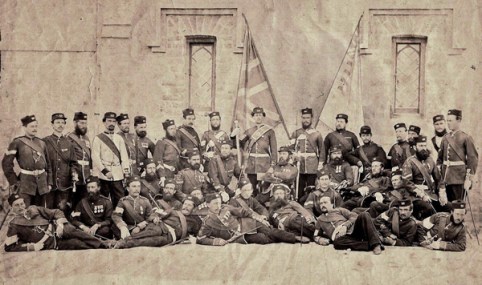
Members of the 82nd Regiment of Foot at Subathoo
The North-West Frontier was the next posting for the regiment and where Ellen gave birth to a son, James, at Sabathoo in early 1864. Unfortunately she succumbed to dysentery in April the same year. A few months later the regiment left India taking up duties at Aden, Ireland and the UK. It is not known what happened to his last born child, James.
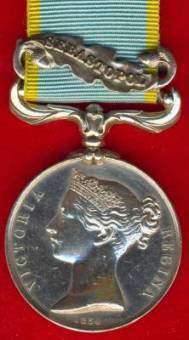
In May 1866 John Collins married Sarah Harrington (spinster) at St. Cybi’s Church, Holyhead. The following year John Collins was discharged from the Army at his own request after completing over 21 years service and moved to Holyhead living at 22 Boston Street. He left with an Army Pension and the Crimean Medal (with clasp for the Siege at Sebastopol), the Turkish Medal and the Indian Mutiny Medal. On his discharge he was recorded as having three good conduct badges, although during his service his name appeared 30 times on the regimental defaulters list and he was court-martialed six times, mainly for ‘habitual drunkenness’. He was at one point promoted to Corporal but was reduced to Private after a year due to drunkenness.
Crimean Medal with clasp for the Siege at Sebastopol.
At Holyhead he initially ran a refreshment room and was anxious to promote his business such that in 1868 he was involved in a confrontation at Holyhead Railway Station with another refreshment room owner resulting in that person being convicted of assault after he had insulted John Collins’ old regiment. In 1879 a similar confrontation took place with another refreshment room owner and both were fined £2 and bound over to keep the peace. At this time he lived with his wife and daughter, Marian Margaret Collins, at 1 Church Terrace, Holyhead.
In 1877 his son, David John Collins, married Emily Pemberton at Moulmein, Bengal, India. He had joined the Great Trigonometrical Survey of India in 1873 as a Surveyor.
John Collins’ daughter, Marian Margaret Collins, married William Fox Lloyd at St. Cybi’s Church, Holyhead in 1887. John Collins was then the landlord of the Sydney Inn, Rhos-y-Gaer Terrace, Holyhead.
In 1895 John Collins’ wife Sarah died of stomach cancer at 7 Moulton Street, Holyhead, aged 72. He then married widow, Grace Parry, at St. Cybi’s Church in 1898. At this time he was living at 21 Baptist Street, Holyhead. In 1901 Grace died, aged 59.
In 1904 John Collins died, aged 76, at 26 Cambrian Street, Holyhead, the home of his daughter, Marian Margaret Lloyd. He was buried at Maeshyfryd Cemetery, Holyhead with Local Volunteers firing a three volley salute at his graveside. The local newspaper reported many prominent townsfolk attending his funeral and listed five grandchildren, the children of Marian and William Fox Lloyd – John, Willie, Thomas, Noel and Nellie among the mourners. William Fox Lloyd was at this time serving as a Chief Steward on the LNWR cross channel ferries at Holyhead. No other family members attended his funeral other than the Lloyd family. His headstone was subsequently erected by his son David John Collins, who later died at Bangkok in 1912.
John Collins Lloyd, son of Marian and William Fox Lloyd and grandson of John Collins, later joined the clergy and served as an Army Chaplin in WW1. His son Charles Courtenay Lloyd served in the Royal Navy during WW2 and later as a linguist for the British Government during the Cold War helping to train British Agents. He married a Princess from the exiled Russian Royal Family and after retiring as a School Master now (2019) lives with his daughter, Masha Lloyd, in Spain. In May 2019 he celebrated his 100th birthday.
The grave of David John Collins at Bangkok
The funeral report also mentions that John Collins was an eye witness to the ‘Charge of the Light Brigade’ in October 1854. This would seem to be unlikely as his regiment did not arrive at the Crimea until well after the event. However, the regiment history does record that a large contingent of the 82nd did transfer to the 34th Regiment of Foot at the outbreak of war and would have reached the Crimea in time. Unfortunately his service record does not include this detail.
An interesting character in Holyhead’s past. He surely must have had some fascinating tales to tell!
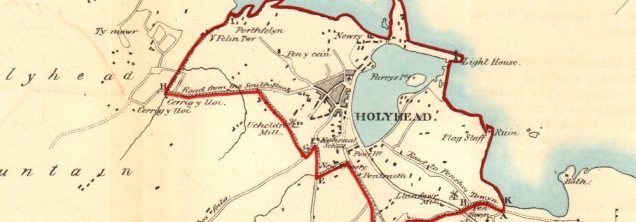
Map of Holyhead prepared by Robert K Dawson Lieut. R.E. as part of the Reform Act of 1832**
In January 1832, Holyhead’s Clerk of the Peace was obliged to draw up a Parish Valuation in order to record the dwellings in the town. This document still exists and it gives us a fascinating snapshot of the town just after the completion of Telford’s ‘Great Holyhead Road’. We learn that the population of the parish at that time was 4,282 and the total number of recorded dwellings was 349.* The town had 34 streets with Stanley Crescent and Market Street being the longest (42 and 40 dwellings respectively) and Hill Street with 3 dwellings, Turkey, with 3 dwellings and Parliament Ditch with its 2 dwellings being the shortest. Some streets remain to this day but others have long disappeared. Who now remembers Willow Garden Row, Well Row and Ponctybobtu?
Market Street and Stanley Crescent were not only the longest streets but also the busiest. There was a Saddler, a Hatter, a Druggist, an Eating house and 3 Public Houses in Market Street (Rose & Crown, Red Lion, King’s Head), whilst Stanley Crescent housed a Sailroom, a Shipwright Yard, a Druggist and 2 Public Houses (The Legs of Man and the Spirit Vaults). Other trades in the town included a Smithy and a Joiner in New Street, two Coal Merchants in Church Lane and a Brew House in Ponctybobtu.
Some dwellings were not in streets – Ucheldre Park, the Tan Yard, the Royal Hotel, the Hibernian Inn and the New Brewery are listed as individual buildings.
Of course, the maritime connection was strong with many houses being identified by the names of sea captains who lived there, e.g. Captain Evan Lloyd’s House in Church Lane; Captain Goddard, Captain Skinner, Captain Grey and Captain Evans’ Houses in Stryd. Captain Duncan’s House and Captain Owens’ House were recorded as individual houses.
Other dwellings bore the name of the occupation of the owner or tenant, e.g. a Guard’s House in Market Street was probably the home of the Mail Coach Guard and the Waiter’s House in the same street probably referred to the house of a Tide Waiter (a Customs official). Dr Walthew also had a house in Market Street.
When the Electoral Roll was published later in 1832, it showed that of the 862 men aged 20 years or older who lived in Holyhead, only 70 were eligible to vote in general elections. In those unenlightened times women were denied the vote which meant that only about 3% of the total adult population could help choose a Member of Parliament. This small band of voters included Sir John Thomas Stanley of Penrhos, Dr Walthew, Robert Spencer (landlord of the Royal Hotel), Edmund Roberts of Ucheldre Park, Owen Owens (the solicitor), the Rev. William Morgan (Minister of Bethel Chapel) and Thomas Powell of Llys-y-Gwynt.
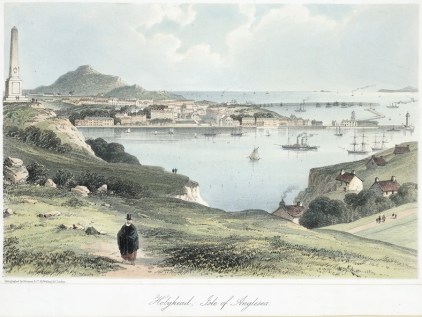
Holyhead in 1850 – the Breakwater is under construction, the railway has reached the town and Skinner’s Monument is in place above the harbour.
Within 12-15 years of this Parish Valuation, Holyhead would experience tremendous and far-reaching changes as the railway age dawned, and so this particular ‘snapshot’ of 1832 could well represent an end of an era. The Holyhead of 1852 would prove to be a very different place.
*The Valuation was carried out in order to calculate who would be eligible to vote after the passing of the Reform Act of 1832. It is highly likely that the poorest dwellings were not listed as the people living there were unlikely to be included in the Electoral Roll.
This gravestone marks the last resting place of Anne Elphinstone (1792 – 1850). Her grave can be found in the Lower Graveyard of St. Cybi’s Church, Holyhead. Her simple slate memorial now lays flat like many others around. The inscription tells us something of the circumstances of this lady’s demise.
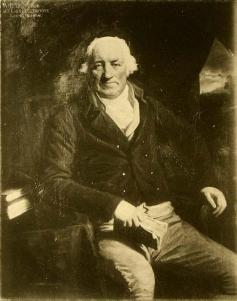
Hon. William Fullerton Elphinstone
Unmarried, she was the youngest daughter of the late Honourable William Fullerton Elphinstone (1740-1834). Previously a Chairman of the Honourable East India Company, he resided at Harley Street, London and was well connected to the Royal Family. Newspapers record Anne Elphinstone’s attendance at many social events, balls and gatherings where King William IV and later the young Queen Victoria were present.
Anne Elphinstone was the cousin of the 13th Lord Elphinstone and had six other siblings. Among them was Major-General William George Keith Elphinstone, who in 1842 led the tragic retreat from Kabul during the first Anglo-Afghan War that resulted in the massacre of many hundreds of British soldiers, native sepoys and camp followers.
Anne Elphinstone – portrait from 1835
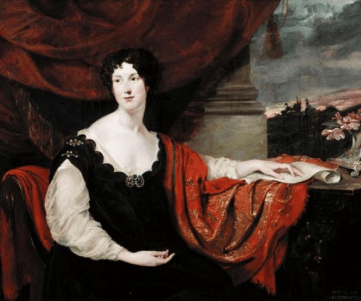
Newspaper reports of the day record the sad details of this poor lady’s death. They tell that on the 20th August 1850 Anne Elphinstone was in the company of the Hon. William Owen Stanley of Penrhos, Holyhead and Lady Sarah Hay Williams of Bodelwyddan, a guest at Penrhos. Lady Sarah was the wife of Sir John Hay Williams. He was the brother of Elin Stanley, wife of the Hon. William Owen Stanley. In 1849 Sir John Hay Williams built Plas Rhianfa (now Chateau Rhianfa) on the banks of the Menai Straits as a present for his wife.
Lady Sarah Hay Williams
The group was returning by open carriage from an excursion to South Stack and was entering Holyhead by way of Summer Hill (Market Hill) when the two horses were affected by a wheelbarrow in the road causing them to bolt and to break the carriage pole. As a result the carriage struck the ‘Old Billiards Room’ (now where the National Westminster Bank building is situated) at speed throwing the occupants out. All suffered injuries but Anne Elphinstone was the most seriously hurt and was thought to have badly damaged her spine. She had been staying at the Royal Hotel, Holyhead (now Victoria Terrace) and died there at 6am on the 29th August 1850. She was aged 58.
Anne Elphinstone lived at 3 Chesham Place, Belgravia, London. Her father and other members of her family are buried at St. Marylebone Parish Church, London. In her will she required that if she died in London she should be buried with her family but if she died in the country then she should be buried at the nearest Churchyard. That explains why she was laid to rest at Holyhead in a simple grave. She left most of her estate to her brother Col. James Drummond Butler Elphinstone. This amounted to £6,000, equivalent to almost £800,000 today.




 Holyhead: Stories of a Port