Holyhead Maritime Museum’s unique collection of historical artifacts help tell the story of the towns maritime heritage. Located outside the museum are two 18th Century ship’s cannon. The following is their story ……
The Irish sea had been plagued by pirates from the withdrawal of the Roman legions from Britain in the fourth century. Turkish, Moroccan, Irish, Viking, Spanish and French were among some of the vessels that plundered ships in these waters. The following account illustrates how vulnerable and unprotected the town was three centuries ago from such threats.
One Saturday in the year 1710, a vessel flying English colours, sailed into Holyhead Bay, firing her guns to indicate that she was in distress. In response, Maurice Owen, the local customs official, launched the Queen’s revenue cutter and proceeded to the vessel to investigate. Once aboard Owen quickly realised that they had been duped, for the ship was the French privateer ‘Fox’, with a crew of over 150 men and heavily armed. After being stripped and interrogated about the town’s defences, the cutter’s crew were taken hostage and held to ransom. The ‘Fox’ then proceeded to anchor off Borthwen Beach, close to Church Bay.
One of the two 18th Century Cannons on display outside the Holyhead Maritime Museum
However, as if by divine intervention, a ferocious storm blew up, de-masting the vessel, forcing her to jettison 14 of her large cannon to allow her to become more maneuverable. This proved to be futile and despite firing her remaining smaller guns in distress, the town’s people, out of fear, chose not to come to their aid. She was eventually driven on rocks somewhere between Borthwen and Penrhos point. On the Sunday morning, seven boats took off the 150 pirates and released Maurice Owen. Twenty of the pirates were sent to Dublin aboard the packet boat ‘James’ for trial.
The cannons remained on the seabed for over one hundred years before they were rediscovered by divers carrying out work for the construction of the Admiralty Pier. They were then stored until George IV visited Holyhead in 1821 and despite being heavily corroded were used to fire the royal salute. They were later relocated to the newly built Market building sometime in the late 1850’s until the Town Council took them into storage in the 1940’s. They were eventually presented to the Holyhead Maritime Museum for display in 1986.
This story is one of more recent times. It has been written by Billy Kynaston Williams in memory of his father. It includes details of an tragic event at sea during the Norwegian Campaign of WW2, 80 years ago, which resulted in his father ending up as a Prisoner of War. It is also essentially a love story.
Thomas Lawrence Williams (1915 – 1990)
With the commemorations of VE Day, having just past, I thought I would share this short piece summarising my father’s war experiences, particularly as the 8th June will be the 80th anniversary of him becoming a prisoner of war in Germany.
He was a merchant seaman in the employ of the Orient Steam Navigation Company Ltd, having joined after completing his course at the National Sea Training School at Gravesend.
Despite the imminent threat of war in 1939, it started as a good year for him, because it was the year he married my Mother, Enid Catherine Kynaston, in Holyhead. He was then employed as an assistant steward on the company’s RMS Orford, a 20,000-ton liner providing mail, cargo, and passenger services to Fremantle and Sydney, Australia – sailing via Gibraltar, the Mediterranean, Suez Canal, and Colombo.
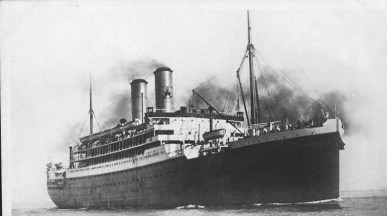
By 1940 he had been transferred to the company’s RMS Orama, which had been requisitioned by the Admiralty and refitted as an auxiliary armed troop transport, becoming the HMAVOrama. His wartime role on the ship, probably among many others, was as a member of a gun crew manning one of the ship’s newly installed anti-aircraft guns.
In 1940 the Orama was engaged in the Narvik campaign transporting the British Expeditionary Force to Norway. This proved to be a disastrous campaign for Britain and resulted in a number of significant naval casualties including the sinking of the aircraft carrier HMS Glorious, two destroyers, HMS Ardent and HMS Acasta, a Norwegian oil tanker and, of course, the Orama.
RMS Orama
On 8 June 1940, 300 miles west of Narvik, they encountered the German fleet comprising the German battleships Scharnhorst and Gneisenau and the heavy cruiser Admiral Hipper with other lighter vessels. The Orama was sunk by a combination of gunfire from the Admiral Hipper and a torpedo from the destroyer Z 10 – nineteen men were killed and 280 became prisoners, including my dad. Thankfully the Orama was not carrying troops at the time.
The images above show the Orama listing after the engagement with the Admiral Hipper and finally sinking. The survivors were picked up by the German Navy and were transported to Trondheim in Norway, and then to Oslo in cattle trucks. From there they embarked onto a small coaster for their transfer to Germany. On arrival they were moved, again in cattle trucks, to Stalag XIIIA in Wolfsburg in Bavaria arriving sometime in late June 1940.
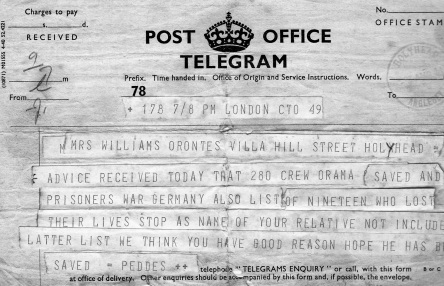
The telegram below was received by my grandparents following the sinking (curiously not sent to my Mother).
Thankfully my Dad survived the sinking and his subsequent incarceration relatively unharmed. It was not until later it was learnt that he had been injured whilst evacuating onto the Orama’s lifeboat when a crew member fell on him injuring his leg quite badly. Later, whilst in the PoW camp, he suffered at least one recurrence of Malaria, first contracted during his earlier voyages to the tropics.
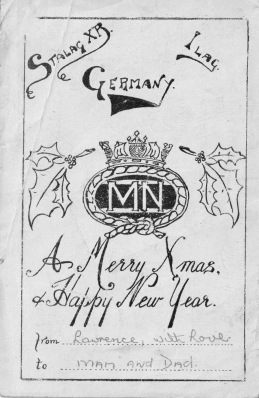
What communication there was from him seemed to indicate, not surprisingly, that he was getting by. One that was sent to my paternal grandparents at Christmas 1941 is shown below.
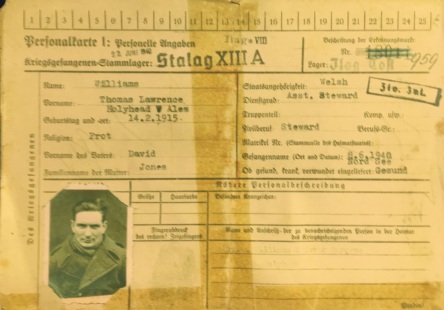
His PoW record card shown below was obtained when inmates ransacked the camp’s offices following its liberation by the allies. The photo of him bears witness to the hardships that he and all PoWs suffered during this period.
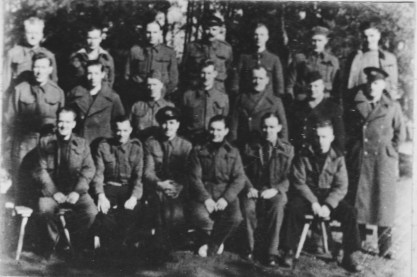
Somehow a few photos did emerge from his time as a PoW, such as the one shown below with my Dad in the front row, third from right. (His record card and other photos from this period have been donated to the Holyhead Maritime Museum).
Prisoners of War at Stalag XIIIA. Lawrence Williams is in the front row, third from the right
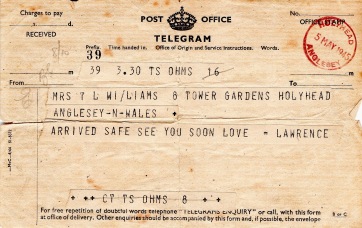
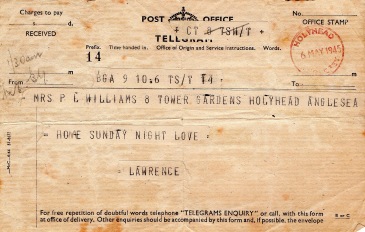
The POW camp was eventually liberated in April 1945. Repatriation from there involved being flown home, probably from Brussels, in a Dakota and arriving somewhere in southern England on 5 May 1945, before finally arriving home in Holyhead two days later.
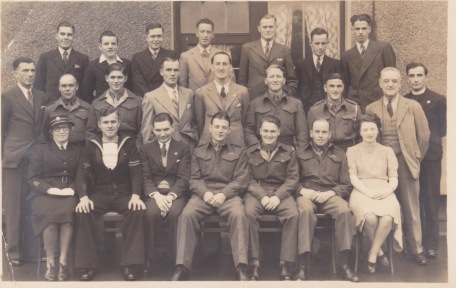
The group photo below was taken immediately after the war and includes other Holyheadians who were also unfortunate in being prisoners of war. Included in the photo is my Mother – front row, first right who worked as a secretary for the British Red Cross.
Fortunately for me, liberation allowed him and my mother to immediately start a family, but around about the time when the photograph below was taken, Mam had developed MS and finally succumbed to the disease at Easter 1960, aged 43.
After the war Dad joined the British Transport Commission’s (later British Rail) cross-channel ferries from Holyhead to Ireland, serving principally on the MV Hibernia until his first retirement at the age of about 58. He then bought a sweet shop and tobacconist in Thomas Street, Holyhead (the Ten-o-Clock Shop), successfully running that, with his second wife, until finally retiring in about 1980 and then moving to live in Trearddur Bay. Dad passed away in December 1990.
Billy Kynaston Williams
June 2020
We are very grateful to Billy for writing up his father’s so well illustrated story and allowing it to be published here. It is important that his story, and others like it, should not fade into the forgotten pages of history.
In September 1827 Edward Randall Pascoe, Commander of H M Steam Packet Arrow, sailed into Holyhead harbour in the midst of a ferocious storm. He had lashed himself to the ship’s wheel to ensure he was not washed overboard. His ship had already suffered damage to its machinery and had been ordered to make for Holyhead to effect repairs. The vessel’s normal route across the Irish Sea was from Portpatrick in Scotland to Donaghadee in Ireland, a three and one half hour crossing.
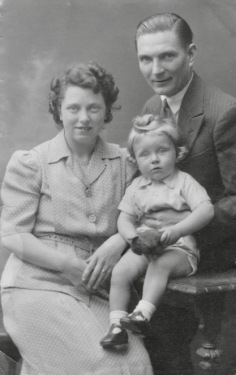
Edward Randall Pascoe RN 1779 – 1827
Born at St Ewe, Cornwall, he was aged 48 and had served in the Royal Navy from an early age. He married Ann Molland at Dover in 1811 and they had seven children. In 1805 he served as Master’s Mate on HMS Naiad at the Battle of Trafalgar. As a smaller ship she was not directly involved in the battle but stood by to help recover damaged and captured vessels. In 1808 he was promoted to Master and took up that position on the 38 gun frigate HMS Niemen. In 1814 he was serving on HMS Granicus, another frigate.
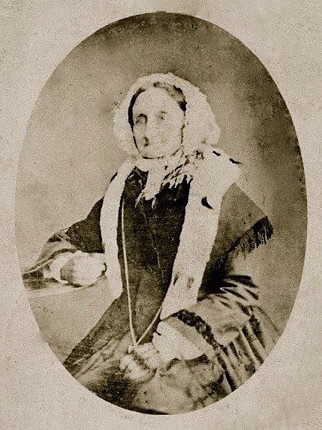
Ann Pascoe (nee Molland) 1781 – 1852
By 1821 he had left the Navy but retained on half-pay. He was commissioned Commander in the Postal Service and took command of the Steam Packet Mansfield to carry mail and passengers across the Irish Sea from Milford to Waterford. By 1825 he and his family had moved to Portpatrick where he commanded His Majesty’s Steam Packet Arrow, being paid £250 per annum.
Typical Steam Packet of the period
When Commander Pascoe reached Holyhead on that September day he was obviously exhausted and possibly injured. He had tried to persuade the Post Office to allow him to return to Portpatrick for repairs to the Arrow but they decided that facilities were inadequate and instructed him to sail to Holyhead where facilities were better and more accessible for those sent to effect the repairs. Sadly his condition developed into a fever and he died at the town on 13 September 1827. He was buried at the Parish Church of St. Cybi on 18 September.
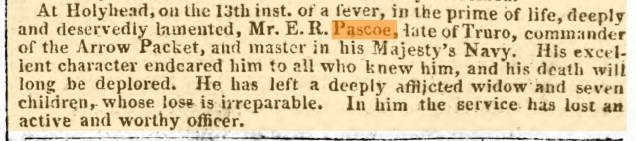
Death notice published in the Cambrian Newspaper, 29 September 1827.
The story does not end here. Recently descendants of Commander Pascoe became interested in his story and began some extensive research. It is this research that has formed the basis for this article. We are grateful to Brian Miller and Sarah Perrott for kindly sharing their information and photographs. Sarah Perrott is a direct descendant of Edward Randall Pascoe.
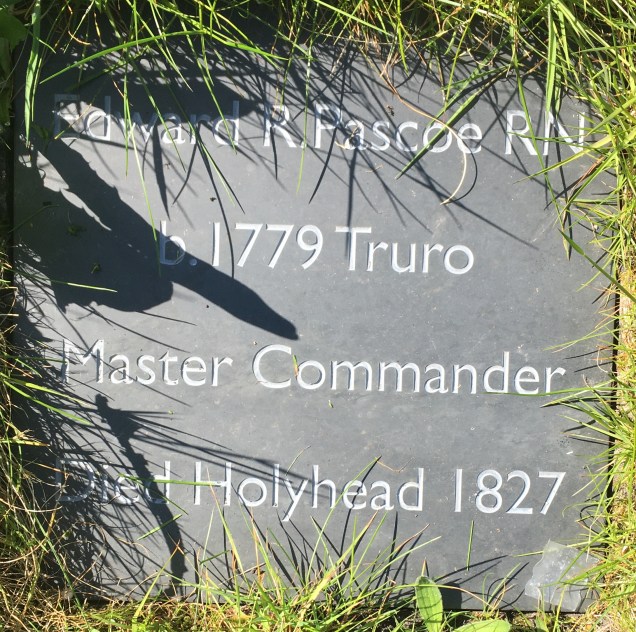
It was not clear if his grave at St. Cybi was marked with a gravestone so she arranged to have a memorial tablet made and gained permission to have it laid at the church graveyard in his memory. Subsequent to this, local research may have located the grave in the north west section of the graveyard. Confirmation of this is awaited as due to the Corona Virus restrictions, this portion of the graveyard has been locked off and is inaccessible.
Memorial Tablet at St. Cybi’s Graveyard, Holyhead
The Steam Packet Arrow was taken over by the Admiralty in 1837 and renamed the Ariel. In February 1840 she carried Prince Albert, accompanied by his father and brother, across the English Channel to the UK for his wedding to Queen Victoria. The crossing took five and one half hours.
HM Steam Packet Ariel entering Dover Harbour on 6 February 1840 carrying Prince Albert on his way to his wedding to Queen Victoria.
The painting of the ‘arrival of Prince Albert’ is by William Adolphus Knell (1801–1875) and is part of the Royal Collection, having being purchased by Prince Albert.
With grateful thanks to Brian Miller and Sarah Perrott for permission to include the results of their research and the images of Edward Randall Pascoe and Ann Pascoe.
The meeting occurred at the ‘Stanley Arms’, Holyhead in 1818. This is not the present Stanley Arms at the bottom of Market Hill, but the ‘Eagle and Child’ hotel built by the Stanley family in about 1770. Later named the ‘Royal Hotel’, the building is now known as Victoria Terrace and is adjacent to the Cenotaph at the entrance to the town centre. In 1818 the hotel was run by Thomas Spencer, who came to Holyhead from Parkgate, nr. Chester in 1808.
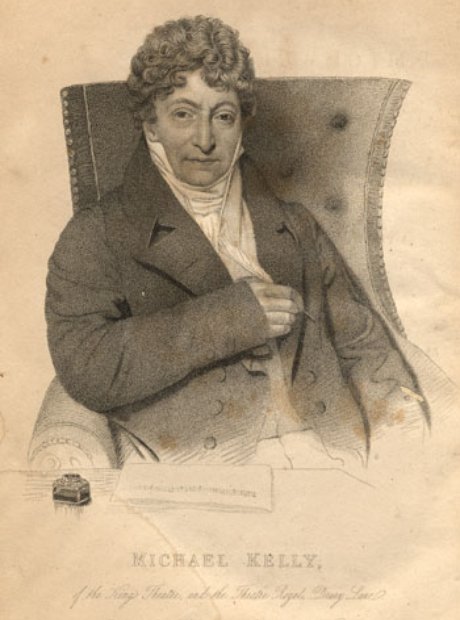
The Royal Hotel, Holyhead (known in 1818 as the Stanley Arms) The Irish Tenor was Michael Kelly, who was born in Dublin in 1762. He was very famous in his day and regarded as one of the finest tenors of the period. He was also an actor and composer and worked alongside well known London theatre producers such as the poet Samuel Taylor Coleridge. He was a friend and contemporary of Wolfgang Amadeus Mozart and worked with other famous composers such as Salieri.
Michael Kelly – operatic tenor, actor and composer.
Michael Kelly was not a well man. He suffered badly with gout. He was in Holyhead whilst on the way to Dublin to progress a lawsuit against a Mr. Hime, who was accused of pirating and publishing a number of his compositions. The following is Michael Kelly’s own account of the time he spent at Thomas Spencer’s hotel and his meeting with Billy-in-the-Bowl. Through this he clearly saw an example of the saying ‘Beauty being in the eye of the Beholder’.
“There was, about this time, a law-suit to come on, in Dublin, in which I was subpoenaed, against a Mr. Hime, a music-seller in Dublin, who had pirated and published a number of my compositions. I was labouring under severe illness at the time, however, I had promised to go, let the consequence be what it might. On the 13th July, I left Tavistock Row for Dublin, in a travelling-carriage, in company with Mrs. Horrebow, Mr. Addison, and Henry Horrebow. I travelled slowly, and by short stages, (still being very ill,) and on the seventh day, reached Holyhead, and put up at the Stanley Arms, kept by Mr. Spenser, from whom, and his family, I received the greatest possible attention. I remained nine weeks in his house, as I was unable to cross the sea, I was told, without the risk of my life. While I was there, a little fellow, a great ally of mine, called upon me every morning. In his person he verified the old adage, that every eye forms its own beauty. This said droll little fellow, surnamed, by the inhabitants of Holyhead, “Billy-in-the-bowl,” though a dwarf, having lost both his legs, or rather, never having had any, went crawling about, literally seated in a bowl-dish; yet, in spite of his deformities, he captivated the heart of a beautiful Welch girl, who would have him for better for worse. Her father, a wealthy farmer, offered to give her a good fortune, and a young and handsome man for her husband; but no she would have Billy-in-the-bowl. She bore him two fine boys, and is, I am told, even now, very jealous of him. On the 25th of August, being somewhat restored to health, though still afflicted with the gout, and unable to venture on a sea voyage, I quitted Holyhead for the Earl of Guilford’s seat, Wroxton Abbey”.
Ref. Reminiscences of Michael Kelly: Of the King’s Theatre, Page 309 …, Volume 2
Michael Kelly died at Margate in 1826, aged 64.
‘The Royal Hotel’ – Footnotes.
The first inn built on the site was;-
‘Plas Glan y Mor’ followed by:-
‘Plas Newydd’ followed by :-
‘The Eagle and Child’ followed by:-
‘The Royal Hotel’ followed by
‘The Railway Hotel’.
Over the years, among other names, the inn was colloquially known as :-
‘The English House’, ‘Jacksons’, ‘Spencers’ and ‘The Bird and Bantling’.
The old elaborate ‘Eagle and Child’ signpost remained outside the hotel throughout the time it was both the Royal and Railway Hotel and beyond. Also etched into the glass window was the following inscription.
“In questa Cassa troverte, Tout de bon on pieut souhaiter, Vinum bonum, Pisces Carnes, Coaches, Chaises, Horses Harness.”
The Translation reads:-
“In this house you will find, Everything good one could wish for, Good wine, Fish Game, Coaches, Chairs (presumably sedan chairs) Horses Harness”.
During the Napoleonic Wars (1790s to 1815), there was a real fear of a French invasion. The Admiralty adopted an idea put forward by one of their captains, Sir Home Popham, that a defence force be formed by recruiting local seamen and fishermen. These people would be familiar with the coastline of their locality and would have access to small vessels which could be used to stand firm against a naval attack, patrol the beaches and protect any Martello Towers that had been built. This force was to be called ‘The Corps of Sea Fencibles’. Some areas established Sea Fencible companies in 1798 but the Holyhead company wasn’t set up until 1804 (although the company Lieutenant was in post from October 1803 onwards).
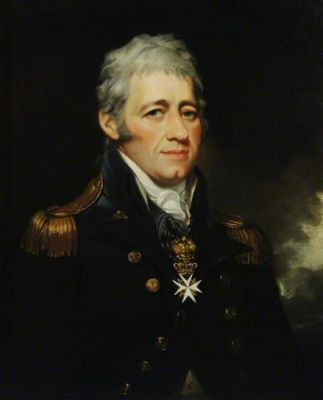
Rear Admiral Sir Home Riggs Popham, KCB, KCH,
There was a District Captain who had overall responsibility for a stretch of coast and, for north-west Wales, this was Captain R. Byron. Each sub-district was under the control of a Lieutenant and for Anglesey this was Lt. Owen Williams. He was responsible for recruiting and for establishing new Fencibles groups. There was a group in Beaumaris (made up of 17 men), a group in Rhoscolyn (made up of 11 men) and a group in Holyhead (which had 15 members in 1804 but this rose to 35 members by the end of 1805). Records of efforts to establish similar groups in Amlwch and Cemais have, unfortunately, not survived to the present day although a note from January 1806 does state that “Amlwch men’ had been employed to search for the anchor and chain of HMS Brisk.
With particular thanks to Paul Evans for permission to use this original artwork
The Holyhead contingent chose William Williams as their Petty Officer and he was paid two shillings and sixpence for every day when on parade or on exercise. Each of the ratings was paid one shilling for being present plus a guarantee that they could not be taken by the press gangs. The Sea Fencibles met once a week and the shilling was useful additional income. Interestingly, Lt. Owen Williams was paid £12.5.0d per month whilst Captain Byron was on a salary of £49 per month.
The original Holyhead crew were: William Williams (Petty Officer); Hugh Davies; Owen Williams; William Michael; John Rowland; George Martin; William Owens; John Ellis; Owen Hughes; William Rowland; John Watkins; Richard Hughes; Morris Jones; James Redfearn; Robert Lewis. Other names which appeared in later years were Robert Lloyd; Robert Jones; William Thompson and Francis Simpson. Except for William Williams, none could write their own names. Both John Macgregor Skinner and Sir John Thomas Stanley were involved in establishing the Holyhead unit and it is possible that the boathouse on the Penrhos estate was used as a base for storing equipment when the group were training.
It is also possible that the Holyhead Sea Fencibles played their part in the rescue efforts made when the ship ‘Andromeda’ went into difficulties off Holyhead in 1810. If so, this would be the first example of a lifeboat being used to try to save lives from vessels in distress. Except for this incident, there’s no record of the gallant Holyhead Sea Fencibles being involved in any action but it’s pleasant to imagine them sitting in one of the many taverns in Waterside with their clay pipes, their pewter tankards of Holyhead ale and their serge jackets, putting the world to rights and planning how brave they would be if a fleet of 50 French ‘men-of-war’ were to come around ‘the Head’ with all guns blazing.
By 1810, the threat of invasion had receded and so the Sea Fencibles were stood down and 35 Holyhead mariners were one shilling a week worse off. The story demonstrates, yet again, how the lives of the people of Holyhead have always been affected by the sea and how they’ve used their traditional nautical skills. And who can blame them for ‘taking the king’s shilling’ if it made life a little bit easier?
Contributed by Peter Scott Roberts and Dr Gareth Huws
References
Nicholas Rogers, ‘The Sea Fencibles, Loyalism and the Reach of the State’, in Mark Philip (ed.), Resisting Napoleon: The British Response to the threat of invasion, 1797-1815 (Ashgate, 2006). National Archives Records of the Admiralty, Naval Forces, Royal Marines, Coastguards and related bodies, ‘Sea Fencibles Pay List, Holyhead and Anglesey, 1804-1810. ADM 28/100 Peter Scott Roberts, The Ancestry, Life and Times of Commander John Macregor Skinner R.N.” (Holyhead, 2006).







![clip_image004[2]](https://holyheadstoriesofaport.com/wp-content/uploads/2020/04/clip_image0042.jpg?w=636)

 Holyhead: Stories of a Port