Protecting Anglesey’s Shores from Napoleon – the Sea Fencibles of Holyhead

During the Napoleonic Wars (1790s to 1815), there was a real fear of a French invasion. The Admiralty adopted an idea put forward by one of their captains, Sir Home Popham, that a defence force be formed by recruiting local seamen and fishermen. These people would be familiar with the coastline of their locality and would have access to small vessels which could be used to stand firm against a naval attack, patrol the beaches and protect any Martello Towers that had been built. This force was to be called ‘The Corps of Sea Fencibles’. Some areas established Sea Fencible companies in 1798 but the Holyhead company wasn’t set up until 1804 (although the company Lieutenant was in post from October 1803 onwards).
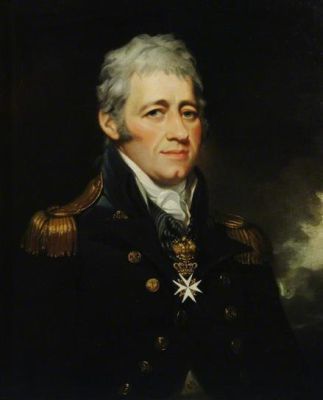
popham
Rear Admiral Sir Home Riggs Popham, KCB, KCH,

There was a District Captain who had overall responsibility for a stretch of coast and, for north-west Wales, this was Captain R. Byron. Each sub-district was under the control of a Lieutenant and for Anglesey this was Lt. Owen Williams. He was responsible for recruiting and for establishing new Fencibles groups. There was a group in Beaumaris (made up of 17 men), a group in Rhoscolyn (made up of 11 men) and a group in Holyhead (which had 15 members in 1804 but this rose to 35 members by the end of 1805). Records of efforts to establish similar groups in Amlwch and Cemais have, unfortunately, not survived to the present day although a note from January 1806 does state that “Amlwch men’ had been employed to search for the anchor and chain of HMS Brisk.

Screenshot 2019-09-01 18.57.47
With particular thanks to Paul Evans for permission to use this original artwork

The Holyhead contingent chose William Williams as their Petty Officer and he was paid two shillings and sixpence for every day when on parade or on exercise. Each of the ratings was paid one shilling for being present plus a guarantee that they could not be taken by the press gangs. The Sea Fencibles met once a week and the shilling was useful additional income. Interestingly, Lt. Owen Williams was paid £12.5.0d per month whilst Captain Byron was on a salary of £49 per month.

The original Holyhead crew were: William Williams (Petty Officer); Hugh Davies; Owen Williams; William Michael; John Rowland; George Martin; William Owens; John Ellis; Owen Hughes; William Rowland; John Watkins; Richard Hughes; Morris Jones; James Redfearn; Robert Lewis. Other names which appeared in later years were Robert Lloyd; Robert Jones; William Thompson and Francis Simpson. Except for William Williams, none could write their own names. Both John Macgregor Skinner and Sir John Thomas Stanley were involved in establishing the Holyhead unit and it is possible that the boathouse on the Penrhos estate was used as a base for storing equipment when the group were training.

It is also possible that the Holyhead Sea Fencibles played their part in the rescue efforts made when the ship ‘Andromeda’ went into difficulties off Holyhead in 1810. If so, this would be the first example of a lifeboat being used to try to save lives from vessels in distress. Except for this incident, there’s no record of the gallant Holyhead Sea Fencibles being involved in any action but it’s pleasant to imagine them sitting in one of the many taverns in Waterside with their clay pipes, their pewter tankards of Holyhead ale and their serge jackets, putting the world to rights and planning how brave they would be if a fleet of 50 French ‘men-of-war’ were to come around ‘the Head’ with all guns blazing.

By 1810, the threat of invasion had receded and so the Sea Fencibles were stood down and 35 Holyhead mariners were one shilling a week worse off. The story demonstrates, yet again, how the lives of the people of Holyhead have always been affected by the sea and how they’ve used their traditional nautical skills. And who can blame them for ‘taking the king’s shilling’ if it made life a little bit easier?

Contributed by Peter Scott Roberts and Dr Gareth Huws

References

Nicholas Rogers, ‘The Sea Fencibles, Loyalism and the Reach of the State’, in Mark Philip (ed.), Resisting Napoleon: The British Response to the threat of invasion, 1797-1815 (Ashgate, 2006).
National Archives Records of the Admiralty, Naval Forces, Royal Marines, Coastguards and related bodies, ‘Sea Fencibles Pay List, Holyhead and Anglesey, 1804-1810. ADM 28/100
Peter Scott Roberts, The Ancestry, Life and Times of Commander John Macregor Skinner R.N.” (Holyhead, 2006).

© Holyhead Maritime Museum

PSS Hibernia – one of the first ‘Railway Ships’

PSS Cambria 1848
PSS Cambria, sister ship to PSS Hibernia

During the eighteenth century and on into the mid-nineteenth century, the port of registration for Anglesey was not, as you’d expect Holyhead, but Beaumaris. The owners of ships were obliged to report to the port authority in Beaumaris every six months an ‘Account of Voyages and Crew of Home Trade Ships’. The two documents relating to the ‘Hibernia’ for January 1st 1862 to June 30th 1862, and July 1st 1862 to December 31st 1862 are still in existence and are to be found at the National Archives in Kew, London (RAIL 113/53). They make for interesting reading.

Built in 1848, the ‘Hibernia’ (official number 27003) appears to have been unexpectedly re-registered at the Port of Chester on October 31st 1854. She had a registered tonnage of 573 tons and her managing owner in 1862 was Charles F. Steward of Euston Station, London. She was a Paddle Steamer and registered to carry “Passengers, Goods and Cattle between the Ports of Dublin and Holyhead”. She was one of four vessels (Hibernia, Cambria, Scotia and Anglia) built for the Chester and Holyhead Railway Company in 1847/8 when it was decided that the mail could be conveyed at a cheaper cost by privately owned ships than on naval vessels. It is believed that she was transferred from the C & H R Co. to the London and North Western Railway Company in 1859 and that she was sold to the Waterford and Limerick Railway Company in 1877.

In 1862, the ‘Hibernia’s captain was Captain George Taylor, who lived at Benburb Lodge, Dublin. The full complement in January 1862 consisted of the following:

Name Age in 1862 Where born Post on Hibernia Other Details
George Taylor 33 Edinburgh Master To stay with ship
John Roberts 43 Holyhead Chief Mate “
Michael Archbold 45 Dalkey 2nd Mate “
William Morris 38 Holyhead Carpenter “
John Cox 40 Hastings Quarter Master “
William Beatty 49 Dublin Quarter Master “
Owen Pritchard 31 Anglesey Seaman Discharged
William Rowlands 36 Anglesey Seaman To stay with ship
Ishmael Jones 22 Holyhead Seaman “
William Rowlands 45 Holyhead Seaman “
John Jones 31 Anglesey Seaman “
Robert Williams 16 Conway Boy “
Samuel Green 37 Norwich Cook “
John Paton 38 Clackmannan Chief Engineer “
George Greenough 60 Wigan 2nd Engineer “ –

Previous ship ‘Scotia’

William Holmes 42 Suffolk Leading Stoker “
Richard Williams 47 Anglesey Stoker “
William Owen 58 Holyhead Stoker “
Thomas Owen 26 Holyhead Stoker “
Thomas Jones 40 Anglesey Stoker “
Edward Lewis 43 Holyhead Stoker “
Richard Jones 39 Holyhead Stoker “
John Williams 35 Holyhead Coal Trimmer “
Patrick Hyland 31 Dublin Steward “
Thomas Wiliams 14 Conway Cabin Boy “
John Lill 40 Lincolnshire Seaman “

Previous ship ‘Scotia’

As only one crew member had been discharged by June 30th 1862, it would be expected that the crew list for the second half of the year would be identical but this was not the case because seven of the names listed above had changed, i.e. almost a third of the crew in December 1862 were different to the ones noted six months earlier. Here are the changes:

Name Age in 1862 Where born Post on Hibernia Other Details
George Cook 45 Chatham Chief Mate To stay with ship
William Hodgson 28 Lancaster Seaman “
George William Cook 14 London Boy “
William Jeffreys 38 Glasgow Chief Engineer “
John Hughes 37 Holyhead 2nd Engineer “
William Jones 50 Holyhead Coal Trimmer “
Patrick Neating 13 Dublin Cabin Boy “

In the first six months of 1862 61% of the crew had been born in north Wales but this figure had fallen to 50% by the end of that same year. The others were not, as would be expected perhaps, from Ireland but from places as far afield as Clackmannan in Scotland and Chatham in England. Even at that time, people were aware that Holyhead was a growing port and were willing to travel great distances to take up work.

The other notable fact is the limited number of crew personnel who would have dealt directly with passengers (stewards or catering staff) and this supports the view that the rival City of Dublin Steam Packet Company was far better equipped to deal with people and mail whilst LNWR concentrated on goods and cattle.

This record is just a snapshot but it gives us a flavour of the background of the captain and crew of one of Holyhead’s ‘regular’ ships and one whose name was to continue in use until the mid-twentieth century.


One of the Seamen mentioned above was Ishmael Jones, recorded as aged 22. He was born in Holyhead in 1839 to Robert and Margaret Jones of Mill Street, Holyhead and was baptised in St. Cybi’s Church on 20 June 1839. His father was a Butcher in the town. On 28 October 1862 Ishmael married Catherine Thomas from Pwllheli at St. Cybi’s Church. He could sign his name but his wife could only make a mark. They lived at 12 Thomas Street, Holyhead and went onto have at least 5 Children, including Henry Thomas Jones who became a School Master at the Holyhead Council School. Ishmael Jones died on 28 July 1903 at 12 Thomas Street, Holyhead at the age of 64, still employed as a mariner and leaving £110 to his wife in his will.

Reference: National Archives Records of the Railway Companies, Two half-yearly crew lists for 1862 submitted to Mercantile Marine Office, RAIL 113/53.

Contributed by Dr Gareth Huws with additions by the editor

© Holyhead Maritime Museum

‘This Once Blessed Isle’

In January 1823 an audacious attempt was made on the life of Richard Owen, whilst carrying out his duties as a Messenger between the Custom Houses of Holyhead and Beaumaris.

5-dick-turpin-sm
Highway Robbery!

His experience was reported in a local newspaper and describes how he was twice shot at when journeying on horseback to Beaumaris at a place close to Cleifiog Farm, five miles from Holyhead. The location is further described as being where ’the old road meets the new one’. The report continues to tell how at about 4am a ball suddenly passed through his hat and another grazed his left side. The attack frightened him so much that he drove his horse hard to get away and by the time he reached Llangefni the animal was too tired to continue. He then had to complete the journey on foot. As he was not carrying any money, only the quarterly accounts, his attacker would have not profited from his efforts. Once Richard Owen had spend off his assailant disappeared and was never apprehended.

D88B0F5B-A02C-427C-BD6A-2FCD2C46A7FC
The probable location for the attack on Richard Owen and the onward route he would have taken to cross the island.

The ‘new road’ referred to in the report is now the A5, built in 1822, part of which is the Stanley Embankment linking Holy Island with the Isle of Anglesey. The ‘old road’ is probably Gorad Road, a section of the ‘Old Post Road’ that ran from Holyhead, via the bridge at Four Mile Bridge, through Bodedern and Llangefni and across Anglesey. The junction in the photograph below is just outside the present village of Valley and is the probable location of the attempted murder of the Customs Messenger.

IMG_2219
The junction of the ‘New Road’ (A5) with the ‘Old Road’ (Gorad Road) just outside Valley

The newspaper report finished with the hope that events of this nature would not become more frequent thus threatening the relative peace of Anglesey – referred to in the article as ‘this once blessed Isle’.

Strangely in the next issue of the newspaper (the North Wales Gazette) it was suggested that Richard Owen had made up the story, an accusation he strongly denied.

From research undertaken by Peter Scott Roberts

The map is from Barnes, F. A. ‘Land Tenure and Landscape in Llanynghenedl’, 
Anglesey Antiquarian Society and Field Club. Transaction 1988, p.72.
© Holyhead Maritime Museum


Dueling at Holyhead

Duelling

During the 18th Century dueling was a common method of settling differences between gentlemen in European society. The object being not necessary to kill an opponent but to ‘gain satisfaction’. Fighting duels in Ireland at this time was illegal. However, dueling in Britain was not banned until 1842. This resulted in a number of duels being fought at Holyhead when antagonists would travel over, sometimes in separate vessels, with their supporters, to find a convenient location to settle their differences.

One such notable duel is reputed to have taken place at Holyhead between two Irish politicians, Henry Flood and James Agar. An account suggests that it occurred in the grounds of St. Cybi’s Church, within the walls of the Roman Fort. Dueling with swords had generally ceased by this time and the use of pistols became the norm. As a result of this engagement James Agar ended up being slightly wounded. However, the disagreement between the two Irishmen did not end here. They again met at Dunmore Park, Kilkenny in 1769 resulting in the death of James Agar. Henry Flood was tried at Kilkenny Assizes the following year but was acquitted.

Portrait_of_Henry_Flood
Henry Flood (1732 – 1791). Portrait by Bartholomew Stoker

Buried in the churchyard at St. Cybi’s Church are the last mortal remains of Major William Houghton. The Northampton Mercury newspaper provides an account of a duel between Major Houghton and a Captain Wolsely that occurred in October 1796. Records show that the duel was fought away from the town and on land belonging to Plas Rhyd-Pont near Four Mile Bridge. It is unclear as to why the duel was fought but sadly it resulted in Major Houghton being shot and instantly expiring.

Screenshot 2019-04-06 17.14.24
Entry in the Holyhead Parish Burial Records

The Parish Burial Register records that William Houghton was a Major in the 23rd Regiment of Foot (Royal Welch Fusiliers) and buried on 12th October 1796. His gravestone bears the following inscription.

‘Here lieth the body of William Houghton late
Captain in his Majesty’s 53rd Regiment of Foot
who departed this life on the 8th of October 1796’

Captain Wolseley would appear not to have been brought to justice but was pursued by the Petty Constable of Holyhead, Hugh Williams, as far as Conwy.

From research undertaken by Peter Scott Roberts.

© Holyhead Maritime Museum

Madam Megan Telini

22728839_1613605485372250_4016427807556770215_n
Megan Telini’s distinctive and elegant grave at Maeshyfryd Cemetery, Holyhead.

This distinctive gravestone  marks the last resting place of a famous Welsh Prima Donna, Madame Megan Telini. The inscription reads:-

Megan Telini
1878-1940
Welsh Prima Donna
Beautiful voice great artist
Charming personality
Lifelong worker for charity
Including Penrhyn Quarry strike
1898-1903
Miners relief fund
1926-1934
And with-all a most loving
and devoted wife and mother.

She was born Margaret Jane Parry at Bethesda in 1878 and was an accomplished singer, winning over 350 prizes and accolades at various concerts and eisteddfodau and eventually winning the Open Soprano competition at the National Eisteddfod in 1898. Her father Robert Parry (known as Trebor Llechid) worked at the Penrhyn Slate Quarry and became involved with the strike fund committee during the great quarry strike of 1898-1902.  She helped to raise a significant amount of money with a ladies choir in support of the quarry workers during this very difficult time.

When the strike ended many Bethesda families moved away from the area and the Parry family came to live at 8 Moreton Road, Holyhead. Megan married David Huw Jones in Bethesda in 1902. After marrying she spent eight years in Edinburgh before going to Italy where she had further training and took up the name of Madam Telini.

On returning to London she was kept busy on the ‘Concert Scene’ for several years, singing on many world stages such as La Scala in Milan.  She released over sixteen records (a great accomplishment for the time). During the great depression of the 1920/30’s she performed numerous concerts to raise money for the miner’s families of South Wales. She also supported many good causes at her adopted town of Holyhead, particularly for Capel Tabernacl, Thomas Street, where the Parry family worshiped. Madam Telini eventually retired in 1934 to keep a small hotel in London. When WW2 broke out Megan and David moved to Pembrey, Carmarthenshire, where she died in 1940.

Returned by her family to Holyhead to be buried, her grave at Maeshyfryd is close to that of her parents and two of her siblings.

From research undertaken by Peter Scott Roberts.

Peter Scott Roberts is keen to continue his research into Madam Megan Telini and would be pleased to hear from anyone with information to offer – scotty1944@talktalk.net or 01407 740246.

© Holyhead Maritime Museum