by David Puleston Williams
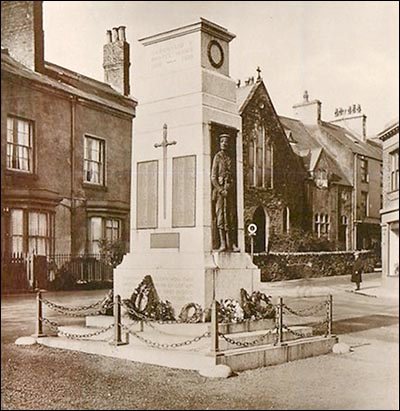
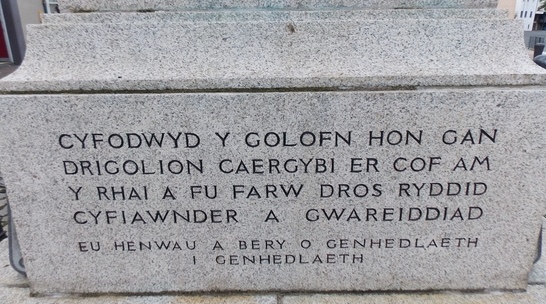
This year, 2023, marks 100 years since the Holyhead Cenotaph was publicly unveiled as a memorial to those lost during the Great War of 1914-1918. In 1953 two granite scrolls were added bearing the names of those from the town lost during the Second World War of 1939-1945. A small memorial plaque was added later to remember a loss resulting from the Falklands’s War of 1982.
The following is an account of the effort made by the town of Holyhead to provide a suitable memorial to those lost during the Great War of 1914-1918. It was prepared by Mr. David Puleston Williams following his extensive research of the records held at Anglesey Archives and elsewhere. We are grateful to Mr. Williams for allowing his account to be published.
On Tuesday the 5th October 1920 a public meeting was held in the town hall at Holyhead, to consider the most appropriate way of commemorating the town’s war dead. A considerable number spoke during the meeting. A motion was put forward:
‘That this meeting of Holyhead townspeople decide to proceed with a War Memorial’.
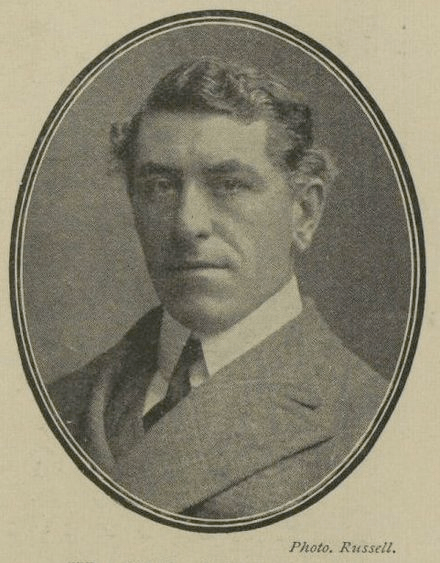
The motion was moved by Sir Ellis Jones-Griffiths K.C., a well-known public figure, as he had been the member of parliament for Anglesey from 1895 until 1918. The Holyhead Mail reported that he said:
‘They knew what they owed to the gallant men. All the liberties they enjoyed were the result of their sacrifice. He was quite sure that they would be lacking in their gratitude if they did not do something to commemorate those who fell. Holyhead’s record during the war was a great one and their memorial should be a fitting one. They should remember the lesson of the Great War, namely, ‘Brotherhood’. A memorial to the fallen heroes should be a visible one; it should be as beautiful as the lives of those who fell’.
By the conclusion of the meeting, unanimous agreement was reached that a War Memorial should be erected and that a War Memorial Committee with 15 members should be formed. The committee, which would consider the form of the memorial, was to consist of a representative of each ward from the Urban District Council, together with eight other representative ladies and gentlemen.
The First Commemorations
In the years immediately after the war’s end Armistice Day would be commemorated by all the members of the various departments of the railway and port gathering around the clock in the harbour. The Holyhead Town Band would also be present. All flags would be lowered on the ships nearby, together with the Union Jack above the Railway Hotel. When the fingers of the clock reached 11.00am, a maroon would be fired – then the sound of the explosion slowly died away, leaving only a profound silence, which allowed the crowd to remember those who had fought in the war, but had not returned.
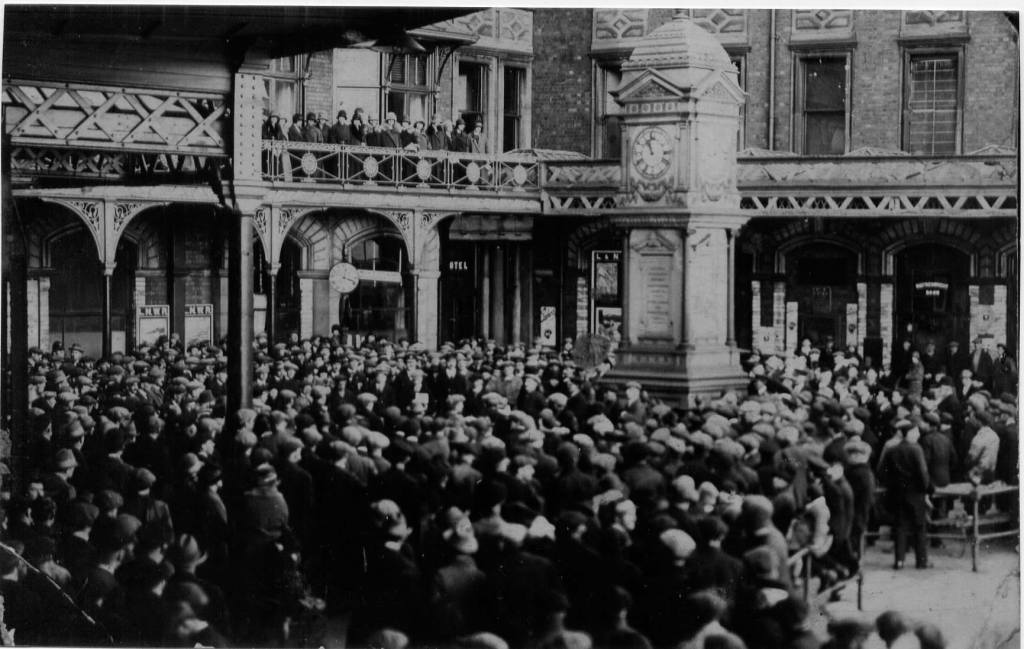
Some kind of temporary structure was erected in the town centre, before the 11th of November, as the Holyhead Mail reported in 1921, ‘on Armistice Day a number of relatives of fallen ex-servicemen placed wreaths on the shrine in Victoria Square in memory of their loved ones’.
Memorials in Chapels and Churches
At this time a considerable number of the Holyhead’s population attended the various chapels and churches located throughout the town. The war dead of these churches were commemorated in almost each of these churches in different ways.
The following are but a few examples. On the 13th August 1920 a plaque was unveiled in the English Methodist Church, Longford Road, to remember the eight members who died in the war. Mount Pleasant Congregational Church lost one member in the trenches of France, another member died when the Tara was sunk off the coast of north Africa, and a third died fighting in Palestine. The three were commemorated by a plaque unveiled on the 9th April 1920. Hyfrydle Methodist Church, in Thomas Street, lost 14 members in the war and these were commemorated by a fine stain glass window, plaque, and communion cups at a total cost of £368.00. The memorial window was unveiled in June 1920 by the Rev John Williams, a former minister of the church, who had lost a son in the war.
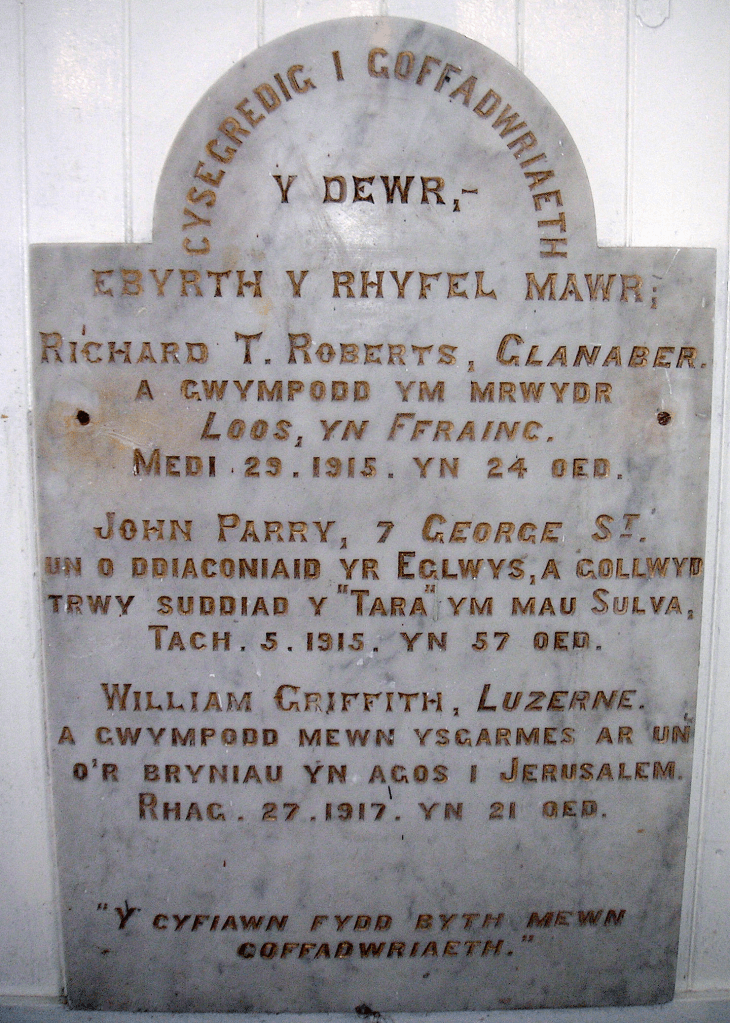

A few months later in September, a memorial plaque to the parish dead was unveiled in St Seiriol’s church. The members of Disgwylfa Methodist Church, London Road, raised the sum of £1,350 towards the purchase and installing of a pipe organ in memory of both the fallen and those that had survived. On the Sunday following Armistice Day 1921, it was arranged that one collection from all the town’s chapels and churches, would go towards the costs of erecting the town’s war memorial. In February, 1921 the Holyhead Mail noted that:
‘The churches and chapels of the town nearly all had tablets unveiled in remembrance of those who fell and were connected with the several places of worship. This may militate against the subscriptions [for the town’s monument] but we think that everyone should do his best to commemorate the sacrifice and heroism of our brave men’.
The Committee Starts its Work
The first meeting of the committee was held on the 25th October 1920. Frank Bodvan Griffith was elected as chairman, he was the chairman of the Urban District Council and an assistant superintendent at the Marine Department of the London & North Western Railway, George Shaw, the chief clerk of the Marine Department, was elected secretary, and Dr Fox Russell was elected vice-chairman. When formed the committee had 28 members, with eight councillors, three members representing different religious denominations and the remaining members representing the Trades and Labour Council, Discharged Soldiers and Sailors Federation, the three local bank managers, and a retired monumental mason.
The chairman explained that their first task was to consider the form the memorial was to take. A number of suggestions had already been made. At the public meeting Sir R. J. Thomas expressed the view that an excellent memorial to those who had died would be a hospital. Another idea was a footbridge from Victoria Square to the railway station. However, the committee resolved unanimously in favour of a monument.

The suitable location for this was considered, and four potential sites were identified, being Victoria Square, Old Market Place, Beach and the new Park. A building sub-committee was formed, with the members being Dr Fox Russell, Arthur Asquith the town surveyor, and T. E. Thomas a local architect, together with the chairman and secretary. A names sub-committee looked at the names to be placed on the cenotaph. Another sub-committee was formed to consider the suitable inscription to be placed on the cenotaph in Welsh and English.
Delay
In the years immediately after the war a number of bodies represented the interest of ex-servicemen, but in 1921 they came together and formed the British Legion. John Clay was elected chairman of the branch formed in Holyhead, and in a meeting of the new branch held on the 5th August 1921, there was criticism that no war memorial had been built in the town.
The chairman referred to the fact that a good number of villages on the island had already seen their memorials unveiled. It was a fair comment. For example, the village of Llanfechell had been busy collecting money for the building of a memorial, which had been unveiled by Margaret Lloyd George, the Prime Minister’s wife, in December 1920. In the parish of Llanfaelog (Rhosneigr), the war memorial was unveiled in September 1921, the honours being done yet again by Mrs Lloyd George.
One factor particular to Holyhead, and which affected the arrangement regarding the war memorial, was the Irish war of independence and then the Irish civil war. This resulted in a marked decline in the mercantile trade between Ireland and Britain. The number of passengers passing through Holyhead declined considerably, being in a one-way direction as thousands of Protestants fled Ireland, with none travelling in the other direction. All this had a marked effect on the town’s economy.
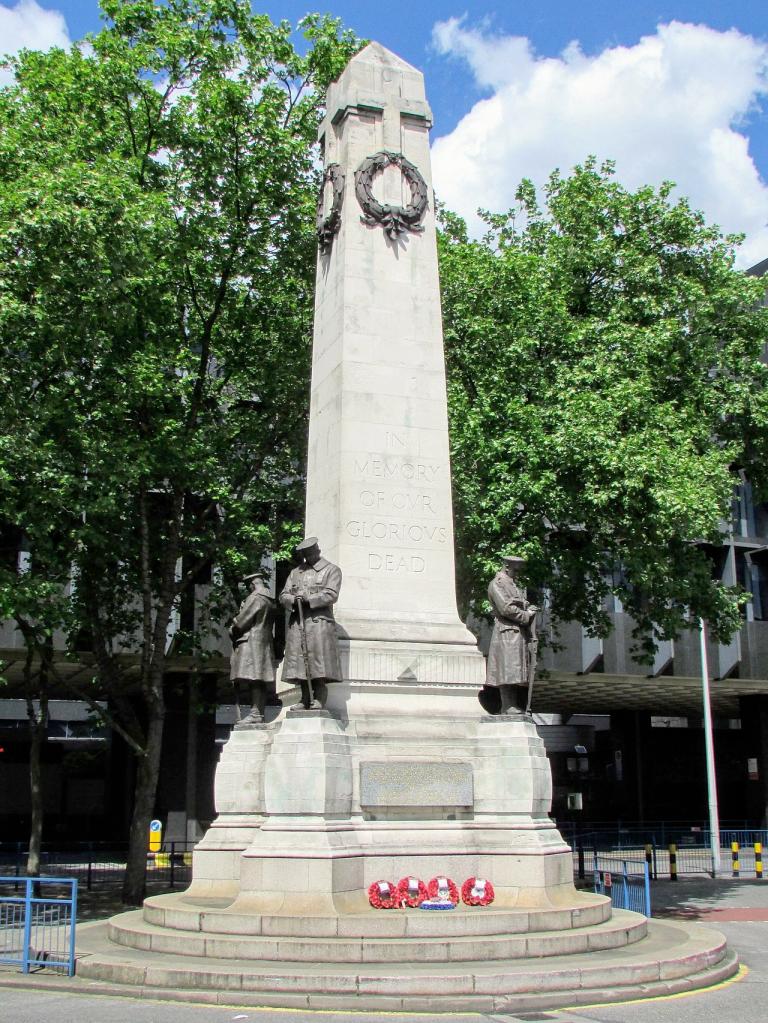
Letters began appearing in the local press complaining about the delay in building the war memorial. At the other end of the railway a striking and imposing war memorial had been erected outside Euston Station, in memory of all those former employees of the London & North Western Railway who had died in the war, and which had been unveiled in September 1921. The designer was Reginald Wynn Owen, who was a native of Beaumaris. Naturally, many from Holyhead would have seen it. This, and the other memorials which had appeared over the island, added to the concern that Holyhead was slow in erecting a suitable memorial.
As there had been criticisms’ concerning the delay with regard to the memorial George Shaw wrote to T.R. Evans, the clerk to the Holyhead Town Council on the 22nd August 1921, and explained:
‘Last September all arrangements had been made to commence the collection, but due to Irish railway trouble most of the men employed at Holyhead were placed on short time, others discharged and others removed from the town. Under these circumstances the committee deemed it advisable not to proceed with the collection.’
Door to door collection were organised and by November 1921, the War Memorial Committee had raised by this method £450.00 – a sum less than had been expected. Sir R. J. Thomas promised a donation of £100 if another four persons offered the same – no one took up the suggestion. Appeals were also made to expatriate members of the town, in other parts of the country and those living overseas. A prolonged industrial dispute in Dublin also had a profound effect on Holyhead, and George Shaw stated in June 1922:
‘Unfortunately, all our cargo boats and Dublin passenger vessels have been laid up since January 29th owing to the strike in Ireland and hundreds of men are out of work or on short time here. Many are so badly hit as to have spent all savings and the town is very gloomy.
The Form of the Monument
A number of options were considered such as a figure, or a clock, but by February 1921 George Shaw could state that:
‘The committee incline towards a simple monument, almost like a Cenotaph. . .’.
The committee advertised for plans for a memorial, and almost 30 were received from sculptors, architects, firms, individuals in the trade, and companies from all over the country. These were considered carefully, and two designs were agreed to be the best, namely one by L. F. Roslyn, a sculptor based in South Kensington, London and the other by Messrs H.H. Martyn & Co. of Cheltenham.
The secretary was instructed to obtain models, samples, nett prices and further details. After some deliberation the committee decided on 21st February 1922, to accept one of the two designs submitted by L. F. Roslyn, which was of an oblong cenotaph. A rough preliminary model of the proposed cenotaph was placed in the window of Cavendish House , in the centre of town, for all to see, together with a sample of the silver-grey Cornish granite which was to be used.
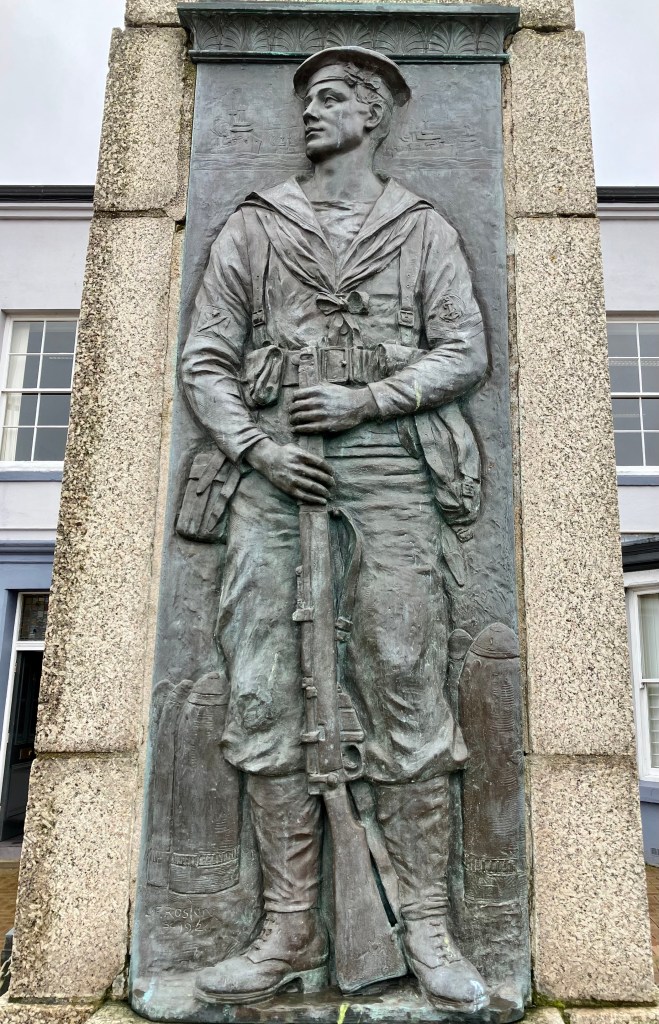
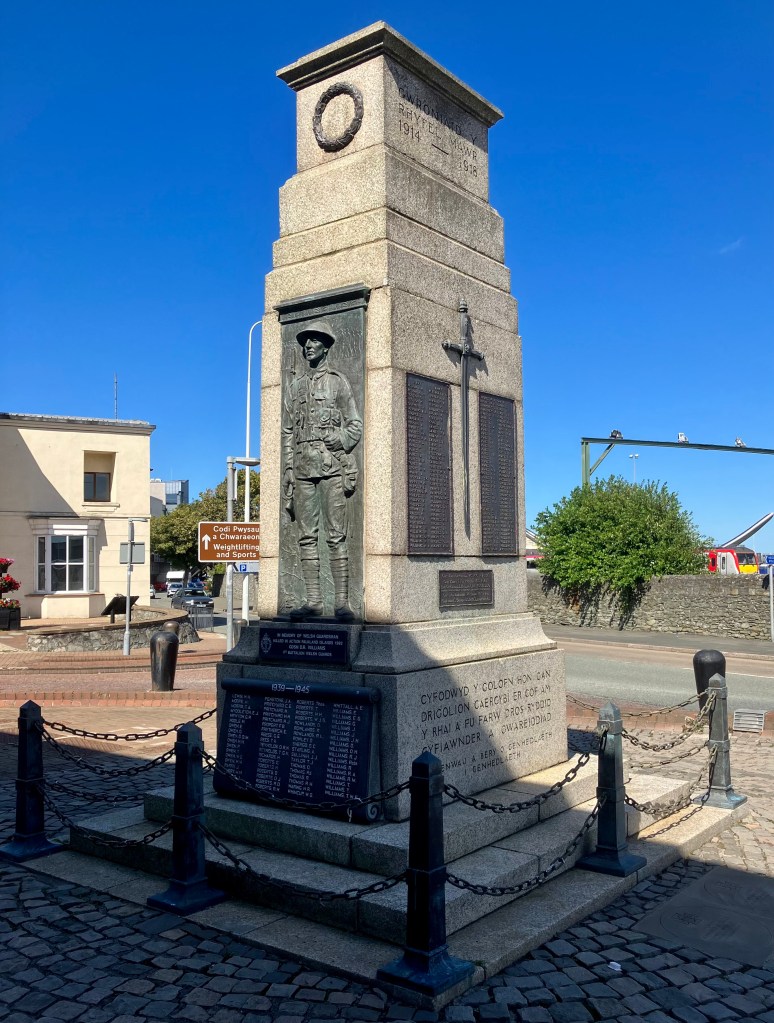
L.F. Roslyn indicated that the memorial would be ready in from four to six months after the date the order was placed with him. His estimate was that the cenotaph would cost between £1,000 and £1,100. The cenotaph would be 16 feet in height, with the lowest steps on the base measuring 10ft 8in x 12ft 3in. On both sides magnificent bronze panels would be fixed, six feet in height, depicting a vigorous soldier and sailor. The names of the fallen were to be carried on two columns.

In a meeting of the committee on the 3rd November 1922 the members inspected the final model of the Cenotaph received from L. F. Roslyn. At that meeting it was resolved to authorize the chairman and secretary to sign the contract, and this was done on the 8th November when the sculptor agreed:
‘To execute in grey granite and fix complete upon foundations to be provided by the Committee with bronze panels of Soldier and Sailor, to scale as shown in model with swords, name tablet, wreaths in bronze and inscriptions cut as shewn all to be executed in best manner for the sum of £1,100.00.‘
The War Dead
The population of Holy Island in 1911 was 12,087. During the war years 2,200 of these served in the armed services engaged in the war effort, with many hundreds more serving with the Mercantile Marine. The total to die during the war from Holy Island came to 288 – with 123 soldiers dead, 47 of these whilst fighting with the Royal Welsh Fusiliers. At sea 36 died while serving with the Royal Navy, and 103 died serving aboard merchant ships.
The Names
The sub-committee formed to deal solely with the gathering and collation of the names of those who had died, had to carry out their work with great care, as the names would be on the bronze plaques which were to be placed on the cenotaph, and thus, they had to ensure that the list of names was comprehensive and correct. It was intended to commemorate all those coming from Holy Island – the parishes of Holyhead and Rhoscolyn – who had died in the war.
To commence the process, a form which required to be completed with the names of the dead and other information, were distributed around the town in April 1922 , together with a request that they be returned by the end of May. By September the information was almost complete, save for 16 names, where confirmation was still needed from relatives.
A number of notices appeared in the Holyhead Advertiser and Weekly News, and on the 20th October 1922 a full-page notice appeared setting out in four columns the names that were proposed to be placed on the panels of the memorial. This was divided into the following classes Navy/Army /Royal Air Force/WRAF/HMS Tara, Scotia, and Cambria/HMHS Anglia /RMS Leinster/ Mercantile Marine, and under the heading INFORMATION WANTED the names of nine men were listed. The notice informed the readers that:
‘The list is now being closed and that it will be understood that once the bronze panels are cast no additions can be made’.
Three cases were omitted in November 1922 as it was understood that the men concerned were already commemorated on memorials in other towns. Over the winter of 1922/23 efforts were made with regard to tracing the relatives of a small number of names:
‘who were believed to be Holyheadians who had lost their lives in the Great War. It would be a pity to omit even one man, but verification is absolutely essential in view of the permanence of the memorial’.
By November all cases had been traced except for four men. It took some time, but by the 23rd January 1923, it was noted that:
‘the list of names is now being definitely closed’.
One town councillor could state:
‘The committee has done its utmost to obtain the names of all those who had made the great sacrifice, and time after time notices have been published in the press.’
The committee initially decided that those who had died in November 1916 when the Connemara, a ship serving the Holyhead to Greenore route, sank following a collision, should not be included. However, in October 1922, George Shaw received a letter from the National Sailors’ and Firemen’s Union informing him that a meeting of the union – representing 400 seamen of Holyhead – had been held and that it had been unanimously passed that the names of those lost on the Connemara be included on the memorial as,
‘. . . they were doing work of national importance, such as carrying food stuffs to this country. . .’.
In January 1923 it was decided to include the names of the 26 crew members who had perished.

Progress
By the beginning of 1923 the sum of £1,080 had been collected toward the cost of the cenotaph and the sculptor L. F. Roslyn had already started work. The chairman and secretary went on a number of occasions to L. F. Roslyn’s studio in London to review the panels as the work progressed.
By early April 1923 L. F. Roslyn had completed setting out the name tablets – they then needed to be checked before putting into bronze. The final visit was in June 1923, when the secretary of the committee, George Shaw, visited L. F. Roslyn in his London studio to make a final check as to the accuracy of the bronze plaques.

By the end of June 1923 the town council had prepared the foundation for the cenotaph, which weighed between 25 to 30 tons, in Victoria Square. By July 1923 the committee could report that £1.109.00 had been collected to date, with a further £100.00 required.
By the middle of July, the monument was completed. George Shaw wrote to all the town’s school headmasters, expressing the desire of the committee that all pupils be informed on the Friday afternoon before the unveiling on the meaning of the War Memorial, how it symbolized the sacrifice of the townsmen, and also of the terrible consequences of war.
The Unveiling
The Cenotaph was unveiled on Saturday the 15th September 1923, at 2.00 o’clock in the afternoon. All the town’s shops, public houses, cafes and businesses were closed. Tickets were issued for a reserved enclosure for widows and parents of the fallen, together for a seating area for about 300 aged or infirm people. Children of the fallen were admitted to a children’s enclosure.
A huge crowd assembled in Victoria Square and along Land’s End. All the ships in the harbour lowered their flags to half-mast. Flanking the four sides of the cenotaph stood ranks of soldiers, sailors from the Royal Navy, men from the Merchant navy, and members of the British Legion.

A religious service was held with ministers from various denominations taking part. The Chairmen of the War Memorial Committee, F. Bodvan Griffith spoke and said he was glad to express thanks for the support which had been received to erect the cenotaph.

The unveiling was performed by the Lord Lieutenant Sir Richard Williams Bulkeley. A minute silence was observed following the sounding of the Last Post and Reveille. The crowd was then addressed by the local M.P., Sir R. J. Thomas, who referred to the fact that Holyhead had sacrificed a great deal, perhaps more than any other town throughout the country.
A programme was produced to mark the unveiling, with 1,500 being printed and sold at 6d each. This included the order of service and a Book of Remembrance, being a list of those who had died. The programme contains the following description of the cenotaph:

The monument is built of imperishable materials. Cornish granite and Bronze being used. The general scheme has been to produce a Memorial which is simple yet dignified. It is well proportioned, with sufficient contrast between the bronze and granite to take away any appearance of bareness. The panels on either side are a tribute to the Navy and the Army, representing also Freedom and Honour. The bronze wreaths represent Victory and the swords symbolise Sacrifice.
1924 -1925
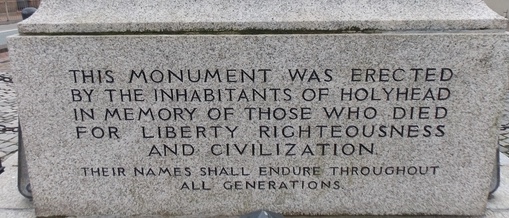
Originally the cenotaph was surrounded by three rows of steps alone, but over the months following the unveiling, it was noted that some persons would sit with their backs resting on the cenotaph, while others laid their bicycles against it. This caused distress to many, including members of the British Legion, and in 1924 the War Memorial Committee decided to add pillars, together with chains, to protect the cenotaph. This resulted in the expenditure of a further £108.
By 1925 the condition of the cenotaph was causing some concern, as verdigris had appeared on the bronze panels, which had run down from the bronze figures on to the granite below. L. F. Roslyn advised the use of bleaching powder , which was tried, but proved unsuccessful, so he provided suitable acid to clean the plaques.
By 1925 L. F. Roslyn was a busy man, as he had by that time designed a number of war memorials in various parts of Britain, and was one of seven shortlisted (out of some 200 proposals received), for the design of Canada’s National War Memorial.
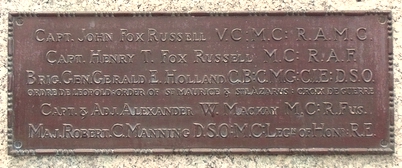
The pillars and chains were added during the summer of 1925. Also added that year, on the Kingsland side of the cenotaph, was the Honours Tablet, which commemorates those awarded the Victoria Cross, Distinguished Service Order and Military Cross. In February the committee also decided that it was necessary to add heel stones on the four corners, as it was noted that there was already chipping to some of the stone steps caused by being clipped by carts etc.
In 1925 there was great activity in raising funds for the building of a gymnasium at the Grammar School, in memory of the former pupils who had died during the war. The sum of £1,050.00 was raised when a grand three-day Bazaar was held in July. Thus, in the years following the war, the residents of Holyhead and Holy Island raised a substantial amount of money towards the various memorials in the numerous chapels and churches, the cenotaph in the middle of the town and the memorial gym at the school.
By February 1925 the committee had raised the sum of £1,210.00 and had expended £1,176.00. The pillars and railings cost a further £120.00 The balance outstanding was borne by the town council. During the 1920’s the question arose as to who would be responsible for the maintenance of the thousands of war memorials which had been erected in almost every town and village throughout the country. The War Memorials Act 1923 provided that a local authority could incur reasonable expenditure in the maintenance, repair and protection of the memorials located within their district. Thus, on the 20th October 1926, the War Memorial Committee held its final meeting and by that time the cenotaph had been handed over to the care of the Holyhead Urban District Council. It is now in the care of the Holyhead Town Council.
© David Puleston Williams and Holyhead Maritime Museum
July 2023.
Further information on those listed on the Memorial.
There are 288 names from the Great War (1914-1918) – https://sites.google.com/site/holyheadwarmemorial19141918/
There are 140 names from the Second World War (1939-1945) and one from the Falklands War of 1982 – https://sites.google.com/site/holyheadsfallenofworldwartwo/
References and Sources
All images are from the editor’s personal collection or from the archive of Holyhead Maritime Museum with the exception of the following:
- Image of Sir Ellis Jones-Grifith is from Wikipedia, original source unknown.
- Photo of gathering at the Station Clock is from a ‘Old Holyhead’ FaceBook post of 22 September 2013, original source unknown.
- Image of Sir Richard Williams Bulkeley is from https://www.maritimeviews.co.uk/byy-biographies/bulkeley-sir-richard-henry-williams-bt/
B R Hillier – Editor
December 2023
 Holyhead: Stories of a Port