Recently a very ordinary exercise book (6) containing numerous handwritten history related articles and jottings, mostly copied from other sources, was donated to the museum. Among the articles was one which described the establishment and activities of the Anglesey Druidical Society, in being on Ynys Môn from 1772-1844.
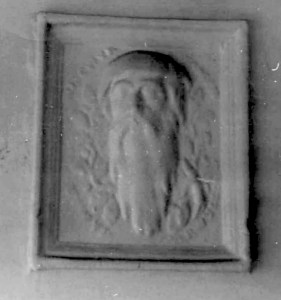
The society was formed at Beaumaris in 1772. Members included clergymen, sea captains, prosperous farmers, persons of title and a number of the minor gentry of the island. Numbering over 100, they would meet monthly, mostly at Beaumaris inns to dine. They were expected to make regular donations and were fined if they failed to wear the adopted uniform of the society, also for non attendance at meetings and for other minor transgressions. Silverware was purchased – four ceremonial goblets. A seal was designed and medals issued. (5) (6)
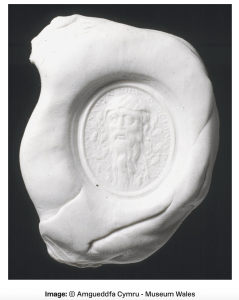
The aims of the society were charitable and benevolent with funds made available to reward bravery in saving life at sea, supporting local hospitals and for arranging apprenticeships for poor children. They later took an interest in rewarding good practice and skills in agriculture. The society eventually became less active and closed in 1844.

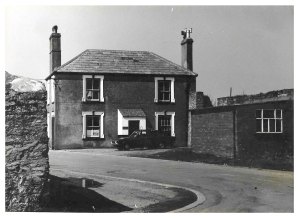
In 1976 work was in progress to expand the Holyhead port facilities at Salt Island and a number of buildings were being demolished, including one previously occupied by the Waterguard Section of HM Customs and Excise. This building at one time had been the offices of the ‘City of Dublin Steam Packet Company’ that operated the Royal Mail service to Ireland from 1860-1921. It stood at the entrance to their ship repair yard. Alongside the main building was a boathouse, that in 1825 is believed to have housed a lifeboat together with a rocket firing apparatus for the rescue of those in difficulties at sea.
Attached to the inner walls of the customs offices were three plaster plaques depicting the images of druids (see above). Their connection to the Anglesey Druidical Society is clear as other known artefacts also depict the same imagery. Their location at the offices can only be guessed at but may be connected to the society’s possible provision of a lifeboat and life saving equipment at Salt Island.
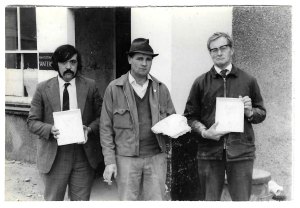
Before the building was demolished Captain Geoffrey Butterworth, John Cave, Roy Jones (Maintenance Supervisor at the Civil’s Section of Anglesey Aluminium), together with Ken Evans of Holyhead Library managed to extract the plaques which were then cleaned and eventually taken to the old Holyhead Library at Queen’s Park. They were displayed on the stairs to the first floor for many years.
In 2019 the town library was relocated to the newly refurbished Market Hall with the plaques no longer on display. The article in the exercise book prompted the museum to try and track down the plaques to ensure that they were being taken care of. With the assistance of council officers and library staff they were eventually located in storage at Llangefni Library but with little known provenance.

The plaques are now to be relocated to the care of Oriel Môn, Llangefni. References to the society have been identfied in the transactions of ‘The Anglesey Antiquarians’ and ‘The Honourable Society of Cymmrodorion’, which provide a valuable provenance for the items and the society they represented, which in their day did much good for the people of Ynys Môn.
References and Acknowledgements
1. The image of the Seal Impression – Credit Amgueddfa Cymru – Museum of Wales
2. The image of the society guilded medal – Ebay (listed at £1,200 and sold)
3. Photos relating to the removal of the plaques – John Hodgkinson posted on Facebook (Holyhead Past and Present, 16/10/2024). Believed to have originated from John Cave MBE.
4. The image of the silver snuff box – listed online for auction with a society medal at Mellors and Kirk in 2017. (Estimated at £3000-£4,000).
5. Geoffrey Butterworth – The Anglesey Druidical Society, 1772-1844. The Anglesey Antiquarian Society and Field Club, 1980
6. The donated exercise book – author unknown
Contributed by the Editor.
© Holyhead Maritime Museum.
 Holyhead: Stories of a Port