The following article (and two others that will follow) are by Mr. David Puleston Williams, an eminent local historian who has spent considerable time and effort researching aspects of the Parish Church of St. Cybi that are not readily known.
This article describes the history of burials at the Church Graveyard over a number of centuries. Two other articles on the church by Mr. Williams will follow this. One will look at features of the South Porch and the other will concern the Sundial on the south wall.
St. Cybi’s Church at Holyhead/Caergybi
EARLY REFERENCES The parish of Holyhead covered the whole of the northern and middle part of Holy Island and measured some 6,988 acres. The graveyard surrounding St Cybi’s church, bounded on three sides by the walls of the Roman fort, and on the fourth by a low cliff overlooking the sea at high tide, was the only space for burying the dead. Thousands must have been buried here over the centuries. For instance, from 1780 to 1789 some 543 burials took place in the churchyard, and a further 393 were buried between 1790 and 1791.
St. Cybi’s Church in 1742
Thus, in a twenty-year period 936 burials took place. It must have been the case therefore that bodies were being buried where many burials had taken place before. The church accounts, starting in the 18th century, refer from time to time to matters concerned with burials. A bier was used for carrying coffins and in 1772 the church account records the payment of £1-1s for a new bier. Interestingly, an item associated with the bier were more expensive, as the account for 1791 records a payment of £3-13s-6d for a ‘new Bier cloth’, with a further payment of 1s-6d for a linen cloth bag to keep the cloth in. Payments are recorded for winding sheets to wrap around the bodies of the dead, as in 1742 when the sum of 10½d was spent ‘towards a winding sheet for an Irishman’, and in 1751 when ‘a sheet to bury a sailor’s corpse in’ cost 1s-9d. A number of those persons buried at St Cybi’s churchyard were travelling to or from Ireland
In 1746 the following burials are recorded: 14 September – two Popish vagrant Irishmen, names unknown. 3 October – a vagrant Irishman, name unknown. 4 October – a vagrant Irishwoman, name unknown. 17 November – James Taylor, an Irish vagrant.
Names of the more affluent also appear, as in 1778 when the following burials are recorded: 15 August – William Sterne Esq., from Ireland. 18 September – William Sutclif, Merchant from Dublin. 24 October – Samuel Tyndall of Dublin.
Payments for coffins appear occasionally in the church accounts, as in December 1785 when the sum of 9s was recorded as the cost ‘[for] a coffin for a vagrant drowned here’. The church accounts show that the paths in the churchyard, or ‘walks’ as they are described, were maintained by the regular spreading of gravel. In 1828 a payment of £1-13s was paid to the Sexton for spreading 22 loads of gravel in the church yard.
The church and the extensive walls of the old fort surrounding the churchyard required regular maintenance as the following examples show:
1772 – 6d was paid for ‘cutting ye ivy boughs on ye church walls’. 1821 – ‘It was ordered that Capt Colin Jones be paid ten pounds . . . for making and putting up gates in the churchyard.’ 1828 – the sum of £2 was paid to John Jones ‘for repairing church yard wall’. 1830 – the sum of £2-14s-½d was paid ‘for arches above the Church gate’. In 1831 – Edward Williams was paid the sum of £2-12s for 26 days work ‘pointing the church walls’.
THE LOWER GRAVEYARD With the building of the new harbour in the early part of the 19th century the population of the town grew rapidly. In 1801 the population was 2,132, but it had reached 4,071 by 1831. More space was desperately required for the burial of the dead, and the churchwardens consulted Richard Griffith and Edward B. Parry, who were both surgeons (doctors) in the town, and they received the following letter, dated 12 February 1818, from them:
‘Having been requested by you to give an opinion respecting the propriety of enlarging the Church yard of this town we beg leave to observe that owing to the great increase of population in this town within the last few years for so extensive a parish we are decidedly of opinion that it is necessary to have some additional ground for a burial ground. The graves are now so much crowded and the generality of earth over some of the coffins so very light, that in the summer time after a hot day with very light airs, we have frequently noticed in passing that direction a most unpleasant affluvia, arising no doubt from too many bodies being crowded together and without sufficient quantity of earth to cover them, we are therefore of opinion that unless some additional ground is added it will lead to very unpleasant consequences’.
It was clear that a new burial ground was required. One place considered by the churchwardens in 1820 was a piece of waste ground close to the National School – but this was not proceeded with. However, with the building of the new road along the western foreshore to Salt Island an alternative and new piece of land became available. The Church wardens applied to the Commissioners of the Harbour for the purchase of the land between the new road and the low cliff beneath the existing church yard. Before the new road was built this land was formerly part of the foreshore, and at high tide would be covered by the sea. The sum of £5 was paid for the land. The Commissioners required the church wardens to erect walls surrounding the new church yard and to undertake to keep them in repair for seven years. The church wardens were obliged to enter into a legal bond to that effect.
At a Vestry held on 26 February 1824 it was resolved that a plan and estimate be obtained for the building of these walls together with steps from the old churchyard. As this land had been formally part of the foreshore some work was required to be carried out on it, so at a meeting of the Vestry held on the 13 May 1825 the churchwardens were directed, ‘to level the new church yard and to cover the surface with earth and to sow it with hay seed.’ A considerable amount of earth was required and this was dug from land owned by the church at Rhos y Gaer. Over £8 was paid for the work. A payment was made to John Thomas for sowing hay seed and harrowing. The walls surrounding the new graveyard was the biggest expenditure, with two men, Hugh Owen and Owen Williams, being paid the sum of £55 for the work. The second largest item of expenditure were the various fees due to the Bishop, the Chancellor and Registrar (both diocesan officials) – they were paid the total sum of £22-15s-8d. The gate for the new church yard weighed 875½ lbs and cost £16-8s-3d. This gate was kept locked as the padlock for it cost 1s-6d. The lower grave yard started being used for burials towards the end of 1826.
INFANT MORTALITY During the 18th and 19th centuries infant mortality, was by modern standards, exceptionally high, and this can be seen from the information recorded in the parish registers. The early registers do not state the age of the children buried, but only refer to infant or child. In 1743 the number of children baptised came to 53, but the same year saw 38 children being buried. Contagious disease must have been the cause of many of these deaths, as in some years many deaths occur close together, as in 1753/54, when during the two months of December and January 25 infants died. During the other ten months only five died.
The Table below gives the numbers buried in the church yard at St Cybi’s from 1813 to 1832. This shows a large number of children aged two years and younger being buried each year. Edward B. Parry (the doctor mentioned above) and his wife Phoebe Parry, lost two baby children. A son Edward Young Parry died at the age of eight months and was buried in the upper graveyard on the 5 April 1822. His brother Henry Parry died at the age of nine months and was buried in the same grave in 24 January 1831.
BURIALS IN THE PARISH OF HOLYHEAD – from the Register of Burials 1813-38
1813 – 1822
1823 – 1832
Year
Aged 2 years or under
Total burials
Year
Aged 2 years or under
Total burials
1813
11
44
1823
26
101
1814
3
39
1824
7
72
1815
19
75
1825
29
99
1816
28
84
1826
21
96
1817
11
46
1827
11
55
1818
19
46
1828
12
59
1819
18
60
1829
6
50
1820
13
51
1830
14
68
1821
8
33
1831
28
84
1822
18
53
1832
10
46
Totals
148
531
Totals
164
730
SHIPWRECKS AND THOSE FOUND DROWNED A number of the burials that took place in St Cybi’s churchyard during the 19th century were of those who had drowned at sea, either from shipwrecks, or those who had been washed overboard. Generally speaking, the practice throughout the country, with respect to dead bodies washed ashore, whose identities were unknown, was that they were frequently buried on land close to where they had been found. However, this changed with the passing of the ‘Burial of Drowned Persons Act in 1808’.
The gravestone of William Holmes lost on the Charlemount Packet in 1790. (There were over 100 people lost but their burial location is not known)
This act required that in the event of a dead body, or bodies being discovered cast on the shore by the sea, that the Churchwardens and Overseers of the parish in which the discovery took place, were to be responsible for the arrangements concerned in ensuring a decent burial of the deceased in the church-yard or burial ground of the parish. One of the provisions of the act was that a reward of five-shillings was to be given to those who found and gave notice of the finding of a body. The paying of the reward due, pursuant to the provisions of the Burial of Drowned Persons Act, continued throughout the century – the 1884 church account show two payments for ‘finding unclaimed body’ in January and February. Owen Ellis was paid 10s for the removal of these bodies and William Williams, Tan yr Efail provided a coffin for the sum of 17s-6d. Thus, the total costs incurred by the church wardens in respect of these two bodies came to £1-17s-6d – this sum was then reimbursed by the County of Anglesey at the following Quarter Sessions.
Two reward payments of 5s were made by the church wardens as late as 1891, in July and December. One payment of 5s was made for ‘picking up a body found drowned’ and the second for ‘taking the body from beach to dead house.’ Further payments of £1-4s-6d were paid with regard the costs of burial. The work and costs involved with the burial of those bodies washed ashore can be seen from a letter sent by Hugh Hughes – who was one of the churchwardens – to the treasurer for the County of Anglesey in 1873 concerning a burial of a body found drowned in the old harbour. Five shillings (the statutory reward) had been paid to a person ‘for finding a dead human body cast ashore’. Four shillings had been paid for canvas to cover the body, and another 4s paid for cartage of the body. The four men who assisted were paid the total of 8s-4d. A fee of 4s went to the Sexton, and the coffin cost 18s. The sum of £1-12s-7d was found on the deceased, so the balance remaining came to £2-3s-6d. In his letter Hugh Hughes explained that the canvas was necessary as this was ‘[an] exceptional case of decomposition’ and referred to ‘the difficulty of having men to help in the removal of dead bodies except they are well paid’.
The following are the details of some of those who had been drowned and then buried at St Cybi’s graveyard between 1815 and 1829:
12 November 1815: two female passengers on board the ‘Swan’, a ship wrecked off the coast, names unknown, one aged 20, and the other aged 22. 22 February 1819: William Baker a ‘stranger who was drowned’, aged 22. 29 September 1821: A stranger, name unknown, drowned with the sinking of the ‘Duke of Leinster’. Age about 40.
1823: On the 28th March the bodies of 28 adults and children were laid out in St Cybi’s church, where they were viewed by the Coroner for Anglesey and his jury. These were some of the passengers who had drowned following the loss of the ‘Alert’ and had been brought into Holyhead harbour. Many of them were women and eight were infants. The findings of the jury at the inquest were the same in respect of all those who had died and was as follows:
On the view of the body of a person unknown then and there lying dead, who was a passenger on board a ship or vessel called the ‘Alert’, packet bound from Dublin to Liverpool that the wind slackened and it becoming a perfect calm, that the said ship or packet, accidentally, casually and by misfortune inconsequence of the strong current then running was thrown against a rock called the West Mouse Rock was wrecked and foundered in Holyhead Bay, and then and there the said person unknown was drowned.
Only one passenger, Mary Flanagan was identified, and she had died together with her unnamed infant. All 28 were buried in the church yard at St Cybi’s.
February 1824: Twelve bodies washed on the shore from the wreck of the ‘John’. Four separate inquests were held in the church – as and when the bodies were discovered and then recovered from the shore and placed in the church – over the following days, with the last being held on the 13 February. Among the dead were a number whose names were unknown and the bodies of three infant children. The finding of the court was the same for all the dead, namely:
‘The [deceased] was a passenger/mariner onboard a certain ship or vessel called the ‘John’, bound from Cork to Liverpool laden with sundries which ship or vessel was on the sixth day of February in a violent Hurricane was wrecked and totally lost on the Rocks near Penrhos in the Parish of Holyhead and then and there the said [deceased] with many of the seamen and passengers onboard were drowned.
20 November & 4/15 December 1826: A total of 12 bodies washed ashore from the wreck of the ‘Marquis of Wellington’. Names unknown.
April/May 1829: A Dutch galliot – a type of small sailing vessel – was on a voyage from Rotterdam to Liverpool with a cargo of bark. On the 28 April, during a severe gale, she sought shelter in Holyhead harbour. A rope from the vessel was attached to the capstan on the pierhead but the rope broke, the vessel then drifted and was wrecked on the rocks known as Cerrig yr Adar, near Penrhos. All persons aboard survived save for the captain’s wife, Pieterke Jans Smid who drowned. Her body was brought to St Cybi’s Church, where the coroner held an inquest and she was buried in the churchyard on the 1 May. The burial register gives her age as 25.
VANDALISM AND APPOINTMENT OF A SEXTANT Throughout the 19th century there were reports of persons vandalising parts of the church building, graves and of general misbehaviour around St Cybi’s church. In 1816 the churchwardens agreed to appoint a Sexton ‘to prevent nuisances’. The first Sexton appointed was ‘found to be totally inadequate’ due to his age and Lewis Roberts was appointed in his place in November 1817 at a salary of £5.00 p.a. and he was provided with a staff and gown. Lewis Roberts would on occasions drink to excess, and in November 1824 he promised that he ‘will never more be guilty of any misdemeanour that will cause offence.’ Lewis Roberts also worked as the town crier, and in 1831 the church account show that he was paid the sum of 2s ‘for proclaiming against nuisance in the Church yard.’
By around 1828 William Hughes had been appointed as the new Sexton. An engraving of c.1830, shows in the distance the new harbour, with, in the foreground, part of the graveyard. On the left side a man stands before a chest tomb, with the handle of a pickaxe or mattock in his right hand, this could well be William Hughes the Sexton. References to the purchase of tools for the sexton appear in the church accounts, for instance in 1822 when 3s-6d was paid for a ‘mattock for sexton’, and in 1826 Hugh Owen was paid 1s ‘for sharpening the picks for new church yard.’ The sum of 1s-6d was spent on three pickaxe handles in 1825. Following the restoration of the church in 1878-79 the Sexton was paid an additional sum of £1-10s for ‘looking after old churchyard’. His work in this respect was made easier than before as £9-2s was spent in March and April 1879 for levelling the church yard. The Vestry meetings during much of the 19th century were held in the Old School room/yr Hen Ysgol (today called Eglwys y Bedd) and in December 1833 the Sexton was instructed ‘to make fire there 11 o’clock each vestry day – on account of this room being so cold and damp and the chimney does not draw the smoke.’
St. Cybi’s Graveyard overlooking the Harbour C.1830
Breaking the windows of St Cybi’s church appears to have been a major pastime of the local youths, as payments for repairs to the windows, or to a glazier, appear regularly in the church accounts during the 1860 and 70’s. The sum of 4s was spent in 1862 on the printing of 50 posters offering a ‘reward for informing on any boys that broke the church windows.’ In 1872 the sum of 1s-9d was paid to Enoch Hughes for printing posters giving a ‘warning to window breaker’s’. The posters did little good as in 1873 the sum of £2-13s-1½d was paid to Robert Hughes, Glazier, followed by a further payment to another glazier, Owen Davies for 11s 1d the following year. Whether a further set of posters (the printer on this occasion was Robert Roberts) printed in November 1877, ‘warning re breaking windows at St Cybi’s Church’ did any good appears doubtful.
To deal with the problem of persons misbehaving around the church in 1869 it was decided that the path running through the church yard, which was a public right of way, be railed in on all sides. Three estimates were obtained, with one from John Jones, Black Bridge Foundry in the sum of £90, the others quoted £89 and £107. But the erecting of railings was put on hold until 1878/79, when the church itself was restored. The railings were erected and the church accounts show that a little over £102 was paid to John Jones, Black Bridge foundry by way of six interim instalments from October 1879 to April 1883. John Jones was a noted iron-founder – for example he did all the work for the City of Dublin Steam Packet Co. He was a prominent Calvinistic Methodist, being an elder at Hyfrydle Church, Thomas Street for over 40 years. The railings in front of the chapel are a fine example of his foundry’s work.
The upper graveyard showing the railings either side of the path.
CLOSURE OF THE GRAVEYARD Considerable additional burial space became available when the graveyard, of over one acre, came available with the opening of St Seiriol’s church in October 1854. By an Order in Council dated 13 August 1855 it was ordered that burials in the churchyard at St Cybi’s be discontinued, save in the case of existing brick graves where space was remaining.
A further Order in Council dated 23 September 1859 ordered that burials be wholly discontinued in the graveyard except ‘in walled graves now completed to the surface, in which each coffin shall be embedded in charcoal and separately entombed in an air tight manner.’
Soil had accumulated against the outer walls of the church and this was causing dampness to the interior – this soil was removed in 1862.
MORE RECENT TIMES The entrance from the lower graveyard to Land’s End was closed in 1919, when the iron gates were removed and the gap filled by a wall. It appears this was done as the gates needed replacing – no funds being available for the £60 cost of new gates – so the cheaper option was taken. However, a new gateway and gate was built in 1926/27 and paid for by Jane Henrietta Adeane (who had died in November 1926) and a niece to W. O. Stanley. The gateway was dedicated by the bishop of Bangor on Sunday 17 April 1927.
Gateway to the Lower Graveyard
The Gateway inscription facing the road – ‘St. Cybi pray for us’.
During the Second World War many iron railings and gates throughout the country were removed to be turned into scrap metal to aid the war effort. It appears that representations on the grounds of special circumstances were made by the church wardens to the Ministry of Works which enabled the railings to be spared. However in the years following the war the dilapidated state of the churchyard became a cause of concern. A grant of approximately £300 was applied for from the Welsh Church Act Fund in 1952 to renovate the churchyard and the adjacent walls dividing the upper from the lower churchyard, levelling the tombs/memorials and re-cutting the inscriptions on the worst worn stones. Unfortunately, the application was refused.
The upper graveyard with the gravestones laid flat – the Roman Wall beyond
A letter dated 4 May 1956 was sent from the Parochial Church Council (P.C.C.) to the Holyhead Urban District Council (H.U.D.C.) asking the Council to receive a deputation from the P.C.C. to consider the condition of the St Cybi’s churchyard. A sub-committee was formed comprising representatives of the H.U.D.C. and the P.C.C. By virtue of a Deed, signed in December 1957, the H.U.D.C. became responsible for improving and maintaining the graveyards at St Cybi’s Church. Work did not begin immediately but among the councils first tasks in 1963 was to repair one of the entrance arch quoins. The proposed improvements included new walling, removal of railings, removal/levelling of tombstones, clearing and levelling of the lower portion and provision of new steps down to the lower level. The total costs of the work were estimated at £454.00. A dwarf wall was built adjoining one side of the footpath through the churchyard. During 1964-65 the lower churchyard was cleared of bushes and undergrowth. In 1965 a section of the top masonry wall collapsed into the lower churchyard and had to be rebuilt.
We are grateful to Mr. David Puleston Williams for his research and permission to publish this article. He wishes to express his thanks to the staff at Archifau Ynys Mon/Anglesey Archives, Llangefni for the considerable assistance provided when researching this article.
This year, 2023, marks 100 years since the Holyhead Cenotaph was publicly unveiled as a memorial to those lost during the Great War of 1914-1918. In 1953 two granite scrolls were added bearing the names of those from the town lost during the Second World War of 1939-1945. A small memorial plaque was added later to remember a loss resulting from the Falklands’s War of 1982.
The following is an account of the effort made by the town of Holyhead to provide a suitable memorial to those lost during the Great War of 1914-1918. It was prepared by Mr. David Puleston Williams following his extensive research of the records held at Anglesey Archives and elsewhere. We are grateful to Mr. Williams for allowing his account to be published.
On Tuesday the 5th October 1920 a public meeting was held in the town hall at Holyhead, to consider the most appropriate way of commemorating the town’s war dead. A considerable number spoke during the meeting. A motion was put forward:
‘That this meeting of Holyhead townspeople decide to proceed with a War Memorial’.
The motion was moved by Sir Ellis Jones-Griffiths K.C., a well-known public figure, as he had been the member of parliament for Anglesey from 1895 until 1918. The Holyhead Mail reported that he said:
‘They knew what they owed to the gallant men. All the liberties they enjoyed were the result of their sacrifice. He was quite sure that they would be lacking in their gratitude if they did not do something to commemorate those who fell. Holyhead’s record during the war was a great one and their memorial should be a fitting one. They should remember the lesson of the Great War, namely, ‘Brotherhood’. A memorial to the fallen heroes should be a visible one; it should be as beautiful as the lives of those who fell’.
Sir Ellis Jones-Griffith KC
By the conclusion of the meeting, unanimous agreement was reached that a War Memorial should be erected and that a War Memorial Committee with 15 members should be formed. The committee, which would consider the form of the memorial, was to consist of a representative of each ward from the Urban District Council, together with eight other representative ladies and gentlemen.
The First Commemorations
In the years immediately after the war’s end Armistice Day would be commemorated by all the members of the various departments of the railway and port gathering around the clock in the harbour. The Holyhead Town Band would also be present. All flags would be lowered on the ships nearby, together with the Union Jack above the Railway Hotel. When the fingers of the clock reached 11.00am, a maroon would be fired – then the sound of the explosion slowly died away, leaving only a profound silence, which allowed the crowd to remember those who had fought in the war, but had not returned.
A gathering at the Station Clock possibly on Armistice Day/Remembrance Sunday prior to completion of the Cenotaph (The time displayed on the clock is 11am).
Some kind of temporary structure was erected in the town centre, before the 11th of November, as the Holyhead Mail reported in 1921, ‘on Armistice Day a number of relatives of fallen ex-servicemen placed wreaths on the shrine in Victoria Square in memory of their loved ones’.
Memorials in Chapels and Churches
At this time a considerable number of the Holyhead’s population attended the various chapels and churches located throughout the town. The war dead of these churches were commemorated in almost each of these churches in different ways.
The following are but a few examples. On the 13th August 1920 a plaque was unveiled in the English Methodist Church, Longford Road, to remember the eight members who died in the war. Mount Pleasant Congregational Church lost one member in the trenches of France, another member died when the Tara was sunk off the coast of north Africa, and a third died fighting in Palestine. The three were commemorated by a plaque unveiled on the 9th April 1920. Hyfrydle Methodist Church, in Thomas Street, lost 14 members in the war and these were commemorated by a fine stain glass window, plaque, and communion cups at a total cost of £368.00. The memorial window was unveiled in June 1920 by the Rev John Williams, a former minister of the church, who had lost a son in the war.
A few months later in September, a memorial plaque to the parish dead was unveiled in St Seiriol’s church. The members of Disgwylfa Methodist Church, London Road, raised the sum of £1,350 towards the purchase and installing of a pipe organ in memory of both the fallen and those that had survived. On the Sunday following Armistice Day 1921, it was arranged that one collection from all the town’s chapels and churches, would go towards the costs of erecting the town’s war memorial. In February, 1921 the Holyhead Mail noted that:
‘The churches and chapels of the town nearly all had tablets unveiled in remembrance of those who fell and were connected with the several places of worship. This may militate against the subscriptions [for the town’s monument] but we think that everyone should do his best to commemorate the sacrifice and heroism of our brave men’.
The Committee Starts its Work
The first meeting of the committee was held on the 25th October 1920. Frank Bodvan Griffith was elected as chairman, he was the chairman of the Urban District Council and an assistant superintendent at the Marine Department of the London & North Western Railway, George Shaw, the chief clerk of the Marine Department, was elected secretary, and Dr Fox Russell was elected vice-chairman. When formed the committee had 28 members, with eight councillors, three members representing different religious denominations and the remaining members representing the Trades and Labour Council, Discharged Soldiers and Sailors Federation, the three local bank managers, and a retired monumental mason.
The chairman explained that their first task was to consider the form the memorial was to take. A number of suggestions had already been made. At the public meeting Sir R. J. Thomas expressed the view that an excellent memorial to those who had died would be a hospital. Another idea was a footbridge from Victoria Square to the railway station. However, the committee resolved unanimously in favour of a monument.
Sir Robert John Thomas – MP for Anglesey
The suitable location for this was considered, and four potential sites were identified, being Victoria Square, Old Market Place, Beach and the new Park. A building sub-committee was formed, with the members being Dr Fox Russell, Arthur Asquith the town surveyor, and T. E. Thomas a local architect, together with the chairman and secretary. A names sub-committee looked at the names to be placed on the cenotaph. Another sub-committee was formed to consider the suitable inscription to be placed on the cenotaph in Welsh and English.
Delay
In the years immediately after the war a number of bodies represented the interest of ex-servicemen, but in 1921 they came together and formed the British Legion. John Clay was elected chairman of the branch formed in Holyhead, and in a meeting of the new branch held on the 5th August 1921, there was criticism that no war memorial had been built in the town.
The chairman referred to the fact that a good number of villages on the island had already seen their memorials unveiled. It was a fair comment. For example, the village of Llanfechell had been busy collecting money for the building of a memorial, which had been unveiled by Margaret Lloyd George, the Prime Minister’s wife, in December 1920. In the parish of Llanfaelog (Rhosneigr), the war memorial was unveiled in September 1921, the honours being done yet again by Mrs Lloyd George.
One factor particular to Holyhead, and which affected the arrangement regarding the war memorial, was the Irish war of independence and then the Irish civil war. This resulted in a marked decline in the mercantile trade between Ireland and Britain. The number of passengers passing through Holyhead declined considerably, being in a one-way direction as thousands of Protestants fled Ireland, with none travelling in the other direction. All this had a marked effect on the town’s economy.
LNWR War Memorial at Euston Station
Letters began appearing in the local press complaining about the delay in building the war memorial. At the other end of the railway a striking and imposing war memorial had been erected outside Euston Station, in memory of all those former employees of the London & North Western Railway who had died in the war, and which had been unveiled in September 1921. The designer was Reginald Wynn Owen, who was a native of Beaumaris. Naturally, many from Holyhead would have seen it. This, and the other memorials which had appeared over the island, added to the concern that Holyhead was slow in erecting a suitable memorial.
As there had been criticisms’ concerning the delay with regard to the memorial George Shaw wrote to T.R. Evans, the clerk to the Holyhead Town Council on the 22nd August 1921, and explained:
‘Last September all arrangements had been made to commence the collection, but due to Irish railway trouble most of the men employed at Holyhead were placed on short time, others discharged and others removed from the town. Under these circumstances the committee deemed it advisable not to proceed with the collection.’
Door to door collection were organised and by November 1921, the War Memorial Committee had raised by this method £450.00 – a sum less than had been expected. Sir R. J. Thomas promised a donation of £100 if another four persons offered the same – no one took up the suggestion. Appeals were also made to expatriate members of the town, in other parts of the country and those living overseas. A prolonged industrial dispute in Dublin also had a profound effect on Holyhead, and George Shaw stated in June 1922:
‘Unfortunately, all our cargo boats and Dublin passenger vessels have been laid up since January 29th owing to the strike in Ireland and hundreds of men are out of work or on short time here. Many are so badly hit as to have spent all savings and the town is very gloomy.
The Form of the Monument
A number of options were considered such as a figure, or a clock, but by February 1921 George Shaw could state that:
‘The committee incline towards a simple monument, almost like a Cenotaph. . .’.
The committee advertised for plans for a memorial, and almost 30 were received from sculptors, architects, firms, individuals in the trade, and companies from all over the country. These were considered carefully, and two designs were agreed to be the best, namely one by L. F. Roslyn, a sculptor based in South Kensington, London and the other by Messrs H.H. Martyn & Co. of Cheltenham.
The secretary was instructed to obtain models, samples, nett prices and further details. After some deliberation the committee decided on 21st February 1922, to accept one of the two designs submitted by L. F. Roslyn, which was of an oblong cenotaph. A rough preliminary model of the proposed cenotaph was placed in the window of Cavendish House , in the centre of town, for all to see, together with a sample of the silver-grey Cornish granite which was to be used.
L.F. Roslyn indicated that the memorial would be ready in from four to six months after the date the order was placed with him. His estimate was that the cenotaph would cost between £1,000 and £1,100. The cenotaph would be 16 feet in height, with the lowest steps on the base measuring 10ft 8in x 12ft 3in. On both sides magnificent bronze panels would be fixed, six feet in height, depicting a vigorous soldier and sailor. The names of the fallen were to be carried on two columns.
In a meeting of the committee on the 3rd November 1922 the members inspected the final model of the Cenotaph received from L. F. Roslyn. At that meeting it was resolved to authorize the chairman and secretary to sign the contract, and this was done on the 8th November when the sculptor agreed:
‘To execute in grey granite and fix complete upon foundations to be provided by the Committee with bronze panels of Soldier and Sailor, to scale as shown in model with swords, name tablet, wreaths in bronze and inscriptions cut as shewn all to be executed in best manner for the sum of £1,100.00.‘
The War Dead
The population of Holy Island in 1911 was 12,087. During the war years 2,200 of these served in the armed services engaged in the war effort, with many hundreds more serving with the Mercantile Marine. The total to die during the war from Holy Island came to 288 – with 123 soldiers dead, 47 of these whilst fighting with the Royal Welsh Fusiliers. At sea 36 died while serving with the Royal Navy, and 103 died serving aboard merchant ships.
The Names
The sub-committee formed to deal solely with the gathering and collation of the names of those who had died, had to carry out their work with great care, as the names would be on the bronze plaques which were to be placed on the cenotaph, and thus, they had to ensure that the list of names was comprehensive and correct. It was intended to commemorate all those coming from Holy Island – the parishes of Holyhead and Rhoscolyn – who had died in the war.
To commence the process, a form which required to be completed with the names of the dead and other information, were distributed around the town in April 1922 , together with a request that they be returned by the end of May. By September the information was almost complete, save for 16 names, where confirmation was still needed from relatives.
A number of notices appeared in the Holyhead Advertiser and Weekly News, and on the 20th October 1922 a full-page notice appeared setting out in four columns the names that were proposed to be placed on the panels of the memorial. This was divided into the following classes Navy/Army /Royal Air Force/WRAF/HMS Tara, Scotia, and Cambria/HMHS Anglia /RMS Leinster/ Mercantile Marine, and under the heading INFORMATION WANTED the names of nine men were listed. The notice informed the readers that:
‘The list is now being closed and that it will be understood that once the bronze panels are cast no additions can be made’.
Three cases were omitted in November 1922 as it was understood that the men concerned were already commemorated on memorials in other towns. Over the winter of 1922/23 efforts were made with regard to tracing the relatives of a small number of names:
‘who were believed to be Holyheadians who had lost their lives in the Great War. It would be a pity to omit even one man, but verification is absolutely essential in view of the permanence of the memorial’.
By November all cases had been traced except for four men. It took some time, but by the 23rd January 1923, it was noted that:
‘the list of names is now being definitely closed’.
One town councillor could state:
‘The committee has done its utmost to obtain the names of all those who had made the great sacrifice, and time after time notices have been published in the press.’
The committee initially decided that those who had died in November 1916 when the Connemara, a ship serving the Holyhead to Greenore route, sank following a collision, should not be included. However, in October 1922, George Shaw received a letter from the National Sailors’ and Firemen’s Union informing him that a meeting of the union – representing 400 seamen of Holyhead – had been held and that it had been unanimously passed that the names of those lost on the Connemara be included on the memorial as,
‘. . . they were doing work of national importance, such as carrying food stuffs to this country. . .’.
In January 1923 it was decided to include the names of the 26 crew members who had perished.
SS Connemara lost in November 1916
Progress
By the beginning of 1923 the sum of £1,080 had been collected toward the cost of the cenotaph and the sculptor L. F. Roslyn had already started work. The chairman and secretary went on a number of occasions to L. F. Roslyn’s studio in London to review the panels as the work progressed.
By early April 1923 L. F. Roslyn had completed setting out the name tablets – they then needed to be checked before putting into bronze. The final visit was in June 1923, when the secretary of the committee, George Shaw, visited L. F. Roslyn in his London studio to make a final check as to the accuracy of the bronze plaques.
By the end of June 1923 the town council had prepared the foundation for the cenotaph, which weighed between 25 to 30 tons, in Victoria Square. By July 1923 the committee could report that £1.109.00 had been collected to date, with a further £100.00 required.
By the middle of July, the monument was completed. George Shaw wrote to all the town’s school headmasters, expressing the desire of the committee that all pupils be informed on the Friday afternoon before the unveiling on the meaning of the War Memorial, how it symbolized the sacrifice of the townsmen, and also of the terrible consequences of war.
The Unveiling
The Cenotaph was unveiled on Saturday the 15th September 1923, at 2.00 o’clock in the afternoon. All the town’s shops, public houses, cafes and businesses were closed. Tickets were issued for a reserved enclosure for widows and parents of the fallen, together for a seating area for about 300 aged or infirm people. Children of the fallen were admitted to a children’s enclosure.
A huge crowd assembled in Victoria Square and along Land’s End. All the ships in the harbour lowered their flags to half-mast. Flanking the four sides of the cenotaph stood ranks of soldiers, sailors from the Royal Navy, men from the Merchant navy, and members of the British Legion.
A religious service was held with ministers from various denominations taking part. The Chairmen of the War Memorial Committee, F. Bodvan Griffith spoke and said he was glad to express thanks for the support which had been received to erect the cenotaph.
The unveiling was performed by the Lord Lieutenant Sir Richard Williams Bulkeley. A minute silence was observed following the sounding of the Last Post and Reveille. The crowd was then addressed by the local M.P., Sir R. J. Thomas, who referred to the fact that Holyhead had sacrificed a great deal, perhaps more than any other town throughout the country.
Lord Lieutenant Sir Richard Williams Bulkeley
A programme was produced to mark the unveiling, with 1,500 being printed and sold at 6d each. This included the order of service and a Book of Remembrance, being a list of those who had died. The programme contains the following description of the cenotaph:
The monument is built of imperishable materials. Cornish granite and Bronze being used. The general scheme has been to produce a Memorial which is simple yet dignified. It is well proportioned, with sufficient contrast between the bronze and granite to take away any appearance of bareness. The panels on either side are a tribute to the Navy and the Army, representing also Freedom and Honour. The bronze wreaths represent Victory and the swords symbolise Sacrifice.
1924 -1925
Originally the cenotaph was surrounded by three rows of steps alone, but over the months following the unveiling, it was noted that some persons would sit with their backs resting on the cenotaph, while others laid their bicycles against it. This caused distress to many, including members of the British Legion, and in 1924 the War Memorial Committee decided to add pillars, together with chains, to protect the cenotaph. This resulted in the expenditure of a further £108.
By 1925 the condition of the cenotaph was causing some concern, as verdigris had appeared on the bronze panels, which had run down from the bronze figures on to the granite below. L. F. Roslyn advised the use of bleaching powder , which was tried, but proved unsuccessful, so he provided suitable acid to clean the plaques.
By 1925 L. F. Roslyn was a busy man, as he had by that time designed a number of war memorials in various parts of Britain, and was one of seven shortlisted (out of some 200 proposals received), for the design of Canada’s National War Memorial.
The pillars and chains were added during the summer of 1925. Also added that year, on the Kingsland side of the cenotaph, was the Honours Tablet, which commemorates those awarded the Victoria Cross, Distinguished Service Order and Military Cross. In February the committee also decided that it was necessary to add heel stones on the four corners, as it was noted that there was already chipping to some of the stone steps caused by being clipped by carts etc.
In 1925 there was great activity in raising funds for the building of a gymnasium at the Grammar School, in memory of the former pupils who had died during the war. The sum of £1,050.00 was raised when a grand three-day Bazaar was held in July. Thus, in the years following the war, the residents of Holyhead and Holy Island raised a substantial amount of money towards the various memorials in the numerous chapels and churches, the cenotaph in the middle of the town and the memorial gym at the school.
By February 1925 the committee had raised the sum of £1,210.00 and had expended £1,176.00. The pillars and railings cost a further £120.00 The balance outstanding was borne by the town council. During the 1920’s the question arose as to who would be responsible for the maintenance of the thousands of war memorials which had been erected in almost every town and village throughout the country. The War Memorials Act 1923 provided that a local authority could incur reasonable expenditure in the maintenance, repair and protection of the memorials located within their district. Thus, on the 20th October 1926, the War Memorial Committee held its final meeting and by that time the cenotaph had been handed over to the care of the Holyhead Urban District Council. It is now in the care of the Holyhead Town Council.
Holyhead Cenotaph – how it stands today with the addition of the granite scrolls listing those lost during WW2 (1939-1945)
The Act of Union of 1800 united the Parliaments of Great Britain and Ireland. As a result greater emphasis was placed on the importance of the Irish Sea connection at Holyhead and especially the existing harbour facilities.
Improvements were made to the Old Harbour between 1810 and 1831 but it soon became clear that a Harbour of Refuge would be required to provide a safe anchorage for ships sailing this frequently hostile stretch of water.
Holyhead Old Harbour – early 19th century.
In 1847 an Act of Parliament was passed to allow the building of a Harbour of Refuge. The Civil Engineer James Meadows Rendel had prepared plans two years previously for an enclosed harbour formed by two breakwaters. His proposal gained consent over others and construction started in 1848.
The contract was awarded to J &C Rigby, one of the most highly regarded firms of civil engineering contractors in the country. Charles Rigby assumed overall control of the project and took residence at Holyhead.
Various Proposals for the building of a Harbour of Refuge
Over 7 million tons of rock was blasted from the Holyhead Mountain Quarry to form the base of the Breakwater. A giant blast in May 1857 produced more than 160,000 tons of material. The work was hard and dangerous and involved sinking 6 foot (2m) wide shafts to a depth of 60 – 80 foot (18-24m) in the solid rock and then charging them with up to a ton of explosive ‘black powder’.
Holyhead Quarry – Mynydd Twr/Holyhead Mountain
The staging for the construction of the breakwater was built using 80ft (24m) Canadian Pine logs which were first treated with Creosote before being driven into the bedrock. The quarried stone was dropped around these to form the foundation.
Providing the foundation.
The image below shows the planned construction of the breakwater. An extended bank of stone was placed on the seaward side to help protect the breakwater wall from the very damaging action of a storm driven sea.
The bank of stone forming the foundation.
Special purpose wagons with a 7 foot gauge track were employed to carry and deposit the stone rubble from the Quarry to form the base of the Breakwater.
Specially adapted wagons to carry the stone.
The image below shows the extent of the construction of the Breakwater in October 1859 when Brunel’s ship ‘Great Eastern’ visited Holyhead. A ferocious storm caused significant damage to the breakwater, toppling cranes into the sea and putting this huge vessel and others in the harbour in great danger.
The breakwater in 1859 and the ‘Great Eastern’
Among a number of deaths associated with the building of the Breakwater was that of Captain George Rowan Hutchinson, Royal Engineers. An experienced engineer, he was sent to Holyhead to increase the output of stone from the Quarry.
On 24 February 1851 he was with a number of spectators viewing a blast when a backfiring of a charge in one of the shafts caused a number of large rocks to fall among the spectators. Captain Hutchinson was severely injured and died within a few hours. He was highly thought of and respected by the quarrymen and they made a collection for a memorial stone which was placed on the spot where he was killed.
Captain George Rowan Hutchinson Royal Engineers
The Memorial Stone
Soldiers’ Point House was completed in 1849 by Charles Rigby, the main contractor for the construction of the Breakwater, as his site residence. It was a magnificent creation with battlements, turreted border walls and castellated turrets and towers with a very large garden leading down to the shoreline.
Soldiers Point – the home of Charles RigbySoldiers Point at a later date.
A second house was built nearby to house James M Rendel, the Government Engineer, and also George Dobson, the Resident Engineer. Two separate areas of accommodation were provided with their own front door entrances. The building later became known as ‘Government House’, the residence of successive Harbour Masters.
Government House – the home of James Rendel and George DobsonGovernment House and Soldiers Point
The formal opening of the Great Holyhead Breakwater took place during fine weather on the 19th August 1873. It was undertaken by Albert Edward, Prince of Wales, accompanied by the Duke of Edinburgh and the Prince of Leiningen, who all arrived in the Royal Yacht, ‘Victoria and Albert’.
In attendance were the Rt. Hon. Chichester Fortescue, President of the Board of Trade, Lord Penrhyn, Sir Watkin W Wynn, M.P., Hon. William Owen Stanley, Lord Lieutenant of Anglesey; the Mayors of Chester and Liverpool and members of the municipal authorities of Holyhead, Bangor and Rhyl together with a large section of the local nobility and gentry.
The Opening Ceremony at the end of the breakwater.
Chief Engineer John Hawkshaw described the building of the breakwater to the Royal party whilst travelling along its length in specially adapted and decorated railway trucks.
The guard of honour was provided by the 101st Regiment. Seven Ironclad ships of the Channel Fleet were at anchor within the harbour and they fired a salute so loud that it shook the town.
Reports mention that the town was well decorated with flags and banners and large crowds including many holiday makers assembled on the seashore to witness the events. The lifeboat house was also decorated and opened to visitors.
Albert Edward, Prince of Wales
The Royal Yacht ‘Victoria and Albert’
HOLYHEAD BREAKWATER – FACTS AND FIGURES The Holyhead Breakwater is 1.7 miles (2.7 km) long and is the longest in the UK and second only in the world to San Diego, USA.
It encloses an area of over 650 acres to form a ‘Harbour of Refuge’ for shipping in the Irish Sea.
£85,681 was allocated by an Act of Parliament in 1847 for the purchase of land. The total cost was £1,285,000 (equivalent to about £115m today).
Some 7 million tons of stone was quarried from Holyhead Mountain to establish the foundations for the Breakwater.
Dressed stone weighing 10 tons each was shipped from Moelfre, Anglesey to form the main structure.
Some 1300 men were employed on the work. Most of these were from Wales and some from Ireland. Skilled men were also brought in from Somerset. There were sometimes significant disagreements and trouble between groups.
Divers in submarine bells created level foundations on which the tiers of facing stones were placed, Men worked underwater in air fed chambers using picks and hammers. Explosives were used in sealed pipes.
Unfortunately over 40 deaths and many injuries occurred during its construction.
Sources and References
The Holyhead Breakwater and Quarries by Edwin Roland Owens (1997).
Holyhead: The Story of a Port by D Lloyd Hughes and Dorothy M Williams (1981).
The archives of Holyhead Maritime Museum.
Images other than listed below are from the Holyhead Maritime Museum archive of photographs and prints.
Cover image – Holyhead Breakwater and Harbour of Refuge – National Library of Wales Collection (Creative Archive Licence).
Image of George Rowan Hutchinson Memorial Stone by permission of Ron Jenkins.
Image of Captain George Rowan Hutchinson RE (internet search, original source unknown).
Photograph of Government House (long view) from ‘Old Holyhead’ FaceBook Page (original source unknown).
Photograph of Soldiers’ Point with figures – from glass plate photo in possession of Richard Burnell.
The life of a Holyhead boatman could be hard and dangerous. The boatmen, whether working alone or together, provided any kind of a service involving a small boat in and around Holyhead harbour for payment. Services included hobbling, hovelling, ferrying goods and people (particularly pilots out to ships) and recovering salvage. They also fished the local waters and foraged in the rocks to feed their families or to sell on the catch. They transported small amounts of cargo, such as coal, from the larger visiting ships to share in the re-sale profits.
Holyhead Harbour
They also helped to rescue boats and people in distress (often but not always in the hope of reward) and they were particularly sought after to crew the RNLI lifeboats for which they also received payment. They were skilled at their trade; their lives depending upon that skill plus their knowledge of the tides and currents, the weather and the local hazards when on the water.
As well as being the main ferry port to Dublin, Holyhead was a safe refuge for ships sailing to and from Liverpool and other ports up and down the British west coast. The coast of North Wales was littered with the sites of historic wrecks and the breakwater and inner harbour provided shelter from the violent storms that regularly plagued the Irish Sea. The rugged cliffs of the coast line, like the North and South Stacks, and the rocky outcrops offshore, like the Skerries outside the breakwater or the Clippera Rocks and the Platters Rocks within the inner and outer Harbours, presented dangers for unwary visiting ships.
Analysis of records for the period 1859-1879 and 1892-1902, focussing on the Welsh coast and the Bristol Channel, suggested that the Platters Rocks in Holyhead harbour were amongst the most dangerous navigational hazards for shipping (excluding trawlers) using Welsh ports, with 18 strandings (1). So, knowledge of those hazards – provided by piloting to avoid accidents and a lifeboat service when all else failed – was an essential safeguard against the loss of life. Even then, many lives were lost each year.
Lewis Jones
Lewis Jones was a Holyhead boatman. He was born in 5 Porth Sach Street on Waterside in 1867, the second son and second eldest of five children born to Lewis Jones, a mariner in the Merchant Service, and Anne Owen. Their other children were William Lewis (b.1862) followed by Mary (b.1868, d.1869), another Mary (b.1870), Catherine Ann (b.1877) and Sarah (b.1883).
The Bolsach/Waterside Area of Holyhead.
Lewis spent his whole life in the Waterside area of Holyhead, always living in the streets that immediately surrounded the small bay of Bolsach (aka Porth Sach) adjacent to Salt Island and the entrance to the Inner Harbour because it was convenient for his work. It was also an area of cheaply-rented and poorly-maintained terraced housing (2) whose affordability fitted with the sporadic and uncertain nature of his self-employed income. Local families moved around from one rented house to another within Waterside on a regular basis.
Holyhead Town Map 1887-89 (adapted) from OS Maps at the National Library of Scotland http://www.nls.uk/
The Waterside Families.
Many other boatmen’s families lived in that same group of streets – mainly Front and Back Bath Street, Parliament Ditch, Porth Sach Street, Stanley Row, Hibernia Row, Northwest Street and Fair View. Some had regular jobs and were only part-time boatmen. They often worked together in groups of three or four and sometimes more depending upon the nature of the job, with other family members or more loosely with neighbours or friends. They might club together to buy a boat or have an arrangement for the use of one for a percentage of whatever they earned. Lewis Jones was a full-time boatman and had an arrangement with Robert Jones, a Trinity Pilot, to use his hobbling boat when he was not engaged in ferrying Robert out to meet ships incoming to Holyhead harbour. Vessels wishing to enter Holyhead harbour were obliged by law to pay pilotage (and port charges) to a licensed pilot.
Day-to-day survival for most families involved struggle whilst rubbing shoulders with occasional violence, petty crime and drunkenness. As a port, Holyhead had many pubs and these were filled with local seamen as well as those from the visiting ships and others from the Royal Navy which often resulted in street fights involving the Police.
Even the women fought, with the local newspaper describing the women of Waterside in 1869, after one particular case before the Magistrates involving fighting between the women of the Jones family, as a “A Colony of Viragoes – That part of Holyhead known by the name of the Waterside has gained an unenviable notoriety by the pugilistic propensities and pugnacious character of its residents. Certainly the weaker sex (who in this part are often the stronger), are no exception to this rule.”(3) Whilst their husbands were also engaged in a constant and dangerous battle with the conditions offshore, for the women that life also included giving birth to a lot of children, some of whom died early.
Bolsach (before the demolition of the surrounding streets) viewed from Salt Island Bridge at high tide: from the Holyhead Past and Present Facebook Page.
Growing up in the Waterside Area of Holyhead
Lewis grew up learning sailing skills, probably at the expense of his formal education. His father, also named Lewis, was a mariner, as was his grandfather Edward, who lived at 7 North West Street. In July 1878 at 11 years old, with the family living on Bath Street, his mother Anne was summoned by the School Board (4) to explain young Lewis’s absences. This resulted in his father being convicted at the Anglesey Michaelmas Quarter Sessions (5) for failing to send Lewis to school. In 1881 Lewis was living with his parents and siblings at 4 Parliament Ditch and was described as a ‘scholar’. It is likely that his schooling still took second place to his sailing but, despite that, Lewis could read and write in both Welsh and English.
Pre 1930s photo (before Prince of Wales Road was built) showing an aerial shot of the inner harbour with the original streets surrounding Bolsach circled. From Front Bath Street at the bottom of the circle stretching to Hibernia Row at the top: From the John Cave MBE Collection supplied by John Hodgkinson.
By 1885 and 1886 when Lewis was 18/19 years old and living at 4 Parliament Ditch the hovelling or hobbling boats “Sunshine” owned by Robert Jones and ? Owens and “Rock Light” owned by Robert Parry were winning races for cash prizes at Holyhead Regatta (6) (the Hovelling boats under 25 feet race over 5 miles, the sailing race for open boats and the scramble sailing race). There is little doubt that Lewis’s sailing skills were becoming apparent and it is likely that he was crewing for the owners in one or both of these boats although it is also likely that it would not be until later regattas that Lewis skippered them in his own right. Robert Jones was a Trinity Pilot and lived not far from Lewis at 2 Stanley Row.
The Boatmen and the Lifeboat Service at Holyhead
In 1851 the National Shipwreck Organisation (to become the Royal National Lifeboat Institution) had published its rules in the local paper (7). Rules 3, 4 and 5 – that the crew list should consist of sailors and fishermen usually resident (in the locality), that payment would be made for attendance at call-out and for exercises, and that the men would be entitled to a share in any salvage – would appeal particularly to the self-employed Waterside boatman. Even more so when the lifeboat house was built conveniently nearby at Newry Beach in 1858.
Until the introduction of the steam lifeboat in 1892 both Holyhead lifeboats were propelled by sail and oars so experienced seamen were essential. It is not known for certain when Lewis joined the RNLI crew but in 1886, when he was 19 years old, there was a mutiny (8) amongst the then lifeboat crew and thirteen of its members resigned rather than continue to serve under the coxswain superintendent, Edward Jones (not a known relation to Lewis). The mutiny was brought about by Edward Jones’ attempt to improve discipline and efficiency amongst the crew. The Committee stood by its cox and resolved to seek a new crew. It was likely that Lewis answered this call for replacement crew members.
The lifeboatmen were known to be an unruly bunch. Even Lewis’s father along with 5 others from the lifeboat crew had been up before the magistrates at the Valley Petty Sessions for fighting amongst themselves and with the Police in Waterside in 1868 (9). Following an apology, they were not fined (because they were lifeboatmen) but each had to pay costs of 3s 6d. Edward Jones may have improved discipline but he could not change nature because in 1892 the crews disgraced themselves again at the Holyhead Regatta (10) – “During the afternoon guns were fired by the coastguards, and the lifeboats were launched and got under sail, their movements being watched by a great number of spectators. Much comment is made on the conduct of a number of the crew in fighting and creating a great, disturbance during a general scramble for the jackets, some of the men being badly assaulted. The matter will doubtless form the subject of inquiry by the institution if not by the police.”
Disagreements and Court Cases
By May 1890, at 23 years old, Lewis was working as a boatman using the “Sunshine” owned by Robert Jones, Trinity Pilot. He and six other boatmen, being the crews of the “Sunshine” and the “Mona”, sued four Trinity Pilots (including Robert Jones) and one boatman at the Menai and later the Holyhead County Courts for the balance of the commission outstanding on the sale of sixty tons of coal to ships calling at the harbour during a coal shortage. (11) The Pilots had bought the coal at 18 shillings per ton from the schooner “Rachel Anne” in Holyhead harbour. They resold it at 30 shillings per ton to boats brought in by themselves and also kept the pilotage fees for bringing those customers into the harbour. There was a lack of clarity in the agreement with the Pilots with the dispute centring upon the payment of commission, allegedly agreed at 5% of the sale price, to the boatmen for delivery of the coal from the “Rachel Anne” to the customers. The boatmens’ argument for the amount of commission expected, in the absence of any written contract, was based upon a claim of past custom and practice but they were able only to provide hearsay evidence of this and so the Judge threw out the claim.
Tragedy whilst Hobbling the Brig ‘Henri Evelina’
The court case seems not to have soured the relationship between Lewis Jones and Robert Jones because in October of that same year Lewis together with Hugh Griffiths (21 years) of Hibernia Row and Joseph Collins Jones (19 years and a sailor) of Park Street went out in the hobbling boat “Sunshine” to meet the French brig “Henri Evelina” as it was tacking around the Breakwater into the Harbour of Refuge making for the port (12).
‘Shipping off Holyhead Harbor, Anglesey’ 1858 by John Wilson Carmichael from ArtHistoryReference.Com website
A hobbling boat was necessary in the days of sail before engine-power made it easier to steer ships within confined spaces such as harbour entrances. A ‘hobbler’ is defined as ‘one of a team of men – often a family enterprise or a group of men each owning a share in the boat – who rowed down the harbour and vied with other hobbling boats for the right to guide a ship into harbour. In this particular case there must have been two men at the oars of the hobbler skiff “Sunshine” with the third steering and readying to throw the hook onto the deck to secure the commission to tow in the visiting ship. Hobbling was a difficult and dangerous occupation, as it often meant waiting outside the shelter of the harbour in all kinds of rough seas to secure the commission, but well paid for the risk. For example, in December 1890, with a gale blowing, a hobbling boat rescued a schooner in distress by securing her and towing the vessel into Holyhead Harbour for a payment of £120 (13) which, even if split 3 ways, would still be a healthy sum for each hobbler.
In this incident the three boatmen fell foul of the “Henri Evelina” whilst trying secure the hook and were run over by the Brig which immediately sank the “Sunshine”. Lewis jumped up and clutched the Brig’s anchor as it passed and was saved but his companions were pitched into the sea. John Collins Jones grabbed at a rope thrown from the Brig and was pulled aboard but Hugh Griffiths, after initially clinging on to Collins Jones, was carried away. In the act of sinking he raised his hand as if to bid farewell to his comrades. His body was recovered at Llanrhyddlad some days later and buried at a well-attended funeral at Maeshyfryd Cemetery. Lewis gave evidence at the subsequent inquest for which a verdict of ‘Accidentally Drowned’ was given.
The “Sunshine” was valued at £40 but not insured so Robert Jones claimed compensation and the award went in his favour plus costs. The High Bailiff arrested the Brig and removed it to the Inner Harbour, resulting in a minor international incident. When he went to secure it the Bailiff had to take the local Police Sergeant aboard for overnight protection. To prevent any conflict between the Police and the Crew, Captain Parry, the French Consul’s local representative, paid the award of £100 in full. The French Consul at Liverpool, writing to Captain Parry on the subject, remarked that he would not fail to mention the case to his Government in order that French captains might henceforth carefully avoid calling at such a place as Holyhead.
A Waterside Wedding
In 1891 Lewis, his occupation described as a sailor, was 24 years old and still lived at 4 Parliament Ditch with his parents and two younger sisters. Nearby at 6 Porth Sach Street lived Jane Jones, 27 years old, single, the daughter of Thomas and Catherine Jones both deceased. Thomas had been a mariner in the Merchant Service and latterly a Waterside boatman and had been awarded the Royal Humane Society’s Bronze Medal for his part in the rescue of crew members from the wreck of the “Cuba” on Holyhead Breakwater in 1869. John Roberts, boatman of 2 Porth Sach Street and then a boy of 19 years, was also awarded the same medal for that rescue. He would become a friend and colleague of Lewis as later events would show. Jane was then head of her family, with her occupation described as Housekeeper, and was single-handedly raising her younger sister Ellen ‘Nellie’ Jones (10 years old) and her younger brother Robert (8 years old). It’s likely that she survived with financial help from her three younger brothers who had all gone to work on building the Manchester Ship Canal. Lewis and Jane were married at St Cybi’s Church in August 1891 and both gave their address as Stanley Row. Nellie and Robert went to live with them.
Irrespective of marrying Jane in August, Lewis had a summons (14) against him to appear before the Holyhead Petty Sessions in October 1891 following a complaint of assault and battery by Jane’s aunt. Anne Owen (formerly Jones) had married John Owen but the marriage had not been a happy one and in 1880 Anne had suffered an eye injury from broken window glass following an assault by her husband (15). She had been left with a ‘china eye’. John served two months in prison for that assault. Anne was widowed and living with her mother at 6 Bath Street in 1891 and employed selling milk. She visited Lewis’s mother at 4 Parliament Ditch to ask for 1s 5d that was due from her or she would lodge a claim in the county court. Anne alleged that Lewis had followed her out of the house and struck her in her ‘china eye’ causing further injury. The only witness was the neighbour from 2 Parliament Ditch who would say nothing except that she heard Anne calling Lewis’s mother names. Without further evidence to support her complaint the case against Lewis was dismissed.
Editor’s Note – further information on the wreck of the Cuba can be found here
The Borth Slipway
Despite the Waterside’s reputation for being a somewhat lawless place, the Boatmen were generally very respectful of the rules of their trade. A rare case (16) before the Petty Sessions in January 1892 was the exception that proved the rule when John Roberts, a hobbler and Lewis Jones’ friend and neighbour who lived opposite him in Porth Sach Street and recently returned from working on the construction of the Manchester Ship Canal at Runcorn, was summoned by the Queen’s Harbourmaster for neglecting to remove the barque “Willamo”, leaking and in danger of sinking, from where it would block the old harbour entrance. John Roberts had towed in the barque but then refused to take it to an approved location immediately when served notice. It was noted that this was the first case ever brought against the hobblers and the severity of the offence was marked by a £4 fine including costs.
Lewis and Jane together with Nellie and Robert were living at 3 Stanley Row in 1892 and Jane’s younger brother Thomas Jones (19 years old) was staying with them, having also returned to Holyhead from working on the construction of the Manchester Ship Canal at Runcorn. Thomas married Jane Williams in November 1892 and they settled just along the street at 6 Stanley Row with Thomas working, probably with Lewis and John Roberts, as a boatman. On 11 August 1894 Lewis and Jane Jones had their first child, also named Lewis Jones. He was followed by Catherine (‘Kate’) in 1896, then Mary Jane (b.1868), Ann Ellen (b.1899 d.1901) and Thomas William (b.1902).
Holyhead Regattas
The Holyhead Regatta (17) was held on Whit Monday as usual in 1895. The London and North-Western Railway Company steamer “Severn” left the inner harbour with the regatta committee and their friends to view the yacht races, and at noon it anchored off Salt Island in order to start the boat races. Lewis Jones with the Hovelling boat “City of Richmond” won a special prize. At the close of the boat races the two Holyhead lifeboats (“Thomas Fielding” and “Joseph Whitworth”,) which had been the means of rescuing a number of lives during the last winter, were launched amidst loud cheers, and they were rowed round in the New Harbour.
In August 1896, at the Towyn Capel Regatta (18) at Trearddur Bay, Holyhead competitors did well in several fishing and sailing boat races and Lewis Jones won the race for three-oared boats without a coxswain. His address was given as Bath Street, Holyhead.
Breakwater Cycling Tragedy
In May 1897 a fatal accident (19) occurred on the breakwater to the principal keeper, Mr Owen Roberts, who was on the eve of his retirement after many years’ service to the Trinity Corporation. Mr Roberts had purchased a tricycle and was testing it by riding from the lighthouse towards the town. In trying to turn the machine on the upper level it became unmanageable, and he was hurled to the lower road, a distance of about 25 feet. The accident was witnessed by some men in a boat belonging to Mr Wm. Williams, contractor, who proceeded to the spot and later conveyed him in the boat to the other side of the harbour. At the inquest Lewis Jones, seaman, gave evidence that he observed the machine going at a terrific rate over the side of the breakwater to the lower incline. Lewis had shouted, and Mr Davies, one of the keepers of the lighthouse, had rushed to his assistance but Mr Roberts was seriously injured, having fractured both arms and his skull, lying bleeding and insensible. He did not recover in spite of all that Drs Hughes and Jones did for him. Action was taken to erect a sign prohibiting cycling and suggestions were made to provide an iron rail along the edge of the upper roadway and that a telephone be established between the coastguard station and the breakwater lighthouse to improve emergency communications. A verdict of ‘Accidental death’ was returned.
Accusations of Assault
George and Ellen Jones were well known publicans, having run several pubs in Waterside. George was also a fisherman and member of the lifeboat crew. However they were not known relatives of Lewis Jones. At Holyhead Petty Sessions in May 1898 George Jones, Marine Social Club, and Ellen Jones, his wife, summoned (20) Lewis Jones, Stanley Row, and James Bell, Hibernia Row, for assaults. The defendant, Lewis Jones, summoned George and Ellen Jones for assault on the same occasion.
Mr T. R. Evans appeared for George and Ellen, and Mr R. A. Griffith for Lewis and James. The parties were hovellers and a dispute took place about piloting a flat to the Valley. A hoveller (21) was a usually-unlicensed coast boatman who did odd jobs in assisting ships or going out to wrecks to land passengers or secure salvage. ‘Hobbling’ and ‘Hovelling’ seem to be very similar self-employed but technically different boatman services. A flat (22) was a barge or raft of loose timber for working on.
On coming ashore the parties started to fight, and George Jones, in his evidence, held that he and his wife had come out of the affray the worse for the encounter. He said that he was unable to get any witnesses to support him on account of the reign of terror at the Waterside; because the Waterside people were afraid of Lewis Jones and his friends.
For the other side, Mr Griffith held that George Jones was not so much the saint and lamb as he was represented to be, but was likely to defend himself if attacked. He kept a social club and was unlikely to take a hammering without a protest. George Jones and his wife had beaten and assaulted Lewis Jones, who was an invalid. Bell only went to help Lewis Jones and it was Mr George and Mrs Jones who had set upon Lewis Jones and abused him terribly. John Roberts, a boatman and close colleague of Lewis, testified that Lewis Jones was set upon by Mr and Mrs Jones and rendered insensible, and that he had told them it was cruel to treat him in that manner. Lewis Jones was fined £1 and costs for the assault on Ellen Jones, and George Jones and Lewis Jones were bound over to keep the peace. The charge against James Bell was dismissed.
Success at the 1898 Holyhead Regatta
On Whit-Monday in June 1898, the annual regatta (23) and aquatic sports were held in connection with the Royal Dee and Royal Alfred Yacht clubs. The day opened very unfavourably, but the afternoon was more satisfactory as the rain kept off. A strong breeze was blowing and the greatest interest was concentrated on the rowing competitions. The four-oared rowing race for hobblers was won by Lewis Jones in “Ocean Home”. Not a bad performance for a man who, only a couple of weeks or so earlier, had claimed in court that he had been badly beaten and was an invalid. The lifeboats were launched at five o’clock. (In the Hobblers sailing race H. Owen won in the “Gladys” or “Gwladys”. In 1902 this boat would feature in the worst-known disaster to befall the Waterside boatmen.)
Herring at Holyhead
During the last few weeks of November 1898, Holyhead Bay was swarming with herring (24), many of them exceptionally large ones. The local fishermen, with their hovelling boats, were getting enormous hauls, such as had not been the case for some years past. Holyhead did not have annual visitations of herrings, only periodical ones but during the last few years they had appeared annually.
Back in the Courts – claim for an unpaid service
March 1899 saw Lewis back in Holyhead County Court (25) together with John Roberts, his next door neighbour now at 2, Stanley Row, Thomas Jones, of 2, George’s Place, and Owen Griffith, of 7, Market Street, Holyhead. They sued Dr O. T. Williams, Rhosygaer, Holyhead, for the sum of £1 for services rendered as boatmen. Mr T. R. Evans appeared for the defence (again).
Thomas Jones, boatman, testified that a foreign vessel was in the Harbour of Refuge in the outer roads and Dr O. T. Williams, in visiting a patient at the Waterside, had called on them and said that the captain of a vessel had called upon him for his services, and asked them to go off to the vessel, which they did. Jack (John) Roberts had said that the fee would be £1, and Dr Williams had replied, “It is all right, the urban council will pay.” They had been paid four times previously by the council for similar services. On reaching the ship and boarding her, the pilot had said that no serious sickness was on board. Dr Williams did not go on board, and on returning to the shore, the doctor had told them to apply to the Urban District Council for payment. The Council had refused to pay. When cross-examined Thomas Jones said that they had boarded the steamer before this, and if any job had to be done they would have got payment. Roberts had asked the captain for payment, but he refused, as he had not engaged them. Dr Williams had said that a report was current that fever was on board.
Mr T. R. Evans, for the defence, said that these men when they took Dr Williams on board looked to the Council for payment and they put in the claim to the Council, which the sanitary authority had refused to pay. In the morning of the day in question, a man had called and said that a doctor was needed on a steamer in the harbour. As the case was urgent, the man had said, as Dr Williams was not home, he must go elsewhere. Later in the day, Dr Williams was visiting a patient at the Waterside, when he incidentally mentioned the matter, and the men came forward, saying that they would take the doctor off, incurring all risk. They would get the money all right from the captain or the Council, and would not look to Dr O. T. Williams for payment.
Dr O. T. Williams, in evidence, stated that the men were in attendance, and pressed him to go to the ship. In doing so, he distinctly told them that he would not be responsible for payment. He had received no remuneration for the work. Judgment was given for the defendant, his Honour holding that their trip to the ship was purely a speculation on the part of the Waterside boatmen as well as the doctor.
More Success at the Regatta
The annual regatta (26) in connection with the Royal Dee and Royal Alfred Yacht Clubs was held on Monday 26 May 1899 at Holyhead. A large number of visitors arrived in the town early in the morning, although at the time the weather seemed very threatening, but towards noon it cleared up well. In the sailing race for bona-fide hobblers or fishermen’s boats with working sails only, Lewis Jones in “Rock Light” was the winner. At the close of the proceedings the two lifeboats were launched, and cruised inside the harbour.
Lewis Jones, Second Cox on Holyhead Lifeboat
Edward Jones, the coxswain superintendent of the Holyhead Lifeboat and the object of the mutiny by the lifeboat crew in 1886, retired (27) from RNLI service in July 1899 after 36 years. He was replaced by William Owen as Coxswain Superintendent of the steam lifeboat “Duke of Northumberland” with Lewis Jones being appointed Second Cox. Under RNLI rules, in the absence of the Coxswain Superintendent the Second Cox would take charge of the Lifeboat. This pairing of William Owen and Lewis Jones would go on to take part in many dramatic rescues. Owen Williams, best man at Lewis’s wedding, was made Coxswain Superintendent of the second lifeboat and John Roberts, the friend, neighbour and work associate of Lewis who gave evidence for him in his fight with George Jones, was made Second Cox.
Lewis Jones fifth from the left on the “Duke of Northumberland”. He must have had a grim sense of humour because on the rear of the photo he had handwritten these lines: “To think this little photograph, On common paper lightly cast, May look into your face and laugh, When I myself have inevitably passed.”
One evening in late September 1899 (28) during a North West gale, six men in a small boat about 20 feet long, were going on board the schooner “Thomas Aylan” in the outer road. The vessel was about 1 1/4 miles from the shore. The men had waited until midnight in hopes that the wind would abate before leaving the beach. After they had set off the wind rose to hurricane force, and the oars were broken, the yawl being driven on to a lee shore on the rocks South West of Salt Island. John Williams, of the Penrhos Arms, a local diver, plunged into the boiling surf and succeeded in carrying a rope to the men who were in such dire peril. John Smith, Richard Williams, Lewis Jones, Thomas Jones, Thomas Jones, Richard Jones, Hugh Owen, and John Roberts entered John Williams’s boat and finally succeeded at great risk in saving the men. A salvage claimed was submitted to Mr McIlgorm, H.M. Customs. Thomas Jones, boatman of 6 Stanley Row and likely Richard Jones, 9 Summer Hill were Lewis’s brothers-in-law. John Roberts, boatman of 2 Stanley Row was Lewis’s next-door neighbour and Richard Williams was a boatman from 8 Stanley Row. Most of the men were from the lifeboat crews.
November 1899 saw the local fishermen taking heavy catches of mackerel (29) and some herrings. These were in demand at several places along the North Wales coast, and commanded a very good sale locally.
Local Fishermen at the Waterside Landing
Tragedy in the Waterside Community
On Sunday evening, about 7.15 on the 1st of June 1900 a young man named Robert Brown (30) (24 years old), the son of Lewis and Jane’s next-door neighbours at 4 Stanley Row, Waterside, met with a shocking accident that terminated fatally. Robert was working in the London and North Western Railway goods shed when he became entangled in a capstan, sustaining a severe fracture of the skull. He was conveyed home but expired before reaching there. The event caused a great sensation in the locality where he lived and in the town generally. The inquest verdict was ‘Accidental death’ with any compensation left to be settled between the Railway Company and the family.
Cadbury’s Chocolate Gift to the Lifeboats
The annual regatta (31) in connection with the Royal Alfred Yacht Club in June 1900, was held at Holyhead. The day was most suitable for such an event with a steady breeze blowing. Much interest was shown in the rowing races. In the four-oared rowing race, with coxswain, for bona-fide hobblers or fishermen Lewis Jones won in “Primrose” with his best man Owen Williams coming second in “Phoebe”. At the close of the day’s proceedings the life-boat was launched and the men looked very well in their red caps and cork jackets. The launch created great interest as, on account of the steam lifeboat being available, it was seldom that the other lifeboat was launched. In that same month it was reported that, in addition to the standard biscuit ration carried by every lifeboat to feed the men, Messrs Cadbury’s (32) had given a supply of chocolate in double-lidded tins to the RNLI to be carried on each lifeboat and Cadbury’s had promised to renew supplies free of cost as they were used up.
The Lewis Jones Family at Waterside
In 1901 Lewis, aged 34 years, and Jane Jones, aged 38 years, were still living at 3 Stanley Row, Holyhead. The 3-bedroomed (33) house was crowded with their children Lewis (7 years), Catherine (‘Kate’) (5 years), Mary Jane (2 years) and Anne Ellen (10 months but died in 1901). Youngest son Thomas William Jones would not be born until 1902. Also still living there was Jane’s unmarried sister Ellen (‘Nellie’) Jones, aged 20 years, working as a dressmaker and recorded as ‘lame’ and Jane’s niece Annie Jones, aged 7 years. Living next door at 2 Stanley Row was Lewis’s friend John Roberts and just around the corner at 13 North West Street was Lewis’s widowed mother Ann Jones with his unmarried youngest sister Sarah, and his other sister Catherine Anne together with her husband Christopher Dodd Hodgson, a general labourer but later to become a fisherman, and their three children.
The ‘Duke of Northumberland’ Tragedy of 1901
There was no doubt that the steam lifeboat “Duke of Northumberland” had proved a great success in saving many lives. However, in June 1901 a dreadful accident (34) occurred on board the steam lifeboat in which two Holyhead men, John Owens, 47 years old and the leading stoker of 2 George’s Place, Waterside and Thomas Owen, second fireman, were killed and John Hall, second engineer, was injured. The lifeboat had been taken to Birkenhead for maintenance and during testing on the River Mersey the boiler had exploded. At the time she had on board Mr Basil Hall, inspector of life-boats for the western district plus the chief coxswain, assistant coxswain, the second engineer, two deck hands, two firemen and James Lee, the Chief Engineer from New Brighton. Judging from those ranks mentioned it is probable that both William Owen (as chief coxswain) and Lewis Jones (as assistant coxswain) were present on board at the time. It is likely that those members of the crew had accompanied the lifeboat to Birkenhead for the repairs and stayed to crew her during the sea-trials following those repair works. John Owens and Thomas Owen were buried at Maeshyfryd cemetery, the funerals taking place on a Saturday afternoon and attended by a vast concourse of people. Lewis and the rest of the crew must have been amongst the mourners. The coast guards attended in uniform, and the coffins were covered with the Union Jacks. Blinds were drawn and business establishments partially closed all along the route of the funeral procession. The RNLI provided £1000 to hand over to the local treasurer (the Rev. James Jones) in the interests of the families and the Prudential Insurance Company Ltd dealt with the compensation payments to the relatives.
The RNLI LIfeboat ‘Duke of Northumberland’ whilst serving at Harwich (1889-1892)
The ‘Gwadlys’ Tragedy of 1905
1905 saw the worst disaster (35) to befall Waterside. Just after midnight on 26th February, with a gale blowing and in torrential rain, the Coastguards called out the steam lifeboat to assist two schooners in distress, dragging their anchors out in ‘the roads’ and likely to be driven ashore. Before this could happen five men unfastened the hobbling boat “Gwladys”, which was about 20 feet long, from its moorings in Porth Sach. William Owen, who was going out as coxswain of the “Duke of Northumberland” tried to dissuade the men, amongst whom was his son Richard, against going out in such a small boat in such heavy seas. He was unsuccessful and the “Gwladys” quickly made her way out toward the distressed schooners. It’s likely that, as second cox, Lewis Jones was amongst the lifeboat crew. When near the Platters Rocks, the lifeboat passed the “Gwladys”, which was being buffeted about. The two boats lost sight of each other, but a few moments afterwards William Owen thought he heard a despairing cry from his son, Richard. The lifeboat crew became alarmed for the safety of the occupants of the “Gwladys” and turned the lifeboat towards the cry but no trace could be found of the boat or its occupants. It was concluded that she had either returned to land or beaten out in the direction of the distressed schooners. The lifeboat then made for the schooners, took the sailors on board and brought them ashore. With no news of the “Gwladys”, the lifeboat put out again in search of the missing boat, being helped in the search by another hobbling craft, but nothing could be found.
All Five Lived at Hibernia Row
The five men who lost their lives were very well known in Holyhead, and all lived on Hibernia Row, in close proximity to each other. Two of them were crewmen on the steam lifeboat. Thomas Thomas, 49 years of age, left a widow and five children. The eldest was only 19, and the youngest 10 years of age. Although a native of Aberystwyth, he had lived for the greater part of his life in Holyhead, and had been for many years Trinity pilot for the district. He had been in the Royal Naval Reserve for twenty years. Hugh Evans was 32 years of age, a single man who lived with his widowed mother and was her only support. Richard Bell was nearing 24 years and was a sailor on the L.N.W. Railway Company’s steamers. He was single and supported his mother, his father having been in delicate health for many years. William Owen was the son of Hugh Owen, pilot. He was 26 years of age, and left a widow and very young child. Richard Owen was 23 years of age, and was a son of William Owen, pilot and coxswain superintendent of the “Duke of Northumberland”. He was unmarried, and lived with his parents. He had been steward on H.M.T.S. “Monarch” and also on steamers of the Gulf Line for seven years. A short time earlier he had bought a trawler and was to have put out to sea in it that week.
A relief committee was formed to raise funds for the dependents of the drowned men and amongst the donations was £100 from the Royal National Lifeboat Institution.
The Gold Medal Rescue of the ‘SS Harold’ in 1908
In 1908 Lewis and his lifeboat colleagues faced possibly their greatest challenge (36) Saturday the 22nd of February was a day of several exciting incidents at Holyhead, and it was considered almost miraculous that no lives were lost in the hurricane which raged off the port all day. The steam lifeboat, “Duke of Northumberland”, under the command of Coxswain William Owen, was out for seven hours rendering aid to vessels and but for the heroism of the crew, there would assuredly have been a heavy list of fatalities.
The steamer “Harold” of Liverpool, which had been beating up channel was seen to be in difficulties and the lifeboat set out, to be met by terrible seas which swept her from end to end. On nearing the North Stack she was robbed of the shelter of the mountain, and the crowds which had gathered on its slopes watched her slow progress with breathless anxiety. The waves rose to an enormous height and engulfed her every few seconds. Sometimes she disappeared from sight for quite a minute and then rose like a cork on the crest of the enormous seas.
Tim Thompson/RNLI painting of the rescue of the crew of the “Harold” by the “Duke of Northumberland” from the Daily Post 16.2.2008.
One of those who was on the lifeboat later said: “The seas were running thirty or forty feet high, and many times the lifeboat men were swallowed up in them. The coxswain (William Owen) alone was on the deck proper, the rest of the crew, except those in the engine-room, were in the “cockpit” up to their necks in water. None of them were lashed down, and often they had to hold on desperately to avoid being thrown out of the lifeboat. At one time, when they were for a long time under water, they thought that their last moment had come, and that they would never reach land again. The task was the most difficult which the lifeboat at Holyhead has ever had to perform … and the men, though inured to perils of the sea, admitted that their experience was a fearful and memorable one.”
After skilful manoeuvring, a hawser was made fast and six of the crew were dragged through the water to the lifeboat. Then a huge wave carried the stern of the lifeboat against the quarter of the “Harold”, and the remaining three jumped on board, the lifeboat slipped the hawser, steamed ahead and proceeded to Holyhead to land the rescued crew in the inner harbour at 7 o’clock. “The coxswain and crew agreed that it was the worst sea they had ever encountered, and the lifeboat behaved splendidly. It was a splendid performance by a gallant crew, and worthy of recognition.”
William Owen received the RNLI Gold Medal and Certificate from the Prince of Wales at Marlborough House. Silver medals and Certificates (37) were later presented to Second Coxswain Lewis Jones, William Owen, jun., Samuel Jones, Lewis Roberts, Richard Jones, George Jones, Chief Engineer Lee, Second Engineer Brooks, Head Fireman McLaughlin, and second Fireman Marshall by Lord Stanley at Holyhead Town Hall on 20th of May 1908.
Editor’s Note – William Owen’s Gold Medal can be viewed at the Holyhead Maritime Museum – a little more of the story here.
Lewis Jones seated, front row, fifth from the left next to Lord Stanley, outside Holyhead Town Hall after the medal ceremony.
Lewis Jones’ Final Years and the Demise of the Hobblers
By 1911 Lewis Jones, at the age of 43 years, was occupied as a Fisherman. With his wife Jane, now 47 years, he continued to live at 3 Stanley Row, Holyhead with children Mary Jane Jones, aged 12 years, and Thomas William Jones, aged 8 years. Members of Lewis’s and Jane’s wider family still lived in the streets nearby. His widowed sister Mary Haynes and her family lived at 6 ‘Borth Sach’ Street and provided a home for his unmarried youngest sister Sarah Jones. Lewis was witness at the wedding of his niece, Mary Anne Haynes that year when she married Hugh Owen, a seaman from 7 Bath Street. Jane’s younger brother Thomas Jones, aged 38 years and a boatman/fisherman and his wife also named Jane, aged 40 years, lived at 8 Stanley Row with seven of their eight children. Thomas likely still worked together with Lewis and John Roberts, who still lived next door at No.2.
Stanley Row in the 1960’s prior to it being demolished.
Lewis Jones died at 3 Stanley Row at the age 47 years on 7 July 1915 and was buried on 10 July at St Cybi’s Churchyard, Holyhead. Although it may seem it by today’s standards, Lewis did not die young. The average life expectancy (38) for males was only 52 years prior to the outbreak of World War One. He had led a hard and dangerous life with the uncertainty of self-employment, before national health or unemployment benefits, whilst working through injury and illness to feed his family, labouring on the sea in all weathers when soaking wet and freezing cold, enduring the sheer physical effort of sailing and rowing, with the nervous anticipation of waiting for the maroons to go up to call-out the lifeboat in the early hours in the worst possible storms followed by the stress of clinging to that lifeboat when swamped by waves on numerous rescues. It must all have taken its toll on his health as he aged.
Although there was still work around the harbour, by the time Lewis died the age of the full-time, independent boatman was drawing to an end. With steam replacing sail, ships were more manoeuvrable and didn’t need hobblers to tow them in. Even when small boats were required, one hoveller in a vessel with a small engine could do the job better, quicker and, in many cases, likely cheaper than sail/oar-powered craft needing a crew. None of Lewis and Jane’s children followed Lewis into his boatman trade and all left Holyhead. Eldest son Lewis Jones became a captain in the Merchant Navy and based his family in Bethesda. Catherine (‘Kate’) Jones moved to live and work with relatives in Liverpool where she married a railwayman from Yorkshire and settled in North Lancashire. Mary Jane Jones married an Engineer Fitter (Salt Works later becoming ICI) and settled in Cheshire. Youngest son Thomas William Jones started out as a mariner and married in Holyhead but then moved his family to Cheshire, being employed as a rigger at a chemical works.
Jane Jones with one of her grandchildren at Stanley Row later in life after the death of Lewis, who never lived long enough to meet any of his grandchildren.
Lewis’s widow Jane Jones continued to live at 3 Stanley Row until her death at 86 years of age in 1950. By then many of the streets around her – Porth Sach Street, Parliament Ditch, Front and Back Bath Street that had once been occupied by the families of boatmen – had been gradually removed either following bomb damage (39) in World War Two or by slum clearance until, finally, Stanley Row itself was demolished in the 1970s.
SOURCES: 1) The Maritime Archaeology of the Welsh Coal Trade. Wessex Archaeology 2009 p67 2) Carnarvon and Denbigh Herald 25/5/1888 ‘The Leasehold System in Holyhead’ 3) Carnarvon and Denbigh Herald 14/8/1869 ‘Petty Sessions, Holyhead’ 4) North Wales Express 5/7/1878 ‘School Board Meeting’ 5) National Archives Anglesey Michaelmas Quarter Sessions 1878 ref WQ/S/1878/M/713 6) North Wales Express 29/5/1885 + Carnarvon and Denbigh Herald 18/6/1886 both ‘Holyhead Regatta’ 7) Carnarvon and Denbigh Herald 16/8/1851 Letter from National Shipwreck Institution 8) Carnarvon and Denbigh Herald 17/9/1886 ‘Reported Disagreement amongst the Holyhead Lifeboat Crew’ + Western Mail 19/9/1886 ‘Lifeboat Scandal’ + Aberdare Times ’16/9/1886 ‘Extraordinary Scene on board a Lifeboat’ 9) North Wales Chronicle 18/1/1886 ‘Valley Petty Sessions’ 10) Carnarvon and Denbigh Herald 10/6/1892 ‘Holyhead Regatta’ 11) North Wales Express 9/5/1890 ‘A Holyhead Lawsuit’ 12) Carnarvon and Denbigh Herald 17/10/1890 ‘Shocking Fatality’ + 7/11/1890 ‘The Recent Drowning Fatality’ 13) Carnarvon and Denbigh Herald 5/12/1890 ‘Gale off the Port’ 14) North Wales Express 16/10/1891 ‘Holyhead Petty Sessions” 15) North Wales Express 6/8/1880 ‘Petty Sessions 16) North Wales Chronicle 2/1/1892 ‘Petty Sessions’ 17) North Wales Chronicle 8/6/1895 ‘Holyhead Regatta’ 18) Carnarvon and Denbigh Herald 28/8/1896 ‘Towyn Capel’ 19) Carnarvon and Denbigh Herald 21/5/1897 ‘Fatal Accident’ 20) Carnarvon and Denbigh Herald 27/5/1898 ‘A Boatmen’s Misunderstanding’ + North Wales Express 27/5/1898 ‘Alleged Assaults’ 21) Merriam Webster Dictionary 22) Modern Shipbuilding Terms – F Forest Pease, J B Lippincott Company 23) Carnarvon and Denbigh Herald 3/6/1898 ‘Holyhead Regatta’ 24) Carnarvon and Denbigh Herald 25/11/1898 ‘Herrings in the Bay’ 25) Carnarvon and Denbigh Herald 24/3/1899 ‘Holyhead Boatmen and the Doctor’ 26) North Wales Express 26/5/1899 ‘Holyhead Regatta’ 27) Carnarvon and Denbigh Herald 14/7/1899 ‘The Lifeboat Committee’ 28) Carnarvon and Denbigh Herald 29/9/1899 ‘The Gale’ + North Wales Express 30/9/1899 ‘A Narrow Escape’ 29) Carnarvon and Denbigh Herald 3/11/1899 ‘The Fishing Trade’ 30) Carnarvon and Denbigh Herald 1/6/1900 ‘Sad Fatality’ + 8/6/1900 ‘Terrible Death at Holyhead’ 31) North Wales Express 8/6/1900 ‘Holyhead Regatta’ 32) North Wales Express 15/6/1900 ‘Royal National Lifeboat Institution’ 33) https://coflein.gov.uk/en/site/15871/ 34) Carnarvon and Denbigh Herald 28/6/1901 ‘Disaster to the Holyhead Steam Lifeboat’ 35) Carnarvon and Denbigh Herald 7/3/1905 ‘Terrible Disaster at Holyhead’ + North Wales Express 21/4/1905 ‘Boat Disaster Fund’ + Carnarvon and Denbigh Herald 19/5/1905 ‘Finding of a Body’ + North Wales Express 30/6/1905 ‘Inquest’ 36) Carnarvon and Denbigh Herald 28/2/1908 ‘The Gale’ + 20/3/1908 ‘Lifeboat Bravery’ 37) North Wales Express 22/5/1908 ‘Here and There’ 38) https://www.statista.com/statistics/1040159/life-expectancy-united-kingdom-all-time/ 39) News by Wales Online 27 September 2011- Interview with Dr Ken Roberts (eyewitness)
The Last Voyage of the Barque ‘Cuba’. Late in the afternoon of Wednesday, 10th November 1869 the 478 ton USA Barque ‘Cuba’, en route from New York to Dublin with a cargo of wheat, was battling a north-westerly gale of force 8 to 9 in the Irish Sea. The Master and part owner was Captain Arthur Prince from Thomaston, Maine, USA. He was accompanied by his wife Victoria Margaret Prince and their children Jennie Case Prince, aged 3, and Arthur Victor Prince, aged 6. The vessel’s crew made up the remaining thirteen on board.
Barque ‘St. Andrew’ built at Canada in 1872, passing Point Lynas, Anglesey. Of similar construction to the ‘Cuba’.
The vessel had already been at sea for 54 days battling the Atlantic and had spent the last four trying to get into the safety of Dublin Harbour. However this was not to be and she was being steadily driven across the Irish Sea towards the Welsh coast. With dark skies, raging seas and very limited visibility Captain Prince decided to give up trying for Dublin and to make for the safety of Holyhead’s Harbour of Refuge. However he had not been to the port before. He consulted his charts with the Chief Mate after passing the South and North Stacks but neither of them seemed familiar with the approach to the harbour and possibly knew very little of the breakwater.
The Great Holyhead Breakwater commenced construction in 1845 and in 1869 was nearing completion. It would be formally opened by the Prince of Wales in 1873. The breakwater snaked across Holyhead Bay for one and three-quarters of a mile. Incorporating two bends, it formed a large Harbour of Refuge. It was built on a stone mound comprising 7 million tons of rock quarried from Holyhead Mountain (Mynydd Twr). The greater quantity of stone was deposited on the seaward side of the great wall resulting, at certain states of the tide, an accessible beach of large and slippery boulders. In 1869 the lighthouse was yet to be built but a red navigation light was located at the end to warn shipping and to indicate to ship’s captains when to round the breakwater to enter the harbour. There was no other lights on the breakwater.
The construction of the Breakwater with the wall set on an immense stone mound. The Cuba would have grounded on the sloping mound on the seaward side of the breakwater.
The Tragedy. At approximately 6pm a small number of onlookers saw the barque heading for the breakwater and immediately realised that she and those on board were in immediate danger. The ‘Cuba’ struck the breakwater at the first bend. Thomas Jones from Back Bath Street, Waterside, Holyhead was one of those who saw the barque strike. He sent a boy to summon the Coastguard and he and two other men went down to the beach to provide help. At Holyhead Captain Robert Hughes of the schooner ‘Holyhead Trader’ together with John Davies, master of the ‘Grace Phillip’ of Porthdinllaen had also seen the tragedy unfold. They with some other men rowed over to the inner wall of the breakwater and with the use of ropes reached the stricken ship stranded on the outer wall.
The ‘Cuba’ struck the outer wall of the breakwater at the first bend. In 1869 there would have been more of the stone mound evident.
They had previously shouted to the crew on board the barque to keep the sails set to steady the vessel but this advice was either not heard or misunderstood and the Captain ordered the mainmast and mizzen mast to be cut away. This caused the ‘Cuba’ to heal over to seaward resulting in powerful waves breaking over the deck washing away the deck cabin and all those on board.
The efforts of the rescuers were rewarded by the saving of five of the crew. They waded into the sea to bring ashore those struggling to reach safety. Unfortunately the ship’s captain, his family and the remaining four crew were washed away and beyond help. The survivors were brought to Captain Rigby’s house at Soldiers’ Point and cared for there. The bodies of those lost were later recovered, some after a few days. Both the Lifeboat and Coastguard had set out to render assistance but could do nothing to help once the vessel had become deluged and the occupants thrown into the water.
Holyhead Breakwater in Storm Conditions
The Inquest. During the inquest held soon after the tragedy the surviving crew were questioned about how the vessel came to be stranded. Seaman Samuel McFee had been to Holyhead five years previously. He knew of the breakwater and the red navigation light but assumed that the captain was aware of this and able to enter the harbour safely and did not pass this information to him. He believed that Captain Prince may have become confused by two strong lights at the shore end of the breakwater causing him to adopt a course that led the barque to strike the breakwater.
TheFuneral of Captain Prince, his wife (named in the Burial Records as Catherine), and two of the crew took place on Saturday, 13 November at Maeshyfred Cemetery, Holyhead. It was attended by Captain Rigby and the American Consul, Captain R R Jones. The five surviving crew members were the chief mourners. The flag draped hearse was accompanied by many of the town’s seafarers and prominent citizens.The bodies of the remaining crew and the two children were found some days later and were also interred in the cemetery. The two children were then placed at rest with their parents.
The Prince Family Grave at Maeshyfryd Cemetery, Holyhead.
The Prince Family of Thomaston, Maine, USA. Arthur Prince was born at Thomaston, Maine on 4 May 1830. His father Hezekiah Prince and his grandfather, also Hezekiah, were both very prominent citizens and businessmen of the town. His grandfather built many of the houses and churches in this area of Maine. Both were Customs Collectors of the port. At this time Thomaston (population about 3,000) was a thriving town with many successful businesses, mostly around shipbuilding. The census of 1840 recorded seven millionaires in the USA. Three of these were Sea Captains residing at Thomaston, having made their money from maritime trade and shipbuilding.
Arthur Prince’s Grandfather and Father – both named Hezekiah Prince.
Arthur Prince went to sea at the age of 14 as a Cabin Boy. He gained experience and responsibility and became, by all accounts, a very able and sucessful ship’s captain. For a time he left the sea and eventually went into the insurance business. He married Victoria Margaret Harrinton of nearby Rockland in April 1856. A son, Frank Dwight Prince, was born in May 1858. A further son, Arthur Victor Prince, in August 1863 and a daughter, Jennie Case Prince, was born in September 1866. In March 1868 Arthur and Victoria Prince divorced but then remarried in November of the same year at Boston. Arthur was then employed as an Insurance Agent.
In 1869 he returned to the sea and took command of the Cuba, a three-masted barque built at Franklin, Maine in 1866. It is believed that he was part owner of the vessel. In August 1869 the Cuba arrived at New York from Havana, Cuba. Whilst at Havana six of the crew were admitted to hospital suffering from Yellow Fever. Two of them subsequently died. Sadly on the voyage to New York Captain Prince’s eldest son, Frank Dwight Prince, also succumed to the disease, aged 11. The Cuba left New York on 16 September 1869 bound for Dublin with a cargo of wheat, comprising 8,908 bags to the value of £3,000 (worth close to £500k in today’s money).
Two weeks after the tragedy the remains of the Cuba and its cargo was auctioned at Holyhead. William Williams, Builder and Contractor of Tanyrefail, Holyhead succeeded in obtaining the cargo of wheat for the sum of £283. There was doubt expressed at the time whether this would end up as a good deal for William Williams. It is interesting to note that he was the contractor who went on to build the lighthouse at the end of the breakwater. It is this lighthouse that now helps mariners navigate a safe entry into Holyhead’s Harbour of Refuge.
The Heroes. Each of the four Holyhead boatmen who waded into the crashing waves to rescue the Cuba’s crew members were rightly recognised for their bravery by the award of the Royal Humane Society ‘Bronze Medal’ – Thomas Jones, Lewis Thomas, Thomas Roberts and John Roberts. It would be good to know where these medals are now.
The Award of the RHS Bronze Medals to the Holyhead Boatmen.
The Holyhead Breakwater was built to offer a much needed Harbour of Refuge to the many ships sailing the Irish Sea. Its presence undoutably helped save many mariner’s lives. However in this instance, and also in at least 3 other recorded instances, the breakwater itself became a significant contributor to tragedy.
The wreck of the Cuba and in particular the loss of the Prince family is not a well known story. It appeared through a search in records regarding another subject. The finding of the grave at Maeshyfryd and its simple wording adds much poignancy to the story. The gravestone now lies flat among many unmarked graves. Someone took the trouble to mark their final resting place and by doing so resulted in someone else, so many years later, to ask the question – I wonder what’s the story here?
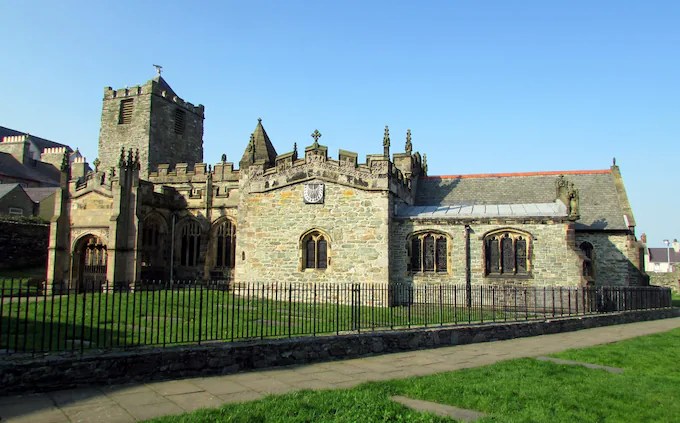


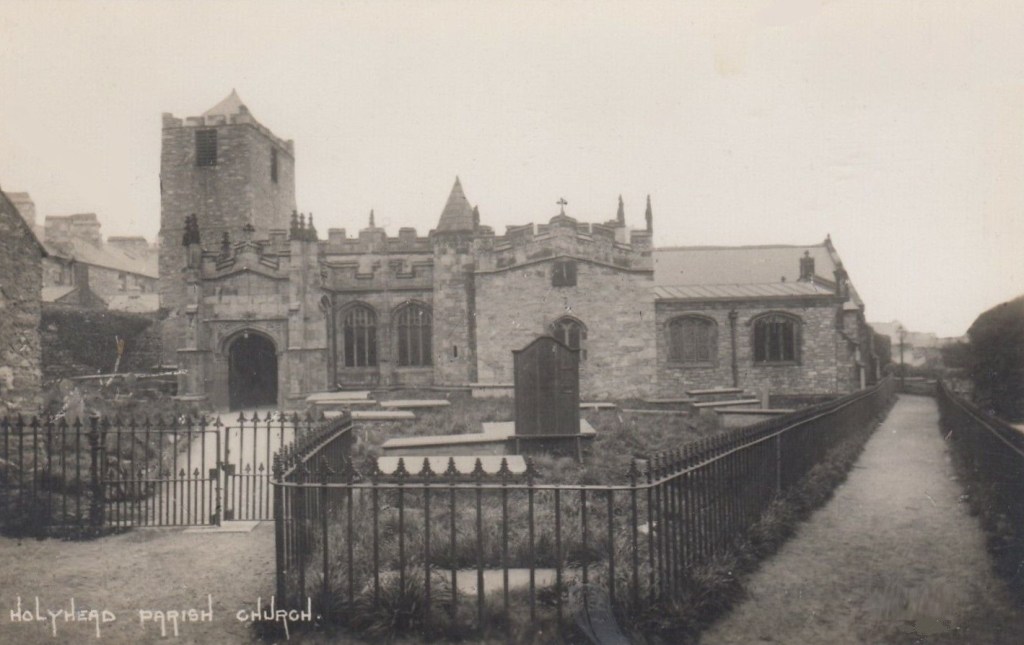

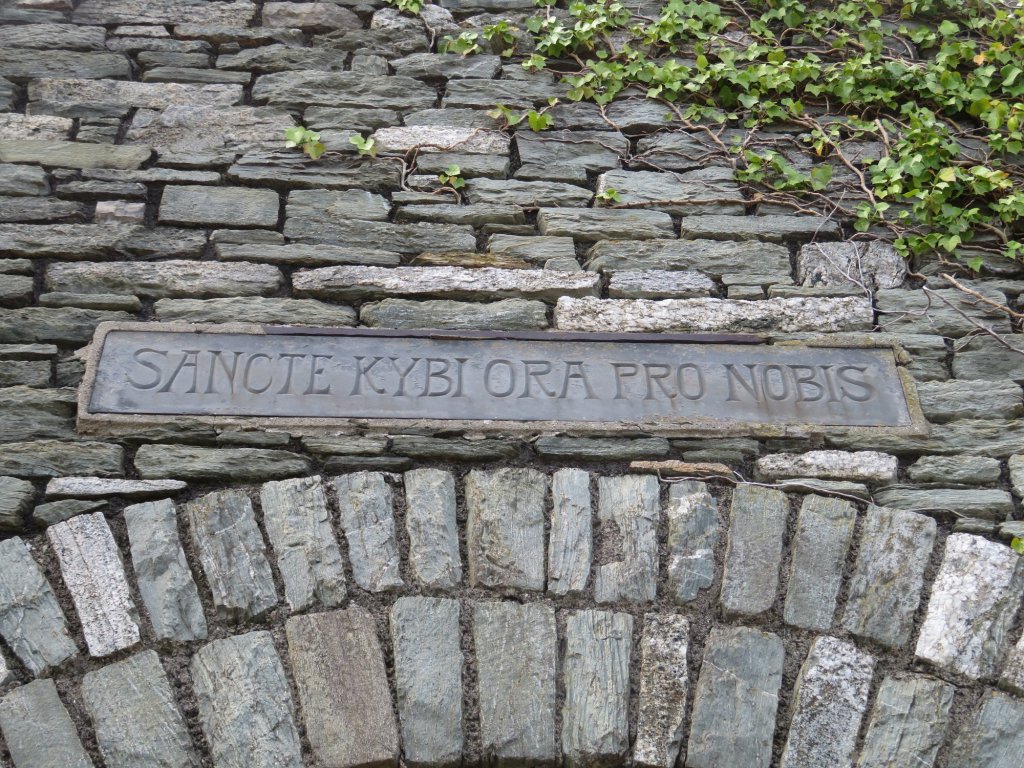

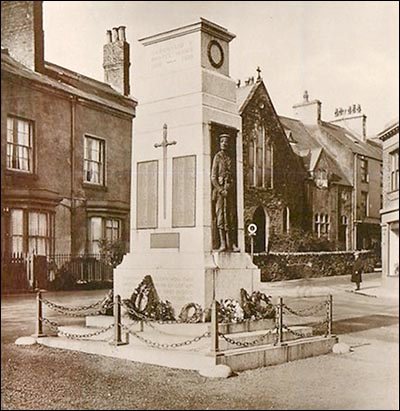
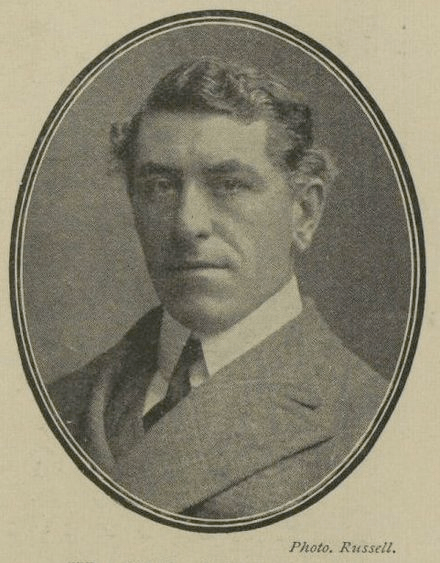
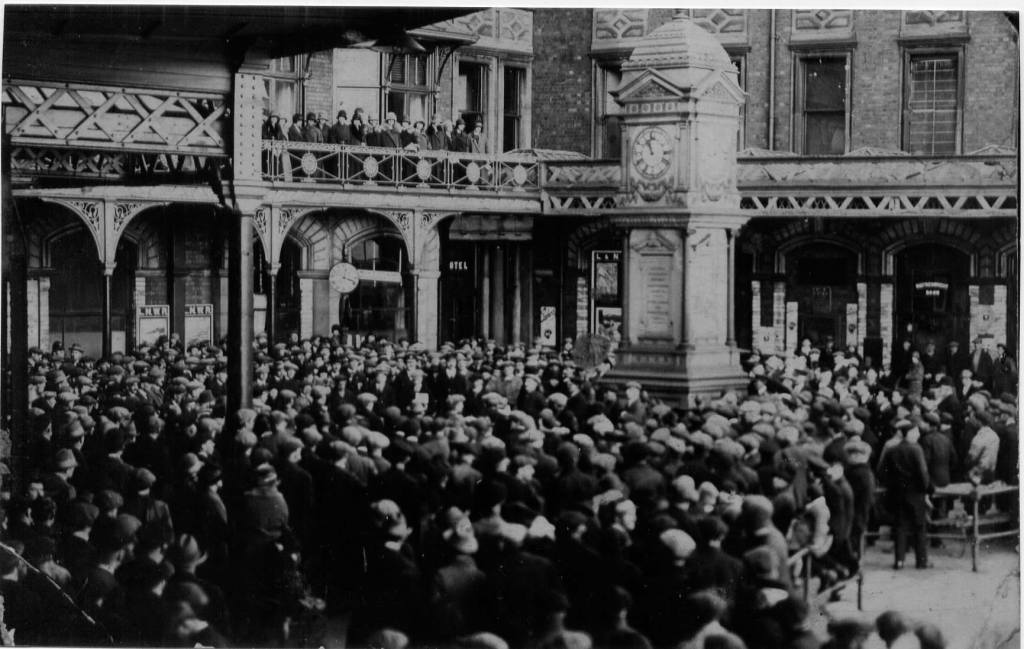
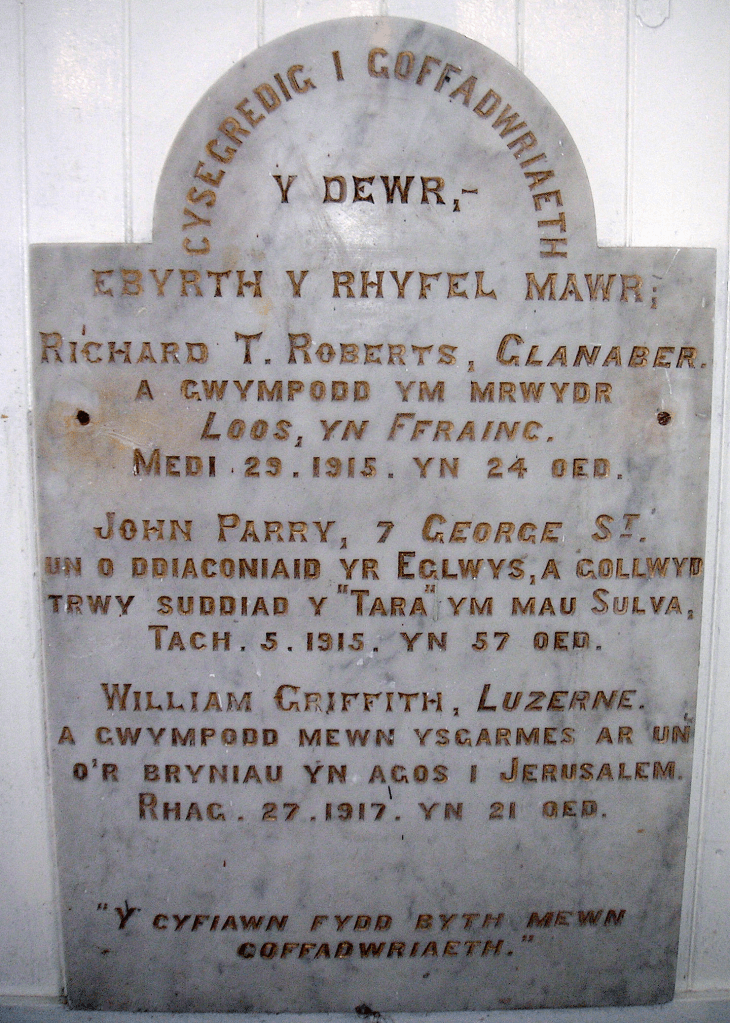


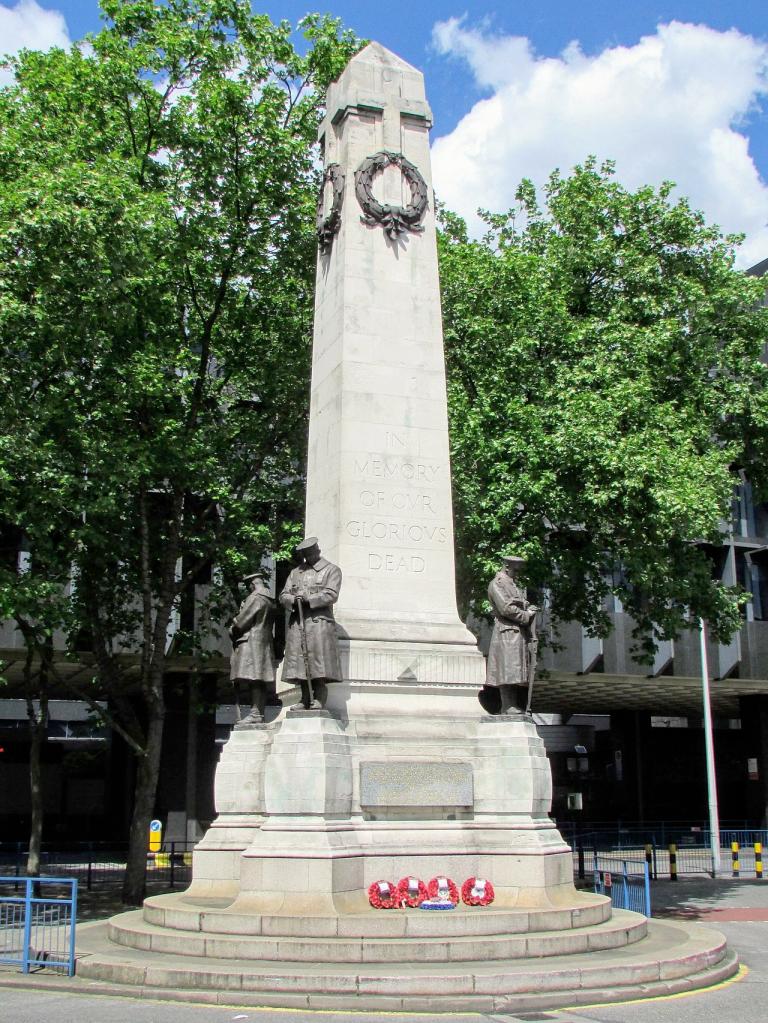

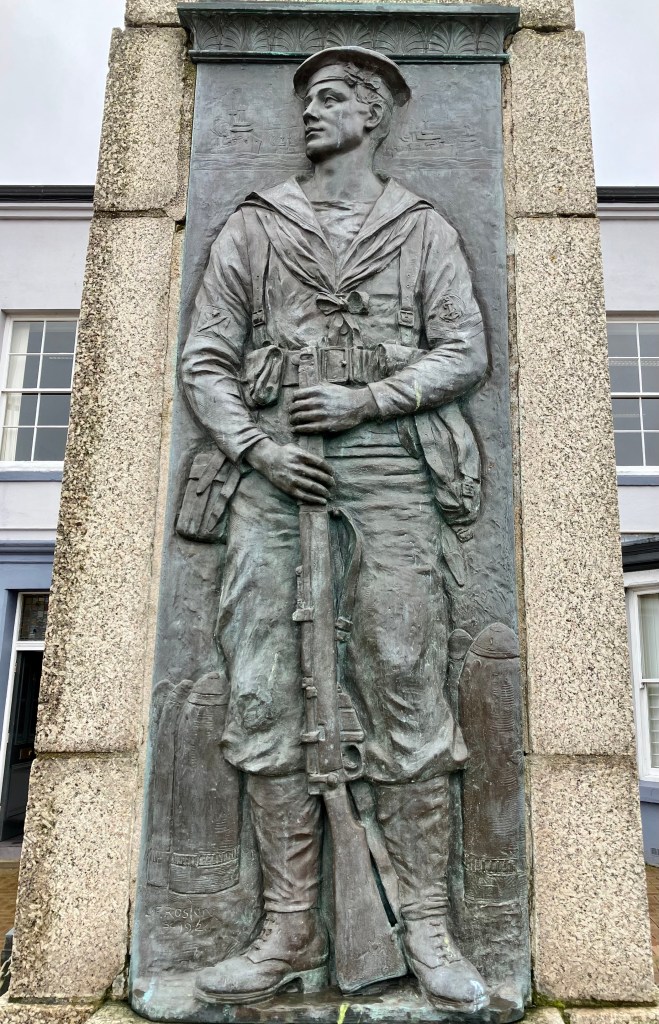


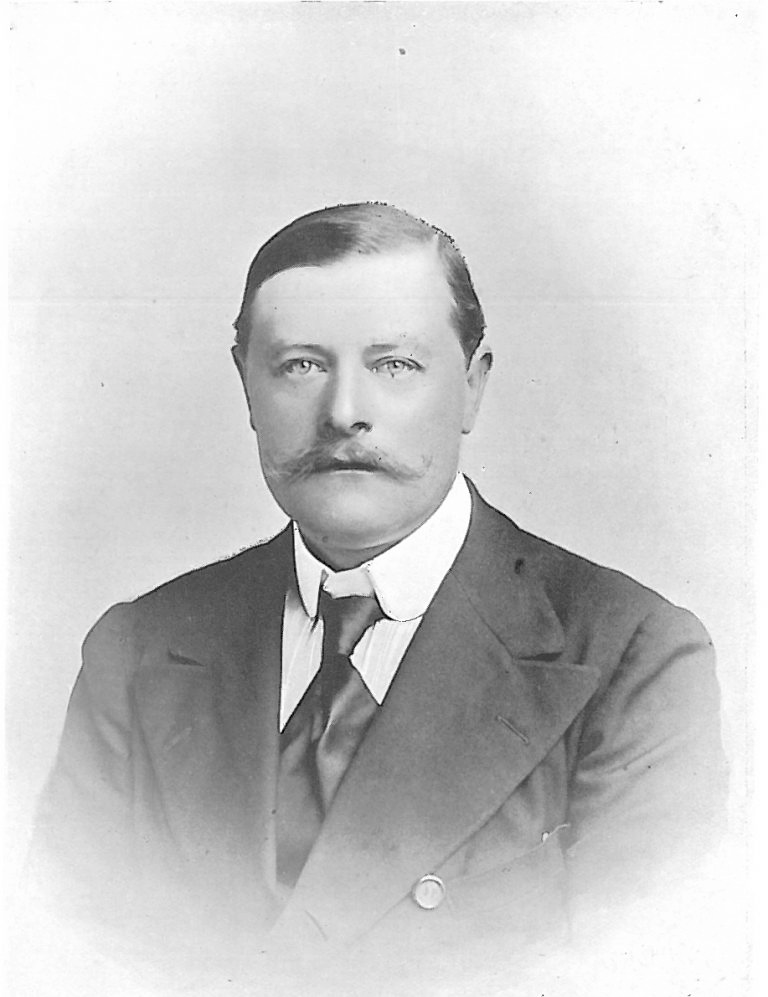

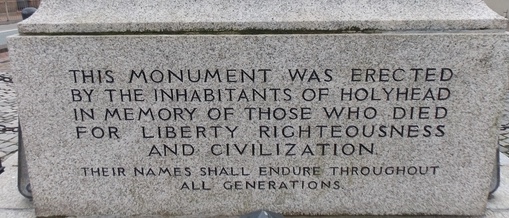
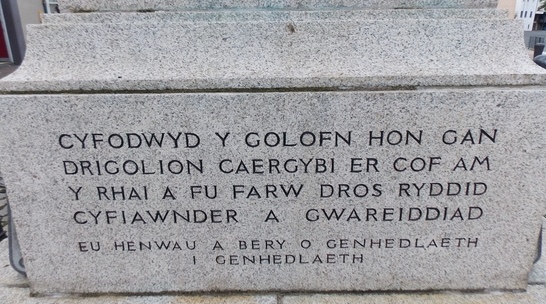
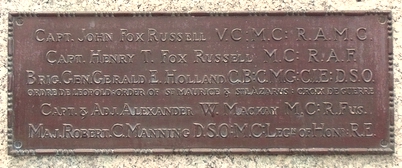
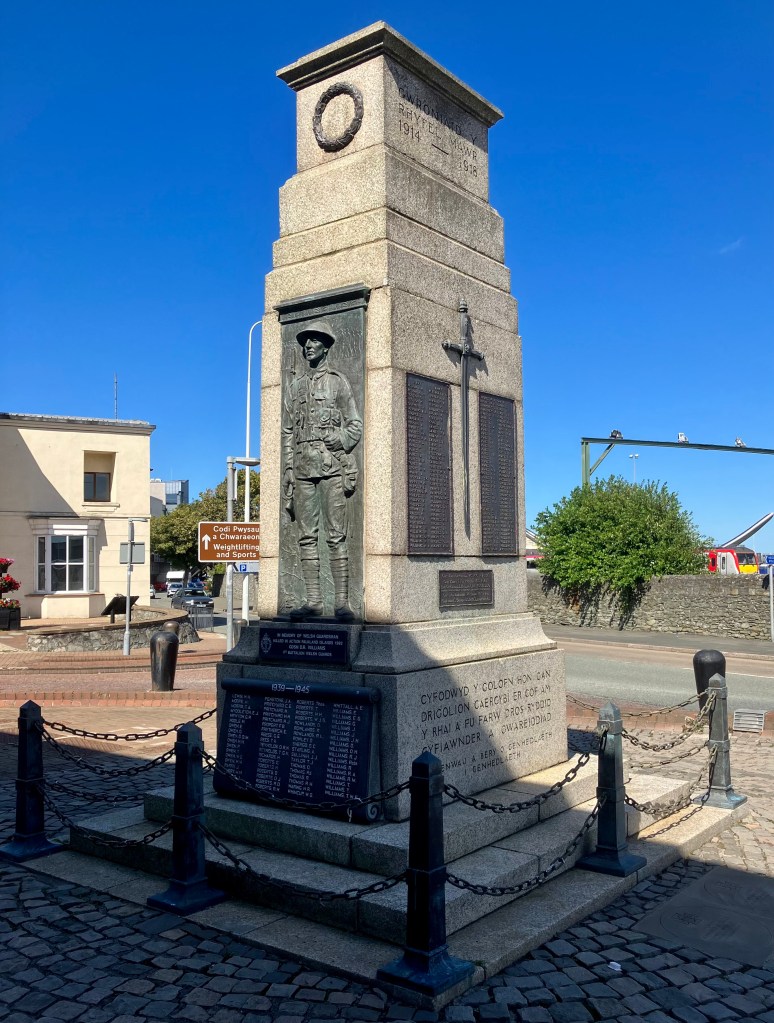


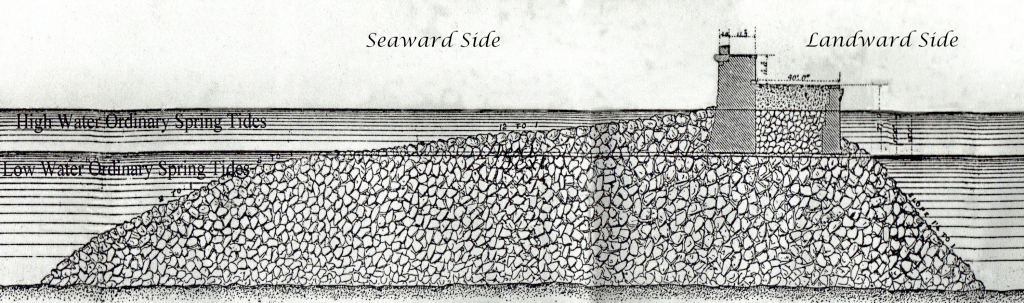


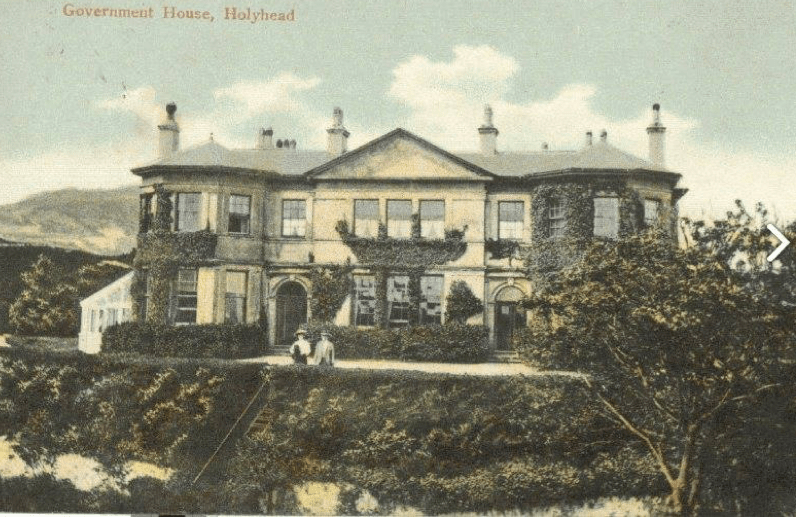

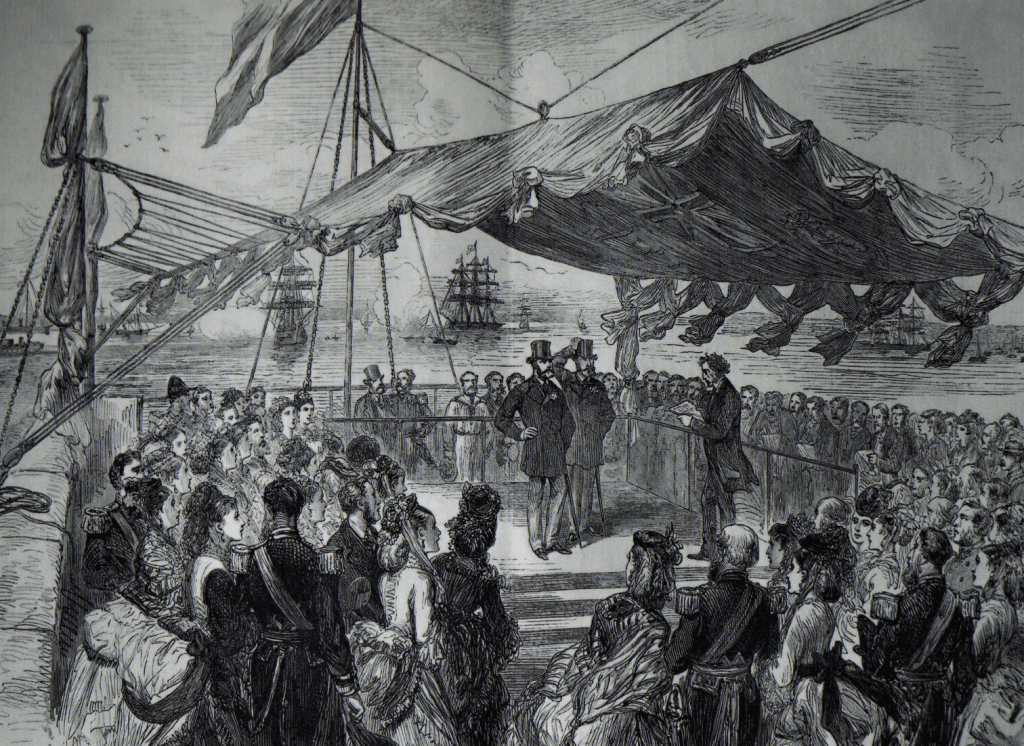
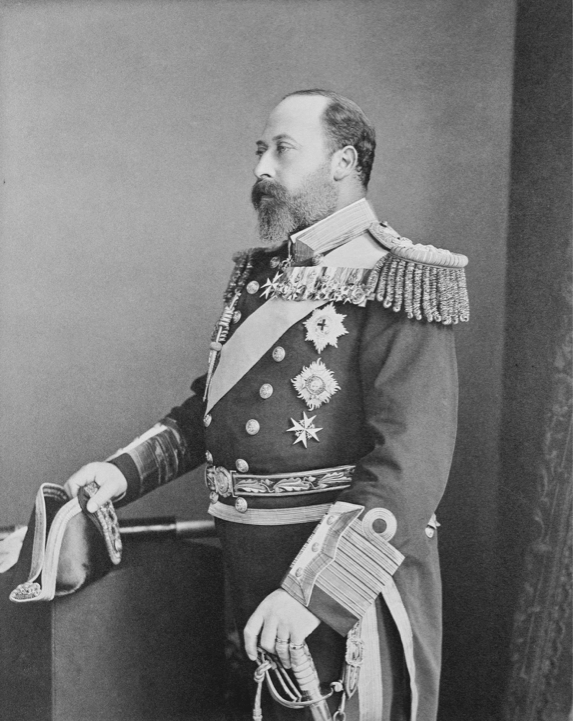
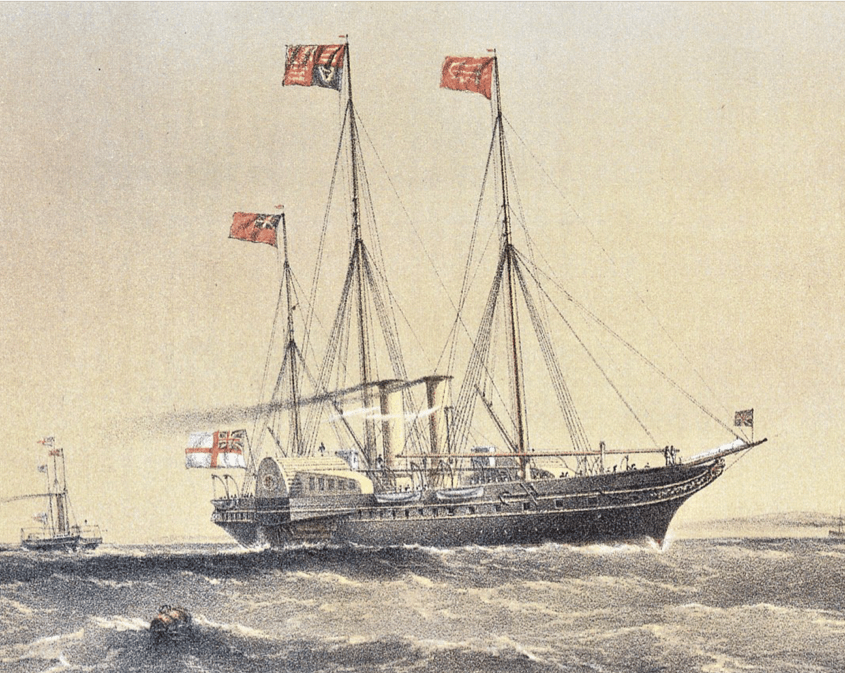
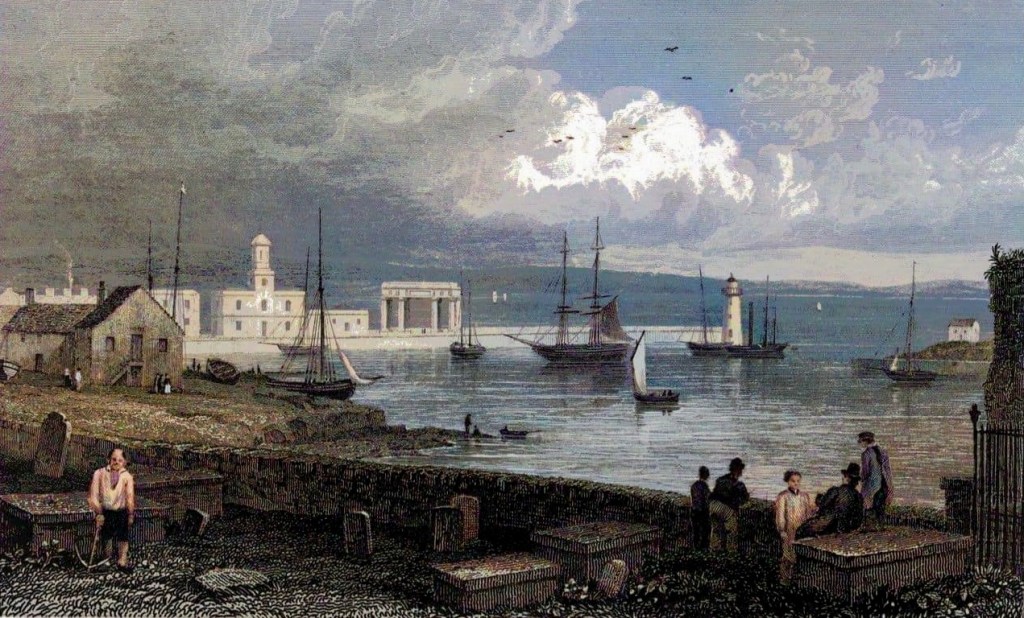


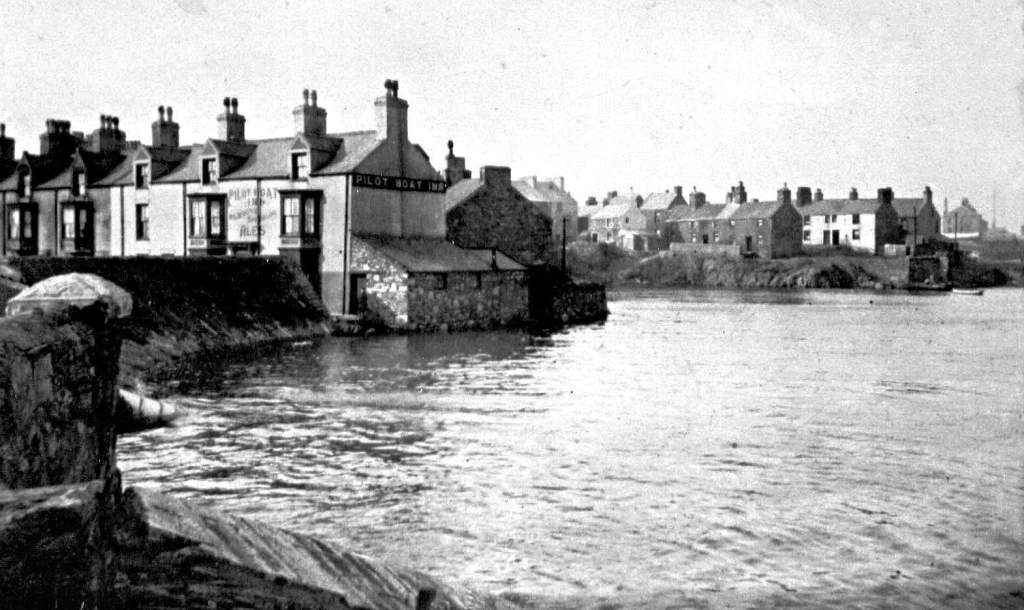


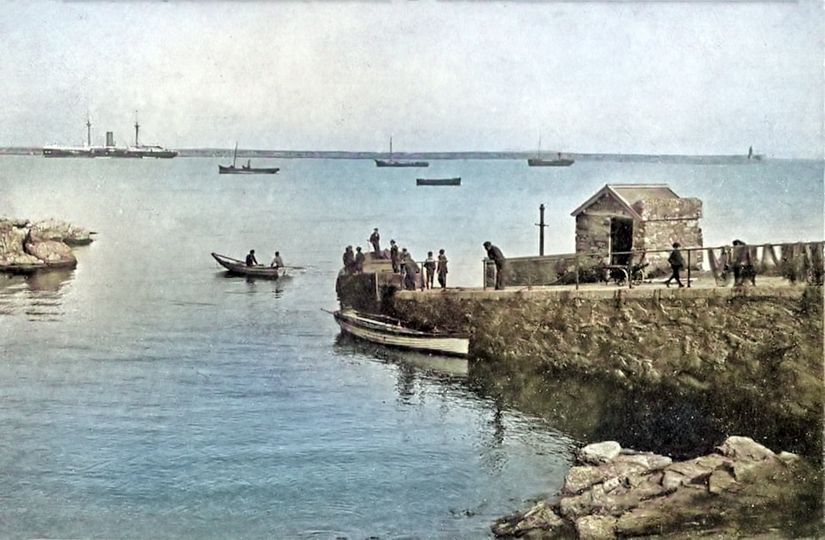


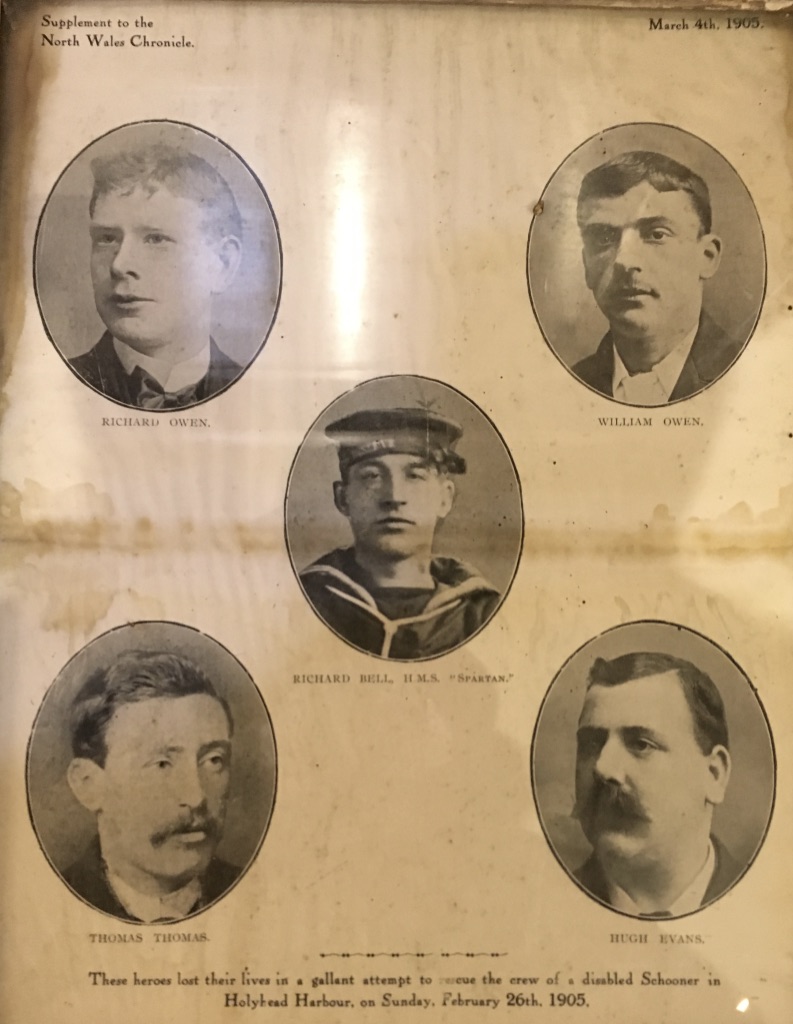

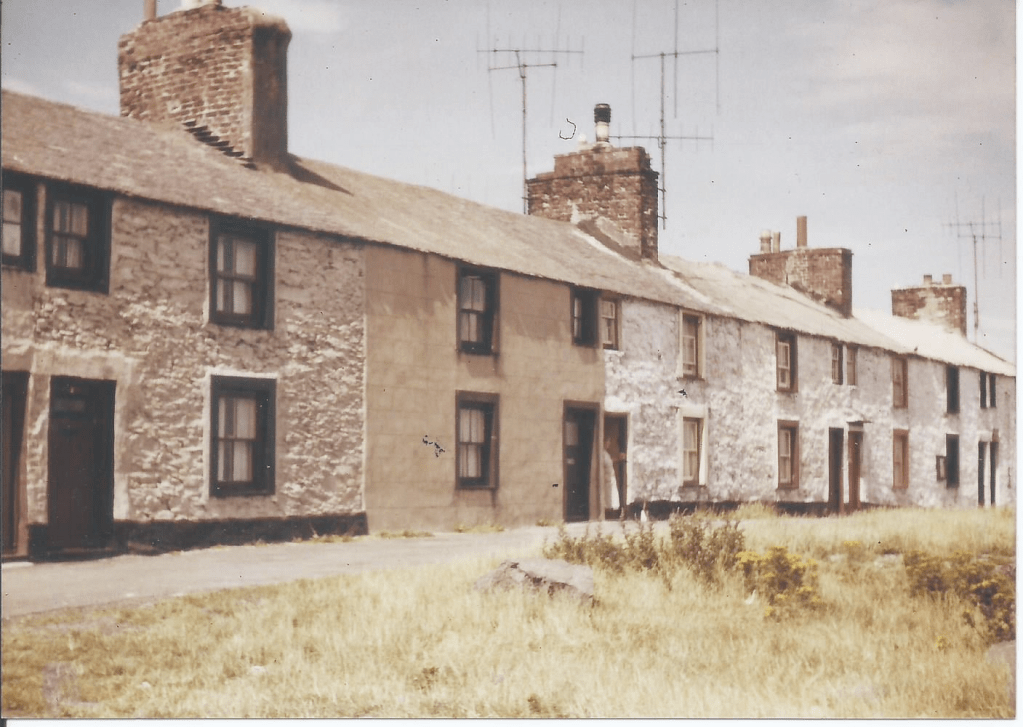
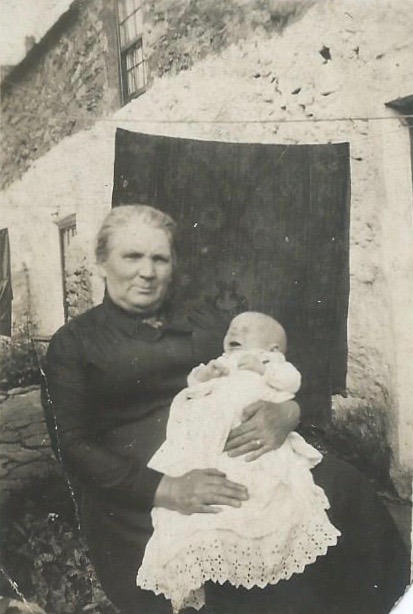

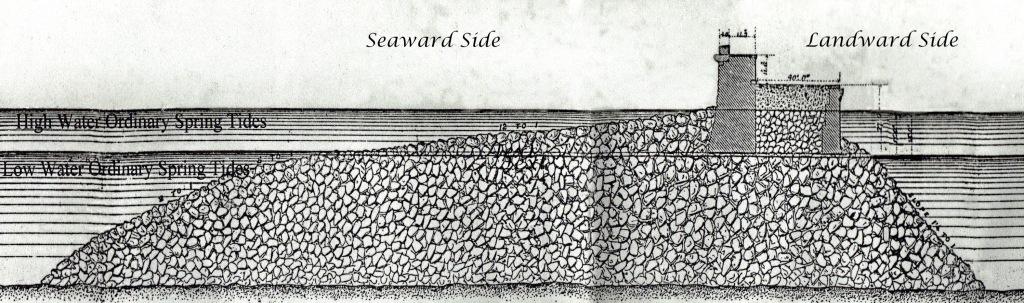
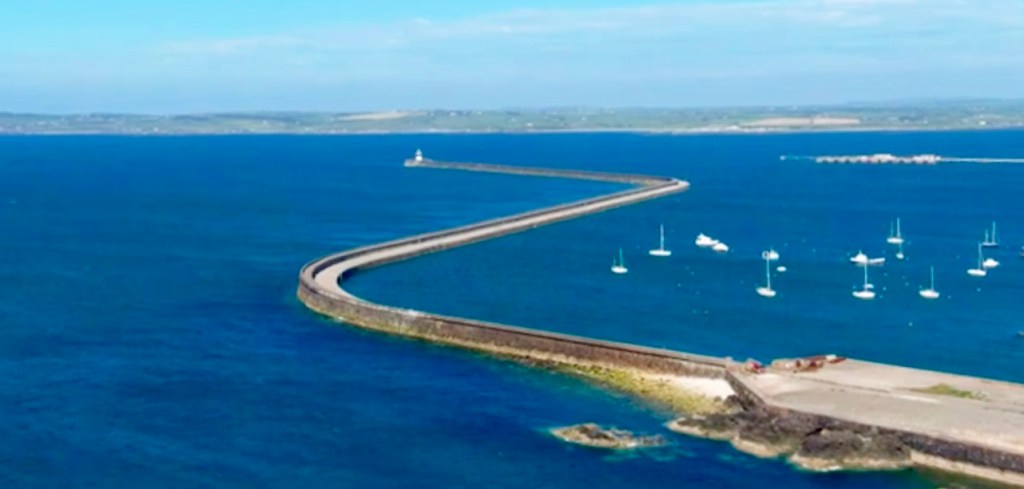
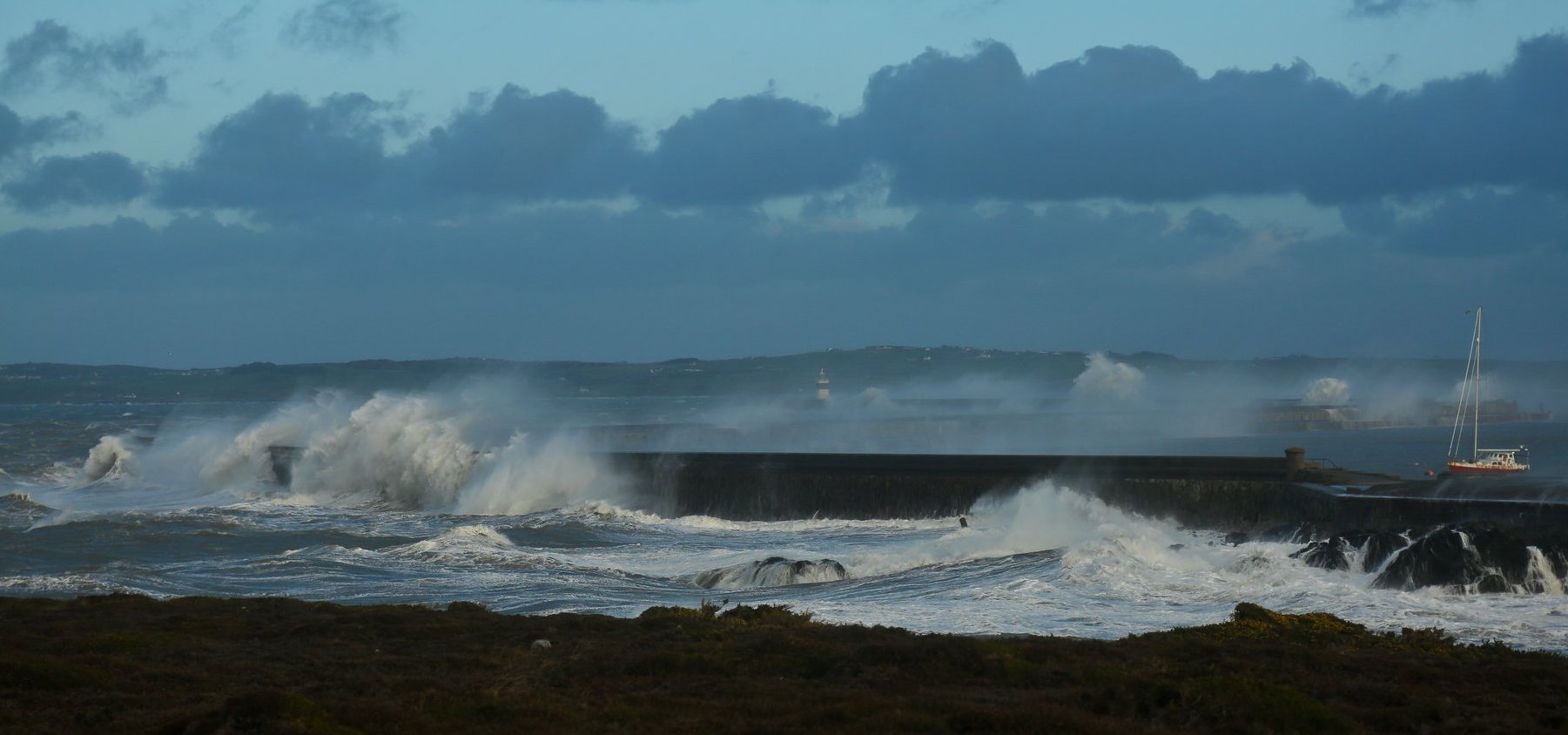

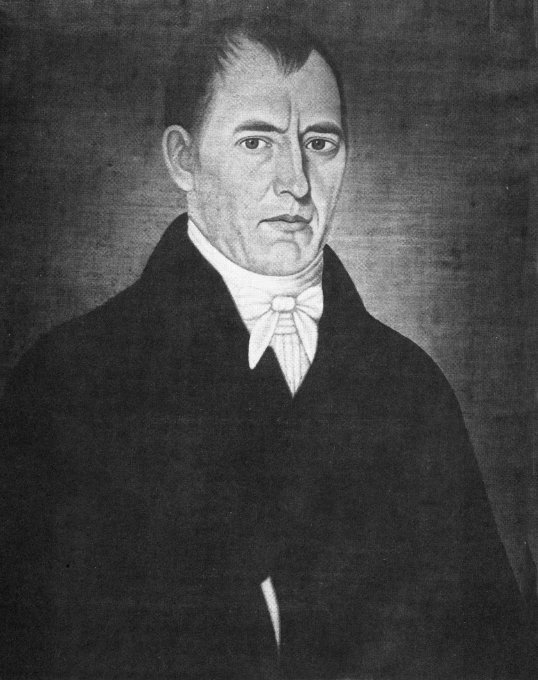
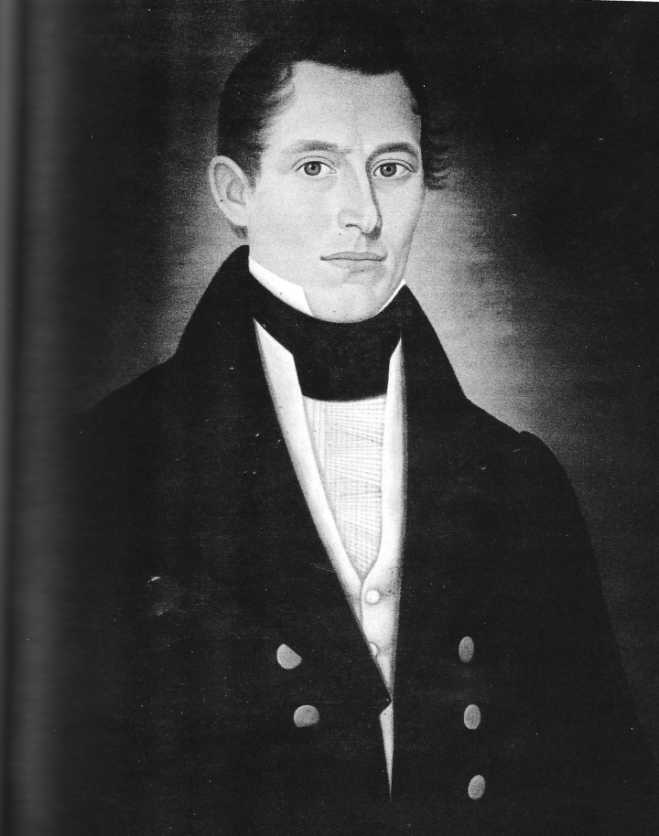

 Holyhead: Stories of a Port