The following article is by David Puleston Williams, a local historian who has spent considerable time and effort researching aspects of the Holyhead Parish Church of St. Cybi that are not readily known. We are grateful to David Puleston Williams for his research and permission to publish this article.
Introduction
As the time approaches for the return to the parish of St. Cybi’s Church after its refurbishment and transformation, it is worth examining one particular feature that has been in place for over 600 years and hopefully will continue for many centuries to come.
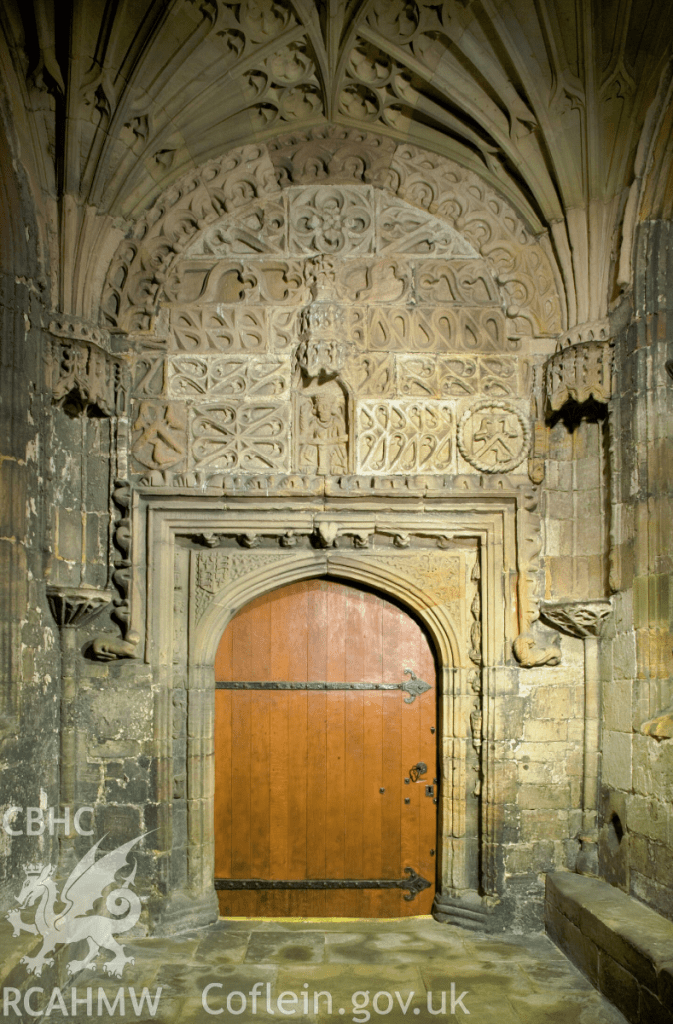
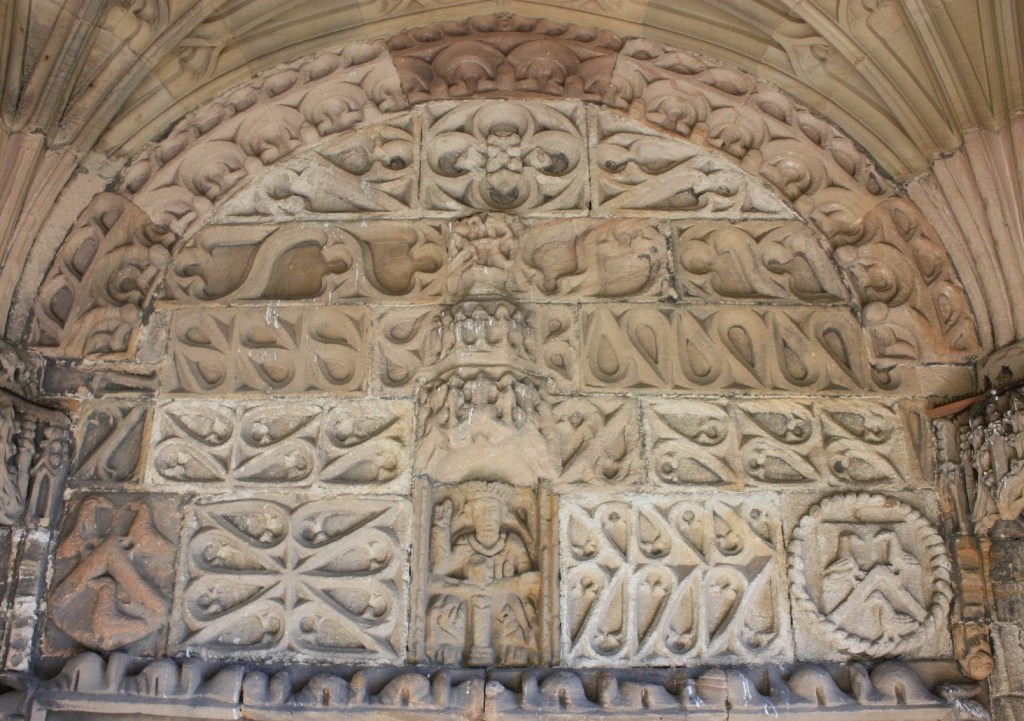
This feature can be found above the door at the south porch, the main entrance to the church. It is called a TYMPANUM. In the centre of this is a depiction of a holy figure situated behind what appears to be a crucifix.
Over time there have been many viewpoints expressed to what this figure represents.
St. Cybi’s Church, South Porch
The South Door
The Tympanum
St Cybi’s Church, Holyhead has in the past been described as follows:
. . . a large cruciform church whose architecture is for the most part typical of the final stage of the decaying Perpendicular style, but with some remarkable detail in its adornment. Most striking of all is the elaborate carving around the inner doorway of the well-proportioned and vaulted south porch. The whole of the wall above the doorway is panelled, a treatment of wall-surface not unusual in churches of the Perpendicular style, but the design here resembles rather that of a greatly extended tympanum.
The Tympanum above the South Door
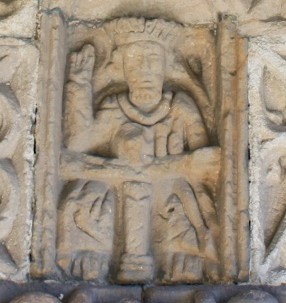
A tympanum is ‘the space enclosed between the lintel and the arch of a mediaeval doorway’. The tympanum, together with a close-up of the figure situated immediately above the door, can be seen in the photographs. The accepted view today is that this figure is a representation of either the Holy Trinity or God the Father with the Son.
Various Viewpoints
An undated guide to the church, when dealing with the South Porch states, ‘In the centre above the doorway is a representation of the Holy Trinity – the Father, crowned, with right hand upraised in the act of benediction, a crucifix between his knees, and the Holy Dove’. A more recent leaflet on the church, when describing the south porch, states, ‘In the centre is a Tympanum: God in Majesty supporting the Crucified Christ’.
Writing in 2003, Peter Lord, in his book, ‘The Visual Culture of Wales: Medieval Vision’, states ‘. . . the central panel of a tympanum over the south door is carved in the form of a figure of God the Father with the crucified Christ between his knees . . .’.
The Central Image
However, the understanding during the 18th and 19th centuries was that this figure was a representation of St Cybi, greeting all those who entered the church named after him. Lewis Morris (1701-1765) wrote a ‘A short account of Holyhead Church’, which appeared in the Cambrian Journal for 1818, and he writes as follows:
Over the south door, in the porch, there is a small bust with a cross before it; the mitre on its head is defaced, as most church antiquities have undergone the same fate, in that general devastation under Oliver Cromwell. On each side of this bust, which seem to be Kybi’s, there is an escutcheon with these arms, a cheveron between three birds, the two uppermost combatant.
The escutcheon or shields referred to can be seen on either side of the figure in the photograph of the tympanum., These are the arms of Llywarch ap Bran, being a chevron with three crows.
A description of the church by R.T. Williams in his book, ‘Nodion o Gaergybi’, (‘Notes from Holyhead’) published in 1877, states:
‘Uwchben drws y porth hwn ceir delw’r sant o un gareg gyfansawdd, yn ei osod allan mal pe buasai yn y pwlpud, a’i law ddehau i fynu. . .’ (Above the porch door there is an image of the saint formed out of one piece of stone, as if he was in a pulpit, with his right arm pointing upwards.)
The Seal of Holyhead
The Holyhead Local Board (the precursor of the Holyhead Urban District Council and subsequently the Holyhead Town Council) came into existence in 1860. Elections were held and 12 members were duly elected on to the new body. Among the 12 were a number of the town’s leading citizens including W.O. Stanley, M.P., Dr William Walthew, John Provis a civil engineer, and William Griffiths the minister of Tabernacl Congregational church.
It came as no surprise that the vicar, the Rev Thomas Briscoe topped the poll with 247 votes, as he was a popular figure in the town, and was held in high esteem by church people and non-conformists alike. The following details are from his obituary in the Times, 18 February 1895:
Rev. Thomas Briscoe, D.D., vicar of Holyhead, Anglesey, and Chancellor of Bangor Cathedral. He was educated at Jesus College, Oxford, taking a first class in classics in 1833, and held a Fellowship of his college from 1834 to 1859. He became vicar of Holyhead in 1857, and from 1880 to 1885 was proctor in convocation for the Dean and Chapter of Bangor. Dr Briscoe was an accomplished linguist and translated portions of the Old Testament and the whole of the New Testament into Welsh.
The Board met for the first time on the 16 February 1860, and the Rev Thomas Briscoe was unanimously elected chairman. At the next meeting of the board, held on the 1 March 1860 a number of resolutions were passed, including this one:
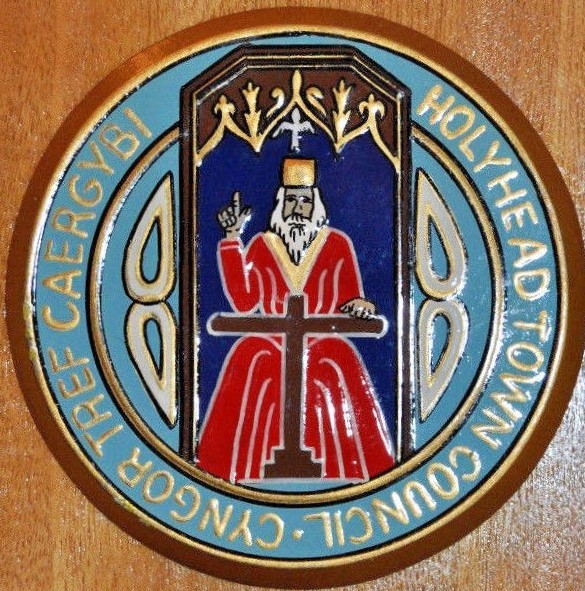
That Cybi, sitting as represented over the Church Door with a Canopy and the Inscription ‘The Seal of the Local Board of Holyhead’, shall be the Seal of the Board.
It is possible that the suggestion to adopt the image of St Cybi came from Thomas Briscoe, as it was he who paid for, and presented the first seal to the Board. Lucy Williams states, ‘The figure of the Trinity, inside the porch became the town crest at the suggestion of Chancellor Briscoe’.
The present Holyhead Town Council Crest (Seal)
That a figure of the Trinity was adopted is incorrect, as there can be no doubt that the Board adopted the figure of St Cybi as an image for its seal. However, the minutes of the Board for the 15 March state: ‘The Chairman having offered to present to the Board a Seal in accordance with the resolution of March 1st.’ During the next meeting of the Board on the 22 April, ‘the seal was laid on the table’. A vote of thanks was given to Thomas Briscoe in the meeting of the 26 April 1869 ‘for his present of a seal to the Board.’
Recently a very ordinary exercise book (6) containing numerous handwritten history related articles and jottings, mostly copied from other sources, was donated to the museum. Among the articles was one which described the establishment and activities of the Anglesey Druidical Society, in being on Ynys Môn from 1772-1844.
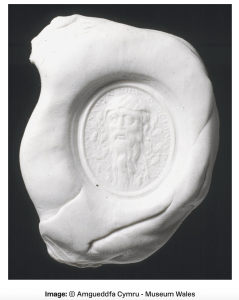
A plaster plaque depicting a Druid, the symbol of the Anglesey Druidical Society. (3)
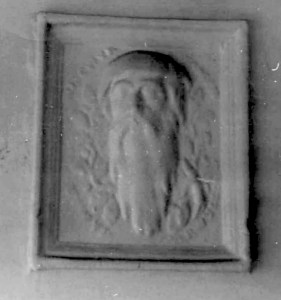
The society was formed at Beaumaris in 1772. Members included clergymen, sea captains, prosperous farmers, persons of title and a number of the minor gentry of the island. Numbering over 100, they would meet monthly, mostly at Beaumaris inns to dine. They were expected to make regular donations and were fined if they failed to wear the adopted uniform of the society, also for non attendance at meetings and for other minor transgressions. Silverware was purchased – four ceremonial goblets. A seal was designed and medals issued. (5) (6)
An impression of the Anglesey Druidical Society seal. (1)
The aims of the society were charitable and benevolent with funds made available to reward bravery in saving life at sea, supporting local hospitals and for arranging apprenticeships for poor children. They later took an interest in rewarding good practice and skills in agriculture. The society eventually became less active and closed in 1844.
A guilded medal of the Anglesey Druidical Society. (2)
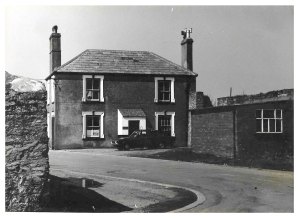
In 1976 work was in progress to expand the Holyhead port facilities at Salt Island and a number of buildings were being demolished, including one previously occupied by the Waterguard Section of HM Customs and Excise. This building at one time had been the offices of the ‘City of Dublin Steam Packet Company’ that operated the Royal Mail service to Ireland from 1860-1921. It stood at the entrance to their ship repair yard. Alongside the main building was a boathouse, that in 1825 is believed to have housed a lifeboat together with a rocket firing apparatus for the rescue of those in difficulties at sea.
The Holyhead Waterguard offices of HM Customs and Excise at Salt Island. (3)
Attached to the inner walls of the customs offices were three plaster plaques depicting the images of druids (see above). Their connection to the Anglesey Druidical Society is clear as other known artefacts also depict the same imagery. Their location at the offices can only be guessed at but may be connected to the society’s possible provision of a lifeboat and life saving equipment at Salt Island.
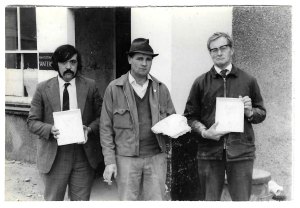
Before the building was demolished Captain Geoffrey Butterworth, John Cave, Roy Jones (Maintenance Supervisor at the Civil’s Section of Anglesey Aluminium), together with Ken Evans of Holyhead Library managed to extract the plaques which were then cleaned and eventually taken to the old Holyhead Library at Queen’s Park. They were displayed on the stairs to the first floor for many years.
Removal of the druidical plaques before demolition. (3)
In 2019 the town library was relocated to the newly refurbished Market Hall with the plaques no longer on display. The article in the exercise book prompted the museum to try and track down the plaques to ensure that they were being taken care of. With the assistance of council officers and library staff they were eventually located in storage at Llangefni Library but with little known provenance.
A silver snuff box, believed to have belonged to Holland Griffith (1756-1839) of Carreglwyd and Plas Berw, Anglesey, an Arch Druid of the Anglesey Druidical Society. (4)
The plaques are now to be relocated to the care of Oriel Môn, Llangefni. References to the society have been identfied in the transactions of ‘The Anglesey Antiquarians’ and ‘The Honourable Society of Cymmrodorion’, which provide a valuable provenance for the items and the society they represented, which in their day did much good for the people of Ynys Môn.
References and Acknowledgements
1. The image of the Seal Impression – Credit Amgueddfa Cymru – Museum of Wales
2. The image of the society guilded medal – Ebay (listed at £1,200 and sold)
3. Photos relating to the removal of the plaques – John Hodgkinson posted on Facebook (Holyhead Past and Present, 16/10/2024). Believed to have originated from John Cave MBE.
4. The image of the silver snuff box – listed online for auction with a society medal at Mellors and Kirk in 2017. (Estimated at £3000-£4,000).
5. Geoffrey Butterworth – The Anglesey Druidical Society, 1772-1844. The Anglesey Antiquarian Society and Field Club, 1980
The following article commemorates the loss 350 years ago of an unique and historically important vessel, ‘His Majesty’s Yacht Mary’ – the first Royal Yacht. The circumstances of her shipwreck in 1675 on Anglesey’s Skerries Islands are well documented. What is less well known is the story of the discovery of the wreck in 1971 and the recovery of her eight bronze cannon and over 1,500 other historically important artefacts.
We are grateful to Joe Caddick for contacting the museum to remind us of the anniversary of the tragedy. Joe was the leader of the diver group that raised these historical items from the seabed and ensured that they were placed in the care of the proper authorities. Joe has allowed the Holyhead Maritime Museum access to his records and many accompanying photographs.
The ‘Mary‘ was built by the Dutch East India Company in 1660 and then purchased by the City of Amsterdam, embellished and presented to Charles ll on his restoration to the English throne in 1660. Her cabins were decorated with gold leaf; her furniture was upholstered in leather and a white unicorn adorned her bows.
Prize wining model of the ‘HMY Mary‘ on display at the Holyhead Maritime Museum
Of 92 tons and measuring 67ft x 18ft, she was armed with eight 3-pounder guns. The vessel was built for speed and had leeboards in order to combine a large sail area with a shallow draught. She was gaff rigged with a long spar supporting the mainsail. The ‘Mary‘ was the first official royal yacht and was initially used by the King for pleasure and to visit his fleet. She was later taken over by the Royal Navy in 1666 and carried officials and other notables, mostly over to Dublin.
A commemorative plate on display at the Holyhead Maritime Museum
On 25th March 1675, the ‘Mary‘ was on passage from Dublin to Chester under the command of Captain William Burstow. The vessel had a crew of 27 and carried 46 passengers, including the Earl of Ardglass and the Earl of Meath, accompanied by his son. The vessel, after crossing the Irish sea, encountered dense sea fog off the Welsh coast and tragically hit a rock on the west side of the Skerries Islands, located off the north-west coast of Anglesey. She became wedged in a gully, tilting over towards a high rocky outcrop. This allowed 39 passengers and crew to climb ashore and scramble to a safe place. The captain bravely went back along the mast to try and save the Earl of Meath who was unable to climb unaided. Tragically this resulted in both losing their lives. It was two days later when a passing vessel from Beaumaris rescued the survivors. In the meantime they set alight to gunpowder flasks for warmth and drank whiskey from kegs salvaged from the wreck.
The Skerries off the north west coast of Anglesey with the location of the ‘HMY Mary‘ marked
The wreck lay undisturbed until July 1971 when the site was discovered by divers from two British Sub Aqua Clubs – Merseyside and Chorley.
On a fine sunny day on the 11th July 1971 a group of divers from the Merseyside club were at Skerries intending to dive on the cargo ship, SS Castillian, sunk in 1943. Weather conditions forced a change of plans and the group moved closer to the Skerries islands to undertake a safer dive. It was here that the divers came across a bronze cannon and then shortly afterwards located the main wreck site with more cannon apparent.
The Chorley group were also diving close by and had coincidentally also located a cannon. The Chorley group managed to raise their cannon after the Merseyside group had returned to Holyhead. The Chorley group declared the cannon to the Receiver of Wrecks at Holyhead who then contacted Dr. Peter Davies of the Council for Nautical Archaeology at Liverpool. The same day the Merseyside group also contacted Dr. Davies for advice on the cannon they had found at the main wreck site. Dr. Davis realising the importance of the find advised that the two groups work together and help firstly to undertake a pre-disturbance survey and then to participate in an organised Marine Archaeological Expedition to record and excavate the site.
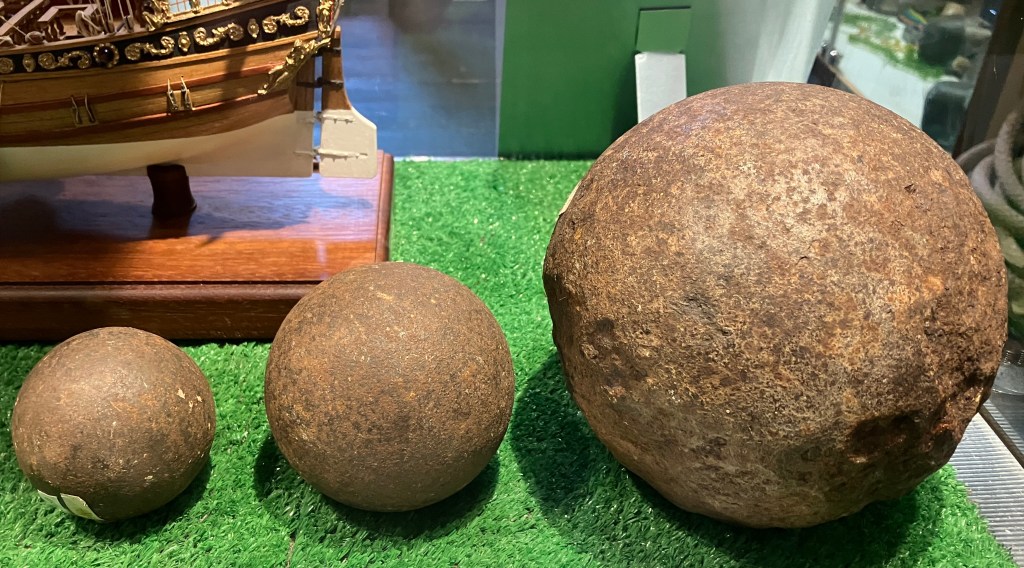
By 21st July the expedition was underway with one of the Merseyside divers, Joe Caddick, in command of the recovery vessel, ‘Francis Sea’. By this time all the evidence was supporting the view that the wreck might be the lost royal yacht ‘Mary’. The pre-disturbance survey had located one Dutch four pounder bronze cannon and six English three pounder bronze cannon together with a large collection of cannon balls, too large for the guns. (These turned out to be ballast for the shallow draft vessel). Also identified was one small bronze bow chaser cannon.
Cannon balls recovered from the ‘Mary’ on display at the Holyhead Maritime Museum. The smaller ball was used with the ship’s armament, the others were for ballast.
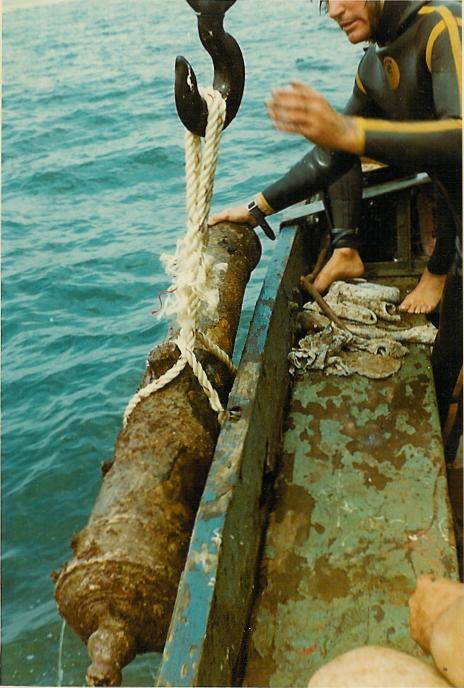
Before the cannon and other artefacts could be recovered it was decided by the experts advising the expedition that the site should undergo a complete and detailed archaeological survey. However the group were becoming concerned about the ongoing security of the site as news of the finds was now common knowledge locally. Wreck sites of this nature have little protection in law and after it became evident that a ‘pirate’ diving group had removed some of the artefacts without reporting them to the Receiver of Wrecks, it was decided to raise the cannon without delay.
Raising a cannon from the wreck of the ‘Mary’.
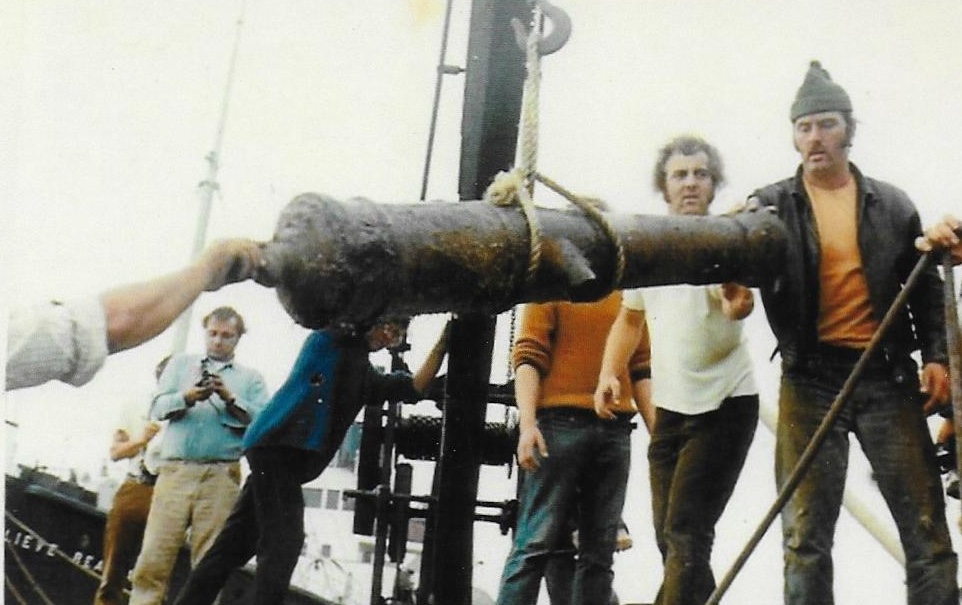
Unloading at Holyhead
Happily those items removed from the wreck site by the ‘pirate’ divers, and never reported to the Receiver of Wrecks, were eventually recovered. Throughout the work to recover the remaining cannon and other artefacts the expedition was regularly interfered with and challenged by other diving groups. One such group even attempted to intimidate the members of the expedition by discharging a shotgun. However, four days after commencing the recovery of the bronze cannon all eight were taken into the care and conservation of the Liverpool Museums.
Seven of the eight bronze cannon being declared to the Receiver of Wrecks
Expedition divers – Peter Caddick, Mike Gillroy and Joe Caddick
In total over 1,500 items were recovered from the wreck of ‘HMY Mary‘. Among many day to day items were numerous pieces of jewellery and over 600 silver coins. Illustrated below is a silver lion’s head thought to be from the butt of an ornate pistol or possibly an adornment on the top of a staff.
Butt of a holster pistol or a adornment for a staff in the form of a silver lion’s head.
The experience by those involved served to highlight the short comings of the law to protect historially important wreck sites such as the ‘Mary’. The significance of this was eventually recognised by the Government and wrecks such as the ‘Mary’ are now covered by the ‘Protection Of Wrecks Act 1973’.
It’s now well over 50 years since the wreck with its historically important artefacts was located. The divers who remain are no longer young men and they are probably justifiably disappointed that the artefacts they worked hard to recover and then handed over to the Liverpool Museums have never been on permanent display and as a result they believe that the full story of ‘HMY Mary‘ risks being lost to future generations.
Retired diver, Joe Caddick, at Holyhead Maritime Museum alongside our display telling the story of ‘HMY Mary’
The photographs relating to the recovery of the artefacts from the ‘Mary’ are the property of Joe Caddick. Those taken at the Holyhead Maritime Museum are the property of the museum. The image of the Skerries is from Google Maps.
Throughout the 18th century and into the beginning of the 19th century, the Royal Navy became the most effective navy in the world. Under the outstanding leadership of great men such as Nelson, Collingwood, Anson, Bligh, and Cook, the British navy won almost every major sea battle it fought.
However, omitted from this illustrious list there were numerous others.
Among these was Admiral John Henry whose distinguished career deserves to be examined. The following narrative briefly cover his roots in Holyhead before entering the navy as a boy and his rise to prominence.
Although archival evidence appertaining to John Henry’s early life and career is somewhat sparse, it is nevertheless supported by secondary sources. This article attempts to further expand these sources and illuminate the life of a long forgotten local sailor.
The references for these sources are highlighted in the text.
Ranking as one of Britain’s most prominent sailors of his time, John Henry was born in Holyhead on September 28th 1731.
Parts of a publication written by Lieutenant John Marshall in 1823, Marshall gave glimpses of John Henry’s naval career and continued to regularly update his publications in further supplements until 1835. An abridged version also appeared in ‘The Gentleman’s Magazine’, in the form of an obituary some six years later, following Henry’s death at Rolvenden in Kent in 1829. 1
Whilst Marshall mentioned parts of Henry’s life, particularly his naval career, other aspects of his life remain untold or undiscovered. Both accounts mentioned that Henry entered the navy as a midshipman in 1744 but disappearing from the record until eighteen years later when he was noted as a senior Lieutenant aboard the ‘Hampton-Court‘.
Far from being complete the author of this narrative attempts to expand further on Marshal’s account
In a letter written by William Morris, a customs official at Holyhead, to his brother Richard who was a clerk at the Admiralty in London dated February 1756, William states the following: –
“I have some private reason for this enquiry. The young fellow whom I suppose is a lieutenant on board Captain Weller’s and who was his clerk and steward on board the Dorset yacht, is John Henry of this place.”
William goes on to remind Richard as to John Henry’s identity.
“You perhaps may remember his father, master of Peter’s brig at Dulas in time of yore’. Gwyddel oedd ei dad a briodws Gybi wraig.”
Translated:- ‘His father was Irish who married a Holyhead woman.’2
The ‘Dorset’ was a Royal Yacht commissioned in 1753 to convey the Lord Lieutenants and other dignitaries to and from Ireland. Her predecessor was the yacht ‘Dublin’ which had carried out those same duties since 1709. The captain of the ‘Dublin’ was Captain John Weller, who had been her commander since 1734. However, in 1751, John Weller resigned this position (thought to be through ill health as he died early in 1753) and his son, also called John Weller, was then appointed to take over as her commander. John Weller junior remained with the ‘Dublin’ until she was broken up in 1752 and, as aforementioned, took command of her successor, the ‘Dorset’ in 1753. He was later elevated to the rank of Rear Admiral and died in 1772.
Both vessels frequently visited Holyhead where Captain John Weller (senior) had forged a great friendship with William Morris as did his son, John (junior).
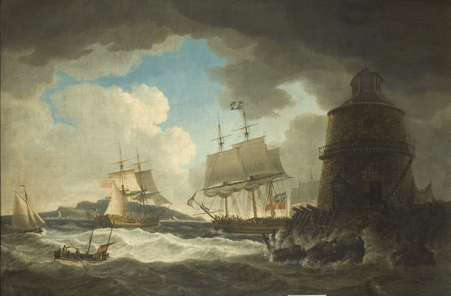
The Royal Yacht ‘Dublin’ in Dublin Bay
There were several ways that a young man could enter the navy as a midshipman, the most common being in the form of patronage in one form or another. Marshall gives no mention to Henry’s naval career from his entry into the navy in 1744 except that he had broken his thigh bone whilst serving as a young midshipman and prior to his appearance as a first Lieutenant aboard the ‘Hampton Court’ at Havana in 1762. It can only be assumed that John Henry began his naval career as a thirteen-year old midshipman aboard the yacht ‘Dublin‘ in 1744 possibly under the patronage of John Weller, senior.
In 1755 John Weller left the ‘Dorset‘ and took over the command of the ‘Assistance’, a fifty-gun man of war, with his clerk, (John Henry) leaving the vessel at the same time. 3
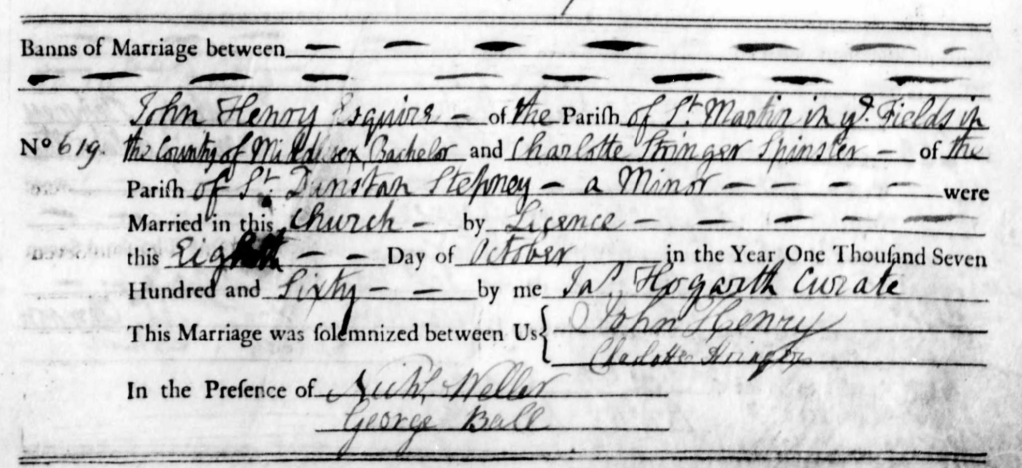
His training as a midshipman would have included a wide range of nautical skills and disciplines. Henry became a naval surgeon and later published a paper where he claimed that he had knowledge of how to cure various medical ailments. 4 It would be difficult to resist the thought that his interest in surgery was not influenced by his own experience after having his thigh broken by a hawser in 1746. John Henry received his commission on the 27th February 1757 but it is unclear whether or not he remained with John Weller. There can be no doubt that Henry was held in high esteem both professionally and socially by the Weller family and went on to marry Charlotte Stringer on the 8th October 1760. Charlotte was the granddaughter of John Weller senior, and niece of John junior.
Henry was also one of the executors of John Weller’s (junior) will. Following Weller’s death in 1772, Henry’s wife Charlotte, was one of the beneficiaries which included a quarter share in plantations, lands and property in Tasmania and a substantial amount of money. 5
Shortly afterwards, Henry purchased Sparks Farm in Rolvenden, Kent which he renamed ‘Sparkswood’. This property was close to Kingsgate, where the Weller family lived. Interestingly, the property, now renamed ‘High Chimneys’, still stands in the village today. 6
Once called ‘Sparkswood’, the home of John Henry, recently renamed ‘High Chimneys’
John Henry married Charlotte Stringer on 8th Ocober 1760 at St. Dunstan and All Saints, Stepney. The signatures of the witnesses are those of Nick (Nicholas) Weller, brother of John Weller (junior) and George Ball, Charlotte Stringer’s uncle. 7
A copy of the banns of marriage between John Henry and Charlotte Stringer
Wherever Henry served after leaving the ‘Dorset’ in 1755 and, according to Marshall’s account, turning up as first lieutenant aboard the ‘Hampton Court’ in 1762, is unclear. The ‘Hampton Court’ at that time took part in the reduction of Havana, the Cuban capital. This conflict was part of the seven-year war between Britain and France and her Spanish allies.
The Cuban capital stands on the north-west coast of what was known as Spanish Cuba and was a primary port in the Spanish American colonies. It was from here that the Spanish regularly transported gold and silver from the Americas to Spain. The siege began on the 6th June and lasted until the 13th August 1762 when the Spanish capitulated but was later returned to Spain the following year under the Treaty of Paris.
Marshall, in his account quoted: – “The expedition against the capital of Cuba, was one of the most daring and best conducted enterprises ever undertaken by any nation”.
Following the signing of the American Declaration of Independence on the 4th of July 1776, hostilities between Great Britain and the Loyalists began to intensify. Ten months later on 16th of May 1777, Henry was promoted by Lord Richard Howe, to the rank of ‘Commander and Commanding Officer’ of the ‘Vigilant’. 8 The ‘Vigilant’ operated out of New York and later Baltimore. During the Philadelphia campaign, Henry was highly praised by Sir William Howe for his excellent work in destroying enemy works on Mud Island. As a result he was posted captain on 22nd November 1777 9 and given the rank of Captain and Commander of the ‘Fowey’.
‘HMS Vigilent’, Henry’s first command
On the 6th May 1778, Henry in co-operation with Major John Maitland led an operation to deal with enemy fortifications up the Delaware to Bordentown. Taking command of the ‘Hussar Galley’ and several other vessels they escorted a battalion of infantrymen aboard eighteen flatboats up the Delaware. Without taking any casualties, the operation was a total success, having destroyed the batteries and destroying nearly fifty enemy ships. 10
Despite being slightly irrelevant, another mariner with close ties to Holyhead, was a young twenty- year old lieutenant was given his first command of the ‘Hussar Galley’, on the 1st March 1780, his name was John Macgregor Skinner!! 11
Returning to the ‘Fowey’ in July 1778 Henry became involved with escorting convoys between Rhode Island, Halifax and to New York. In 1779 he was in command of a small naval squadron anchored off Savannah. The siege of Savannah was to become the second deadliest battle of the Revolutionary War and where Henry greatly distinguished himself against the superior forces of the Comte d’ Estaing.
In May 1780 he took command of the captured frigate ‘Providence’ leaving New York for England in September with dispatches. At the end of December of that year he was appointed to take command of the ‘Renown’ of 50 guns. The ‘Renown’ had also taken part in the siege of Savannah and she too had returned to Plymouth for a refit and where she remained until Henry recommissioned her in March 1781. For almost the remainder of that year the ‘Renown’ resumed routine naval duties.
Joining Rear-Admiral Richard Kempenfelt’s squadron on the 12th of December of that year, Henry took part in the Second Battle of Ushant. This battle involved the squadron taking several prizes out of a heavy protected French convoy before returning to Portsmouth.
In June 1781, the ‘Renown’, accompanied by the ‘Diomede’ under Captain Thomas Lenox Frederick, escorted a large convoy bound for New York with victuals. Avoiding being captured by the French, Henry put into Halifax in the second week of August. Whilst remaining in North American waters Henry captured the American privateer ‘Grace’ on the 28th October 1782. The following year the conflict ended with the Treaty of Paris being signed on the 3rd September 1783. Whilst the future of the loyalist population was being decided, the ‘Renown’ remained in New York, flying the flag of the commander-in-chief, Rear-Admiral Hon. Robert Digby. The ‘Renown’ finally departed from American waters sailing from Halifax in the late spring of 1784 and arrived in Portsmouth in July the crew was paid off in Chatham in August.
Following France declaring war against Britain in February 1793, Henry commissioned the 74 gunned ‘HMS Irresistible’ and escorted a convoy of merchant vessels to the West Indies. Here he was involved with the reduction of the French islands and was where he terminated his active Naval career.
‘HMS Fortitude’ or ‘Irresistible’ as they were identical, Henry’s last command.
In 1794 he was elevated to the rank of Rear-Admiral of the Blue. In 1795 to the rank of Rear-Admiral of the Red. In 1799 to the rank of Vice-Admiral of the White. In 1801 to the rank of Vice-Admiral of the Red. In 1804 to the rank of Admiral of the Blue. In 1808 to the rank of Admiral of the White. In 1812 to the rank of Admiral of the Red. 12
Once again, it should be noted, John Henry out ranked Nelson by two ranks at the time of the battle of Trafalgar.
John Henry’s wife Charlotte, died on the 16th February 1816 and was buried in St Mary’s Church Rolvenden. John Henry died at ‘Sparkswood’ on the 6th August 1829 aged 98.
In part of his will 13, (kindly transcribed by Dr. Ruth Sellman of the National Archives, London), there is no mention of any surviving family at Holyhead or he chose to forget about them!. His bequests went to his goddaughter, Charlotte Coombe (the daughter of Richard Morris and Mary Kadwell of Rolvenden, baptised there in 1775), her husband the Rev John Richard Coombe and their daughter Charlotte Coombe (who subsequently married Major George Willcock of the East India Company). He also left bequests to Francis Weller (his wife’s cousin) and his son, Francis, and to Anne Georgiana Ball, widow of Rear Admiral Henry Lidgbird Ball (his wife’s nephew). The two trustees he nominated lived locally to him in Kent.
Throughout the 18th century the Royal Navy regularly vied with the French, Dutch, Spanish and Portuguese navies for maritime supremacy, before it eventually became the world’s largest and most powerful navy. Retaining that dominance enabled the navy to transport Britain’s armies to wherever and whenever they were needed. Another extremely important role that they played, was in protecting Britain’s shipping interests with its colonies. Trade between the Indian sub-continent and the South China Seas was regularly fought over by the East India Company but other trade routes which transported other commodities such as sugar from the Caribbean, cotton from America and furs from Canada were also important. Much of the wealth generated, particularly in the Caribbean and the Southern States were sadly dependant on the horrendous trading of slaves from the West coast of Africa.
Numerous sea battles were fought and won in the colonisation of the Caribbean, as they were in America before their declaration of independence in 1776.
Almost from time immemorial Holyhead has owed its living to the sea, with its sons having an almost hereditary sea faring aptitude bred into them. Therefore, it not surprising that Admiral John Henry, who played a fairly central role in the aforementioned activities, carried on that proud Holyhead tradition and was elevated to this prestigious rank at the peak of his profession.
The people of Holyhead can rightly feel a sense of pride in the achievements of Admiral John Henry.
Contributed by Peter Scott Roberts who wishes to acknowledge the help of Dr. Gareth Huws for his invaluable advice on research and editorial issues. May 2024.
Royal College of Surgeons of England. “ An account of the means by which Admiral Henry, of Rolvenden in Kent, has cured the rheumatism, a tendency to gout…….” J. Callow, London, 1816. ↩︎
Syrett, David, (Robert L. DiNardo, Ed.) Commissioned Sea Officers of the Royal Navy (Vol 1 + 2) Routledge; 1994. ↩︎
Hindley, Brian, current owner of ‘High Chimneys’ alias ‘Sparkeswood’ Rolvenden. ↩︎
Parish Records. St. Dunstan and All Saints, Stepney, Tower Hamlts England, October 1760. ↩︎
The following article is by Mr. David Puleston Williams, an eminent local historian who has spent considerable time and effort researching aspects of the Parish Church of St. Cybi that are not readily known.
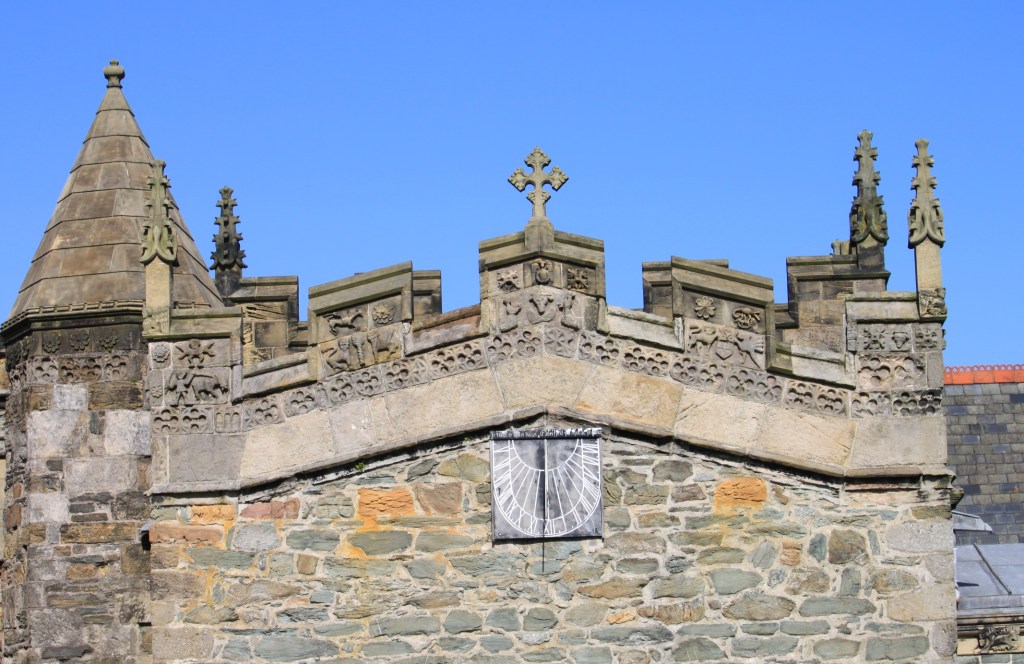
Many will have passed by St. Cybi’s Church and noticed the Sundial on the south wall, possibly checking their modern day watches or smart phones to see how accurate the sundial might be. On closer inspection they may also have noticed the Welsh inscription and wondered what the meaning was.
The south wall of St. Cybi’s Church
A sundial has been on the south wall of St Cybi’s church for many years. It appears likely that it has been replaced or renewed a number of times due to weathering. The account of the church for 1738 has the following entries (the original spelling has been retained):
Paid for a Diall board . . . . . . £0 – 6s – 2d
Two further disbursements are listed in the following year:
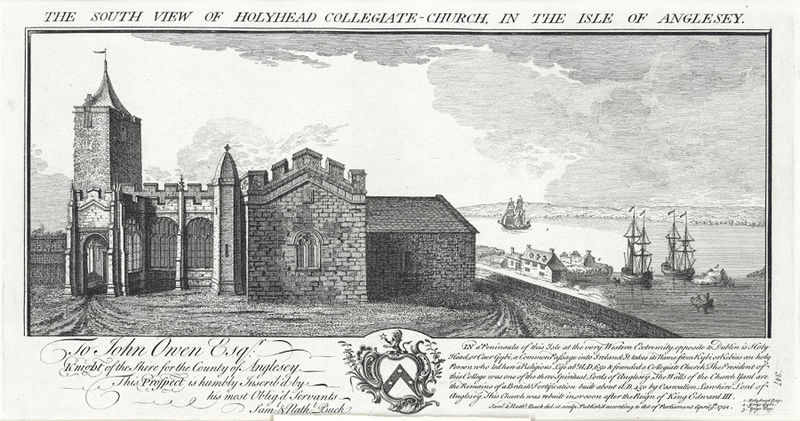
It is impossible to say if this was the first time a dial was fixed to the wall or whether this dial, purchased in 1738/39, replaced a previous one. The dial is shown, in the same position as it is today, on Lewis Morris’s drawings of the church drawn c.1740, and in the well-known engraving of the Church by the brothers Samuel and Nathaniel Buck, in 1742. The dial appears to have been well looked after as the church accounts for 1785, 1791 and 1799 record the payment of oil and paint for the dial.
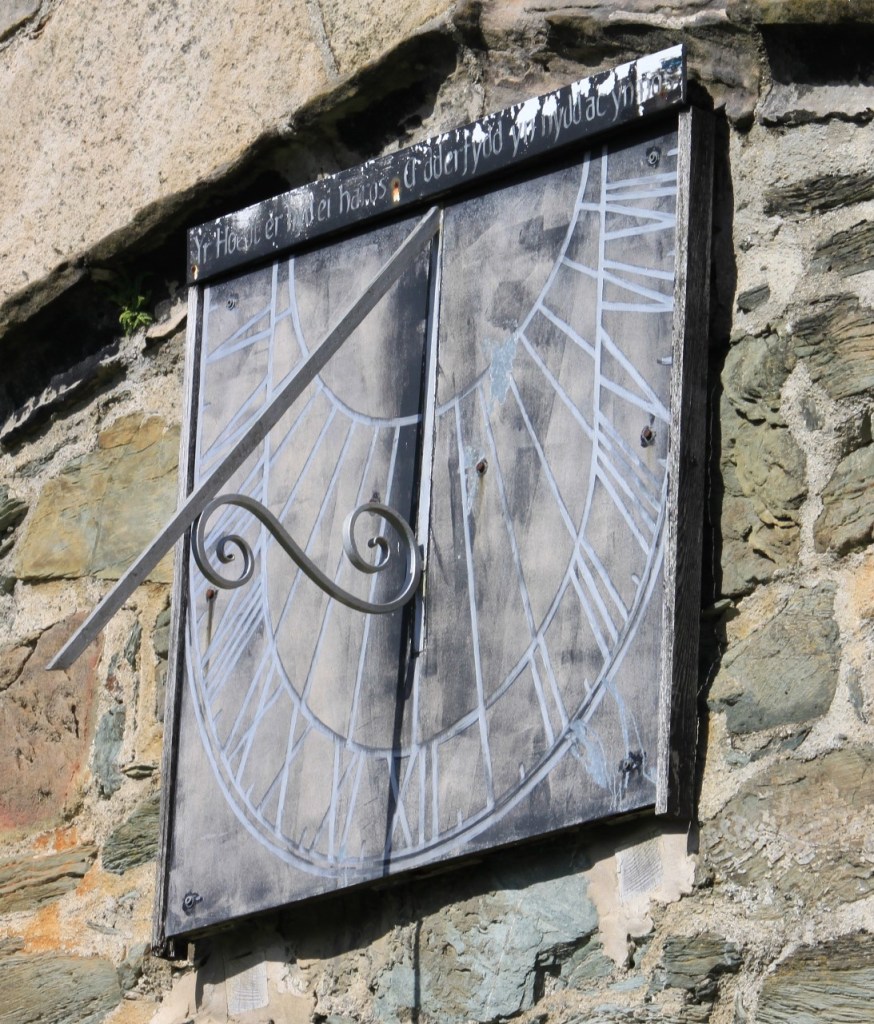
The Sundial
R.T. Williams in his book ‘Nodion o Gaergybi’, states that the sundial was a gift from Robert Roberts the publisher and compiler of almanacs. But Lucy Williams, in her article, ‘The Portionary Church of Caergybi and Jesus College’, states that it was Robert Roberts who made a new sundial during the incumbency of Rev Ellis Annwyl Owen, who was rector from 1815 to 1827. Robert Roberts died in 1836, at the age of 58 and was buried only a few yards away from the sundial, next to the path leading to the double arches. The Church account for 1906 record that the sum of £2-5s-0d was spent on repairing the dial.
The description of the dial in ‘An Inventory of the Ancient Monuments in Anglesey’ (1937) is as follows:
Sundial: on S. wall of S. transept, with inscriptions on dial and gnomon; dated 1813.
The gnomon is the arm of the sundial which casts the shadow. In 1926 the sundial was taken down as the fastenings holding the dial to the wall had become unsafe. At the same time the wooden frame was strengthened and the dial was renovated. It was noted at the time that there were inscriptions on the gnomon, with on one side:
This dial was given by Captain Skinner of the Union Packet to the Parish of Holyhead, 1814.
and on the other side:
The roof etc of the Church was repaired in 1813 and 1814. W. Lloyd, minister; H. Evans and R. Roberts, Wardens.
Thus, it would appear that a new sundial had been installed in 1814 and placed in the same position as before. Captain Skinner lived in Stanley House adjoining the church yard.
‘The Book of Sun-dials’ (1890), by Margaret Gatty, gives information about the inscriptions or mottos to be found on sundials in the British Isles, Italy, France, Germany and other countries. In all she refers to 867 dials, but on page 538, she sets out the inscription on the dial on St Cybi’s Church and states:
This, our last motto, is one of the most remarkable in the collection. It is a unique specimen being the only Welsh inscription.
The words ‘yr hoedl er hyd ei haros, a dderfydd, yn nydd ac yn nos’, placed at the top of the sundial, are a couplet taken from a poem concerning the months of year. This was the final verse dealing with the month of December in a late medieval poem known as ‘Englynion y Misoedd‘, being a collection of twelve verses describing the nature of each month. The full verse is as follows:
Mis Rhagfyr, byrddydd, hirnos, brain yn egin, brwyn yn rhos: tawel gwenyn ac eos; trin yn niwedd kyfeddnos; adail dedwydd yn ddiddos, adwyth diriaid heb achos yr hoydl er hyd i haros, a dderfydd, yn nydd a nos.
As can be seen there is a slight variation between the inscription on the sundial and the version set out in the complete stanza above. The poet speaks of December’s short days and long nights. The ravens are among the young shoots, with rushes on heathland. Even the bees and nightingales are silent. A disturbance after a night of celebration, with ill-fated destruction, but the homes of the fortunate are safe. The span of life is a sojourn first with light, but then ends with darkness. A more literal translation of the couplet being:
Life, however prolonged it may, Will end as does the night and day.
We are grateful to Mr. David Puleston Williams for his research and permission to publish this article. He wishes to express his thanks to the staff at Archifau Ynys Mon/Anglesey Archives, Llangefni for the considerable assistance provided when researching this article.
Editor’s footnote – Enquiries have indicated that the last time the Sundial was refurbished/replaced was sometime in the early 1990’s. The photos show that it is in need of attention.










 Holyhead: Stories of a Port