The following article is by David Puleston Williams, a local historian who has spent considerable time and effort researching aspects of the Holyhead Parish Church of St. Cybi that are not readily known. We are grateful to David Puleston Williams for his research and permission to publish this article.
Introduction
As the time approaches for the return to the parish of St. Cybi’s Church after its refurbishment and transformation, it is worth examining one particular feature that has been in place for over 600 years and hopefully will continue for many centuries to come.
This feature can be found above the door at the south porch, the main entrance to the church. It is called a TYMPANUM. In the centre of this is a depiction of a holy figure situated behind what appears to be a crucifix.
Over time there have been many viewpoints expressed to what this figure represents.

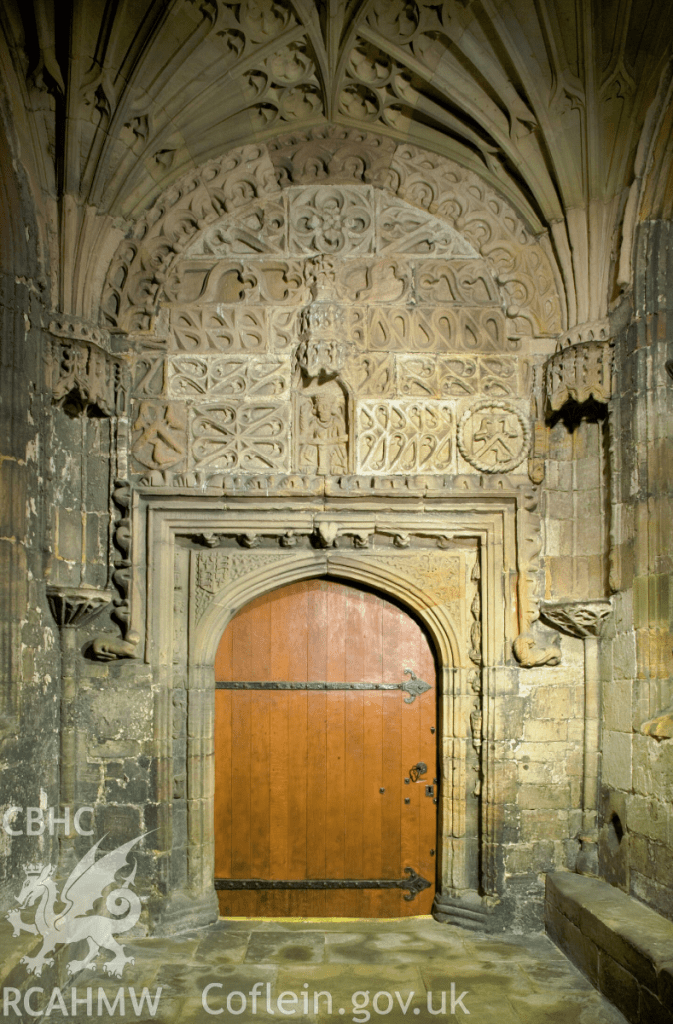
The Tympanum
St Cybi’s Church, Holyhead has in the past been described as follows:
. . . a large cruciform church whose architecture is for the most part typical of the final stage of the decaying Perpendicular style, but with some remarkable detail in its adornment. Most striking of all is the elaborate carving around the inner doorway of the well-proportioned and vaulted south porch. The whole of the wall above the doorway is panelled, a treatment of wall-surface not unusual in churches of the Perpendicular style, but the design here resembles rather that of a greatly extended tympanum.
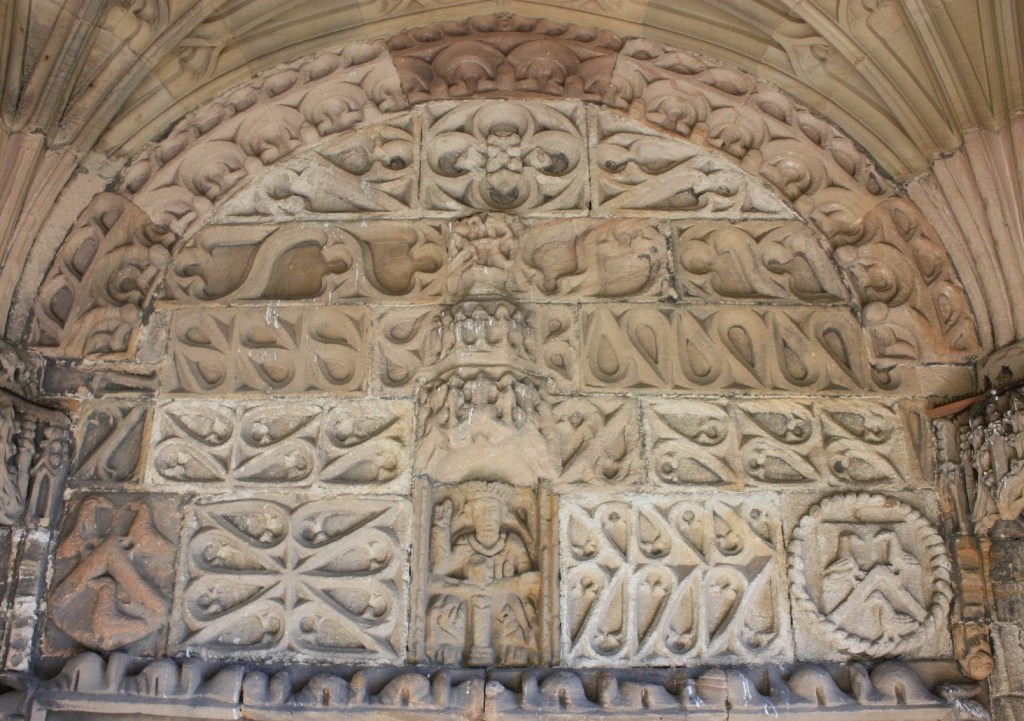
A tympanum is ‘the space enclosed between the lintel and the arch of a mediaeval doorway’. The tympanum, together with a close-up of the figure situated immediately above the door, can be seen in the photographs. The accepted view today is that this figure is a representation of either the Holy Trinity or God the Father with the Son.
Various Viewpoints
An undated guide to the church, when dealing with the South Porch states, ‘In the centre above the doorway is a representation of the Holy Trinity – the Father, crowned, with right hand upraised in the act of benediction, a crucifix between his knees, and the Holy Dove’. A more recent leaflet on the church, when describing the south porch, states, ‘In the centre is a Tympanum: God in Majesty supporting the Crucified Christ’.
Writing in 2003, Peter Lord, in his book, ‘The Visual Culture of Wales: Medieval Vision’, states ‘. . . the central panel of a tympanum over the south door is carved in the form of a figure of God the Father with the crucified Christ between his knees . . .’.
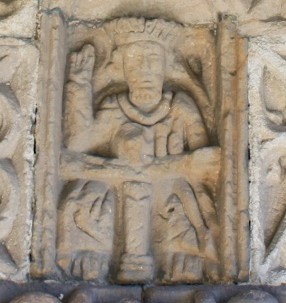
However, the understanding during the 18th and 19th centuries was that this figure was a representation of St Cybi, greeting all those who entered the church named after him. Lewis Morris (1701-1765) wrote a ‘A short account of Holyhead Church’, which appeared in the Cambrian Journal for 1818, and he writes as follows:
Over the south door, in the porch, there is a small bust with a cross before it; the mitre on its head is defaced, as most church antiquities have undergone the same fate, in that general devastation under Oliver Cromwell. On each side of this bust, which seem to be Kybi’s, there is an escutcheon with these arms, a cheveron between three birds, the two uppermost combatant.
The escutcheon or shields referred to can be seen on either side of the figure in the photograph of the tympanum., These are the arms of Llywarch ap Bran, being a chevron with three crows.
A description of the church by R.T. Williams in his book, ‘Nodion o Gaergybi’, (‘Notes from Holyhead’) published in 1877, states:
‘Uwchben drws y porth hwn ceir delw’r sant o un gareg gyfansawdd, yn ei osod allan mal pe buasai yn y pwlpud, a’i law ddehau i fynu. . .’ (Above the porch door there is an image of the saint formed out of one piece of stone, as if he was in a pulpit, with his right arm pointing upwards.)
The Seal of Holyhead
The Holyhead Local Board (the precursor of the Holyhead Urban District Council and subsequently the Holyhead Town Council) came into existence in 1860. Elections were held and 12 members were duly elected on to the new body. Among the 12 were a number of the town’s leading citizens including W.O. Stanley, M.P., Dr William Walthew, John Provis a civil engineer, and William Griffiths the minister of Tabernacl Congregational church.
It came as no surprise that the vicar, the Rev Thomas Briscoe topped the poll with 247 votes, as he was a popular figure in the town, and was held in high esteem by church people and non-conformists alike. The following details are from his obituary in the Times, 18 February 1895:
Rev. Thomas Briscoe, D.D., vicar of Holyhead, Anglesey, and Chancellor of Bangor Cathedral. He was educated at Jesus College, Oxford, taking a first class in classics in 1833, and held a Fellowship of his college from 1834 to 1859. He became vicar of Holyhead in 1857, and from 1880 to 1885 was proctor in convocation for the Dean and Chapter of Bangor. Dr Briscoe was an accomplished linguist and translated portions of the Old Testament and the whole of the New Testament into Welsh.
The Board met for the first time on the 16 February 1860, and the Rev Thomas Briscoe was unanimously elected chairman. At the next meeting of the board, held on the 1 March 1860 a number of resolutions were passed, including this one:
That Cybi, sitting as represented over the Church Door with a Canopy and the Inscription ‘The Seal of the Local Board of Holyhead’, shall be the Seal of the Board.
It is possible that the suggestion to adopt the image of St Cybi came from Thomas Briscoe, as it was he who paid for, and presented the first seal to the Board. Lucy Williams states, ‘The figure of the Trinity, inside the porch became the town crest at the suggestion of Chancellor Briscoe’.
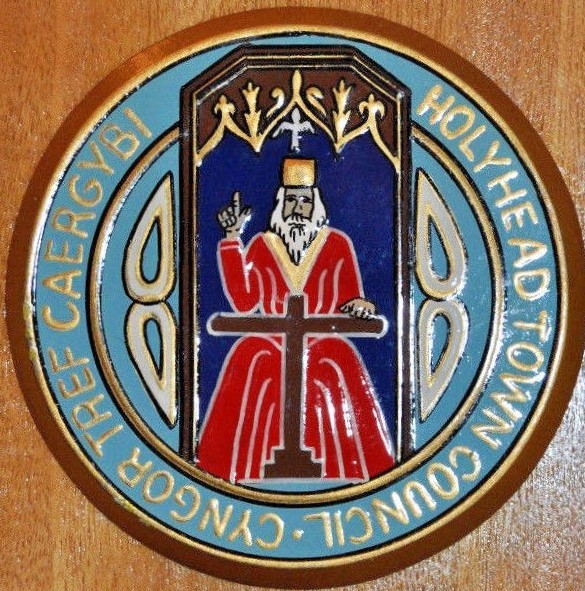
That a figure of the Trinity was adopted is incorrect, as there can be no doubt that the Board adopted the figure of St Cybi as an image for its seal. However, the minutes of the Board for the 15 March state: ‘The Chairman having offered to present to the Board a Seal in accordance with the resolution of March 1st.’ During the next meeting of the Board on the 22 April, ‘the seal was laid on the table’. A vote of thanks was given to Thomas Briscoe in the meeting of the 26 April 1869 ‘for his present of a seal to the Board.’
A very detailed 3-D view of the South Porch can be seen here – https://sketchfab.com/3d-models/st-cybis-church-porch-holyhead-anglesey-e1fc8d303dfe443bb55b58be5ba0a086
References
- The image of the South Porch Door is from https://coflein.gov.uk/en/site/27500/images/6314563
- The 3D View of the South Porch is from Heneb Gwynedd Archaeology/Sketchfab
© David Puleston Williams and Holyhead Maritime Museum September 2025
 Holyhead: Stories of a Port