The following article (and two others that will follow) are by Mr. David Puleston Williams, an eminent local historian who has spent considerable time and effort researching aspects of the Parish Church of St. Cybi that are not readily known.
This article describes the history of burials at the Church Graveyard over a number of centuries. Two other articles on the church by Mr. Williams will follow this. One will look at features of the South Porch and the other will concern the Sundial on the south wall.
EARLY REFERENCES
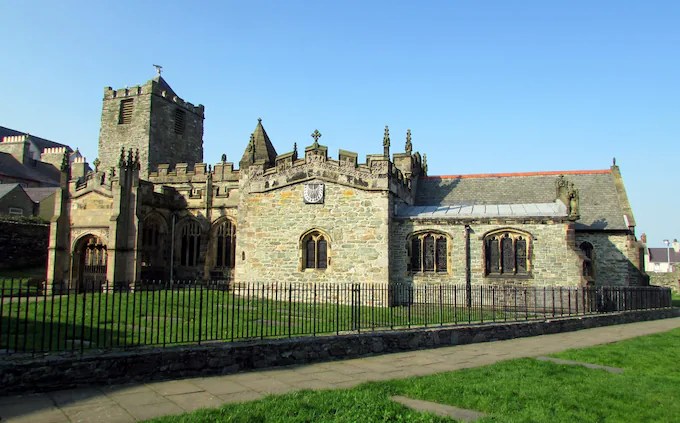
The parish of Holyhead covered the whole of the northern and middle part of Holy Island and measured some 6,988 acres. The graveyard surrounding St Cybi’s church, bounded on three sides by the walls of the Roman fort, and on the fourth by a low cliff overlooking the sea at high tide, was the only space for burying the dead. Thousands must have been buried here over the centuries. For instance, from 1780 to 1789 some 543 burials took place in the churchyard, and a further 393 were buried between 1790 and 1791.

Thus, in a twenty-year period 936 burials took place. It must have been the case therefore that bodies were being buried where many burials had taken place before. The church accounts, starting in the 18th century, refer from time to time to matters concerned with burials. A bier was used for carrying coffins and in 1772 the church account records the payment of £1-1s for a new bier. Interestingly, an item associated with the bier were more expensive, as the account for 1791 records a payment of £3-13s-6d for a ‘new Bier cloth’, with a further payment of 1s-6d for a linen cloth bag to keep the cloth in. Payments are recorded for winding sheets to wrap around the bodies of the dead, as in 1742 when the sum of 10½d was spent ‘towards a winding sheet for an Irishman’, and in 1751 when ‘a sheet to bury a sailor’s corpse in’ cost 1s-9d. A number of those persons buried at St Cybi’s churchyard were travelling to or from Ireland
In 1746 the following burials are recorded:
14 September – two Popish vagrant Irishmen, names unknown.
3 October – a vagrant Irishman, name unknown.
4 October – a vagrant Irishwoman, name unknown.
17 November – James Taylor, an Irish vagrant.
Names of the more affluent also appear, as in 1778 when the following burials are recorded:
15 August – William Sterne Esq., from Ireland.
18 September – William Sutclif, Merchant from Dublin.
24 October – Samuel Tyndall of Dublin.
Payments for coffins appear occasionally in the church accounts, as in December 1785 when the sum of 9s was recorded as the cost ‘[for] a coffin for a vagrant drowned here’. The church accounts show that the paths in the churchyard, or ‘walks’ as they are described, were maintained by the regular spreading of gravel. In 1828 a payment of £1-13s was paid to the Sexton for spreading 22 loads of gravel in the church yard.
The church and the extensive walls of the old fort surrounding the churchyard required regular maintenance as the following examples show:
1772 – 6d was paid for ‘cutting ye ivy boughs on ye church walls’.
1821 – ‘It was ordered that Capt Colin Jones be paid ten pounds . . . for making and putting up gates in the churchyard.’
1828 – the sum of £2 was paid to John Jones ‘for repairing church yard wall’.
1830 – the sum of £2-14s-½d was paid ‘for arches above the Church gate’. In 1831 – Edward Williams was paid the sum of £2-12s for 26 days work ‘pointing the church walls’.
THE LOWER GRAVEYARD
With the building of the new harbour in the early part of the 19th century the population of the town grew rapidly. In 1801 the population was 2,132, but it had reached 4,071 by 1831. More space was desperately required for the burial of the dead, and the churchwardens consulted Richard Griffith and Edward B. Parry, who were both surgeons (doctors) in the town, and they received the following letter, dated 12 February 1818, from them:
‘Having been requested by you to give an opinion respecting the propriety of enlarging the Church yard of this town we beg leave to observe that owing to the great increase of population in this town within the last few years for so extensive a parish we are decidedly of opinion that it is necessary to have some additional ground for a burial ground. The graves are now so much crowded and the generality of earth over some of the coffins so very light, that in the summer time after a hot day with very light airs, we have frequently noticed in passing that direction a most unpleasant affluvia, arising no doubt from too many bodies being crowded together and without sufficient quantity of earth to cover them, we are therefore of opinion that unless some additional ground is added it will lead to very unpleasant consequences’.
It was clear that a new burial ground was required. One place considered by the churchwardens in 1820 was a piece of waste ground close to the National School – but this was not proceeded with. However, with the building of the new road along the western foreshore to Salt Island an alternative and new piece of land became available. The Church wardens applied to the Commissioners of the Harbour for the purchase of the land between the new road and the low cliff beneath the existing church yard. Before the new road was built this land was formerly part of the foreshore, and at high tide would be covered by the sea. The sum of £5 was paid for the land. The Commissioners required the church wardens to erect walls surrounding the new church yard and to undertake to keep them in repair for seven years. The church wardens were obliged to enter into a legal bond to that effect.

At a Vestry held on 26 February 1824 it was resolved that a plan and estimate be obtained for the building of these walls together with steps from the old churchyard. As this land had been formally part of the foreshore some work was required to be carried out on it, so at a meeting of the Vestry held on the 13 May 1825 the churchwardens were directed, ‘to level the new church yard and to cover the surface with earth and to sow it with hay seed.’ A considerable amount of earth was required and this was dug from land owned by the church at Rhos y Gaer. Over £8 was paid for the work. A payment was made to John Thomas for sowing hay seed and harrowing. The walls surrounding the new graveyard was the biggest expenditure, with two men, Hugh Owen and Owen Williams, being paid the sum of £55 for the work. The second largest item of expenditure were the various fees due to the Bishop, the Chancellor and Registrar (both diocesan officials) – they were paid the total sum of £22-15s-8d. The gate for the new church yard weighed 875½ lbs and cost £16-8s-3d. This gate was kept locked as the padlock for it cost 1s-6d. The lower grave yard started being used for burials towards the end of 1826.
INFANT MORTALITY
During the 18th and 19th centuries infant mortality, was by modern standards, exceptionally high, and this can be seen from the information recorded in the parish registers. The early registers do not state the age of the children buried, but only refer to infant or child. In 1743 the number of children baptised came to 53, but the same year saw 38 children being buried. Contagious disease must have been the cause of many of these deaths, as in some years many deaths occur close together, as in 1753/54, when during the two months of December and January 25 infants died. During the other ten months only five died.
The Table below gives the numbers buried in the church yard at St Cybi’s from 1813 to 1832. This shows a large number of children aged two years and younger being buried each year. Edward B. Parry (the doctor mentioned above) and his wife Phoebe Parry, lost two baby children. A son Edward Young Parry died at the age of eight months and was buried in the upper graveyard on the 5 April 1822. His brother Henry Parry died at the age of nine months and was buried in the same grave in 24 January 1831.
| BURIALS IN THE PARISH OF HOLYHEAD – from the Register of Burials 1813-38 | |||||
| 1813 – 1822 | 1823 – 1832 | ||||
| Year | Aged 2 years or under | Total burials | Year | Aged 2 years or under | Total burials |
| 1813 | 11 | 44 | 1823 | 26 | 101 |
| 1814 | 3 | 39 | 1824 | 7 | 72 |
| 1815 | 19 | 75 | 1825 | 29 | 99 |
| 1816 | 28 | 84 | 1826 | 21 | 96 |
| 1817 | 11 | 46 | 1827 | 11 | 55 |
| 1818 | 19 | 46 | 1828 | 12 | 59 |
| 1819 | 18 | 60 | 1829 | 6 | 50 |
| 1820 | 13 | 51 | 1830 | 14 | 68 |
| 1821 | 8 | 33 | 1831 | 28 | 84 |
| 1822 | 18 | 53 | 1832 | 10 | 46 |
| Totals | 148 | 531 | Totals | 164 | 730 |
SHIPWRECKS AND THOSE FOUND DROWNED
A number of the burials that took place in St Cybi’s churchyard during the 19th century were of those who had drowned at sea, either from shipwrecks, or those who had been washed overboard. Generally speaking, the practice throughout the country, with respect to dead bodies washed ashore, whose identities were unknown, was that they were frequently buried on land close to where they had been found. However, this changed with the passing of the ‘Burial of Drowned Persons Act in 1808’.

This act required that in the event of a dead body, or bodies being discovered cast on the shore by the sea, that the Churchwardens and Overseers of the parish in which the discovery took place, were to be responsible for the arrangements concerned in ensuring a decent burial of the deceased in the church-yard or burial ground of the parish. One of the provisions of the act was that a reward of five-shillings was to be given to those who found and gave notice of the finding of a body. The paying of the reward due, pursuant to the provisions of the Burial of Drowned Persons Act, continued throughout the century – the 1884 church account show two payments for ‘finding unclaimed body’ in January and February. Owen Ellis was paid 10s for the removal of these bodies and William Williams, Tan yr Efail provided a coffin for the sum of 17s-6d. Thus, the total costs incurred by the church wardens in respect of these two bodies came to £1-17s-6d – this sum was then reimbursed by the County of Anglesey at the following Quarter Sessions.
Two reward payments of 5s were made by the church wardens as late as 1891, in July and December. One payment of 5s was made for ‘picking up a body found drowned’ and the second for ‘taking the body from beach to dead house.’ Further payments of £1-4s-6d were paid with regard the costs of burial. The work and costs involved with the burial of those bodies washed ashore can be seen from a letter sent by Hugh Hughes – who was one of the churchwardens – to the treasurer for the County of Anglesey in 1873 concerning a burial of a body found drowned in the old harbour. Five shillings (the statutory reward) had been paid to a person ‘for finding a dead human body cast ashore’. Four shillings had been paid for canvas to cover the body, and another 4s paid for cartage of the body. The four men who assisted were paid the total of 8s-4d. A fee of 4s went to the Sexton, and the coffin cost 18s. The sum of £1-12s-7d was found on the deceased, so the balance remaining came to £2-3s-6d. In his letter Hugh Hughes explained that the canvas was necessary as this was ‘[an] exceptional case of decomposition’ and referred to ‘the difficulty of having men to help in the removal of dead bodies except they are well paid’.
The following are the details of some of those who had been drowned and then buried at St Cybi’s graveyard between 1815 and 1829:
12 November 1815: two female passengers on board the ‘Swan’, a ship wrecked off the coast, names unknown, one aged 20, and the other aged 22.
22 February 1819: William Baker a ‘stranger who was drowned’, aged 22.
29 September 1821: A stranger, name unknown, drowned with the sinking of the ‘Duke of Leinster’. Age about 40.
1823: On the 28th March the bodies of 28 adults and children were laid out in St Cybi’s church, where they were viewed by the Coroner for Anglesey and his jury. These were some of the passengers who had drowned following the loss of the ‘Alert’ and had been brought into Holyhead harbour. Many of them were women and eight were infants. The findings of the jury at the inquest were the same in respect of all those who had died and was as follows:
On the view of the body of a person unknown then and there lying dead, who was a passenger on board a ship or vessel called the ‘Alert’, packet bound from Dublin to Liverpool that the wind slackened and it becoming a perfect calm, that the said ship or packet, accidentally, casually and by misfortune inconsequence of the strong current then running was thrown against a rock called the West Mouse Rock was wrecked and foundered in Holyhead Bay, and then and there the said person unknown was drowned.
Only one passenger, Mary Flanagan was identified, and she had died together with her unnamed infant. All 28 were buried in the church yard at St Cybi’s.
February 1824: Twelve bodies washed on the shore from the wreck of the ‘John’. Four separate inquests were held in the church – as and when the bodies were discovered and then recovered from the shore and placed in the church – over the following days, with the last being held on the 13 February. Among the dead were a number whose names were unknown and the bodies of three infant children. The finding of the court was the same for all the dead, namely:
‘The [deceased] was a passenger/mariner onboard a certain ship or vessel called the ‘John’, bound from Cork to Liverpool laden with sundries which ship or vessel was on the sixth day of February in a violent Hurricane was wrecked and totally lost on the Rocks near Penrhos in the Parish of Holyhead and then and there the said [deceased] with many of the seamen and passengers onboard were drowned.
20 November & 4/15 December 1826: A total of 12 bodies washed ashore from the wreck of the ‘Marquis of Wellington’. Names unknown.
April/May 1829: A Dutch galliot – a type of small sailing vessel – was on a voyage from Rotterdam to Liverpool with a cargo of bark. On the 28 April, during a severe gale, she sought shelter in Holyhead harbour. A rope from the vessel was attached to the capstan on the pierhead but the rope broke, the vessel then drifted and was wrecked on the rocks known as Cerrig yr Adar, near Penrhos. All persons aboard survived save for the captain’s wife, Pieterke Jans Smid who drowned. Her body was brought to St Cybi’s Church, where the coroner held an inquest and she was buried in the churchyard on the 1 May. The burial register gives her age as 25.
VANDALISM AND APPOINTMENT OF A SEXTANT
Throughout the 19th century there were reports of persons vandalising parts of the church building, graves and of general misbehaviour around St Cybi’s church. In 1816 the churchwardens agreed to appoint a Sexton ‘to prevent nuisances’. The first Sexton appointed was ‘found to be totally inadequate’ due to his age and Lewis Roberts was appointed in his place in November 1817 at a salary of £5.00 p.a. and he was provided with a staff and gown. Lewis Roberts would on occasions drink to excess, and in November 1824 he promised that he ‘will never more be guilty of any misdemeanour that will cause offence.’ Lewis Roberts also worked as the town crier, and in 1831 the church account show that he was paid the sum of 2s ‘for proclaiming against nuisance in the Church yard.’
By around 1828 William Hughes had been appointed as the new Sexton. An engraving of c.1830, shows in the distance the new harbour, with, in the foreground, part of the graveyard. On the left side a man stands before a chest tomb, with the handle of a pickaxe or mattock in his right hand, this could well be William Hughes the Sexton. References to the purchase of tools for the sexton appear in the church accounts, for instance in 1822 when 3s-6d was paid for a ‘mattock for sexton’, and in 1826 Hugh Owen was paid 1s ‘for sharpening the picks for new church yard.’ The sum of 1s-6d was spent on three pickaxe handles in 1825. Following the restoration of the church in 1878-79 the Sexton was paid an additional sum of £1-10s for ‘looking after old churchyard’. His work in this respect was made easier than before as £9-2s was spent in March and April 1879 for levelling the church yard. The Vestry meetings during much of the 19th century were held in the Old School room/yr Hen Ysgol (today called Eglwys y Bedd) and in December 1833 the Sexton was instructed ‘to make fire there 11 o’clock each vestry day – on account of this room being so cold and damp and the chimney does not draw the smoke.’

Breaking the windows of St Cybi’s church appears to have been a major pastime of the local youths, as payments for repairs to the windows, or to a glazier, appear regularly in the church accounts during the 1860 and 70’s. The sum of 4s was spent in 1862 on the printing of 50 posters offering a ‘reward for informing on any boys that broke the church windows.’ In 1872 the sum of 1s-9d was paid to Enoch Hughes for printing posters giving a ‘warning to window breaker’s’. The posters did little good as in 1873 the sum of £2-13s-1½d was paid to Robert Hughes, Glazier, followed by a further payment to another glazier, Owen Davies for 11s 1d the following year. Whether a further set of posters (the printer on this occasion was Robert Roberts) printed in November 1877, ‘warning re breaking windows at St Cybi’s Church’ did any good appears doubtful.
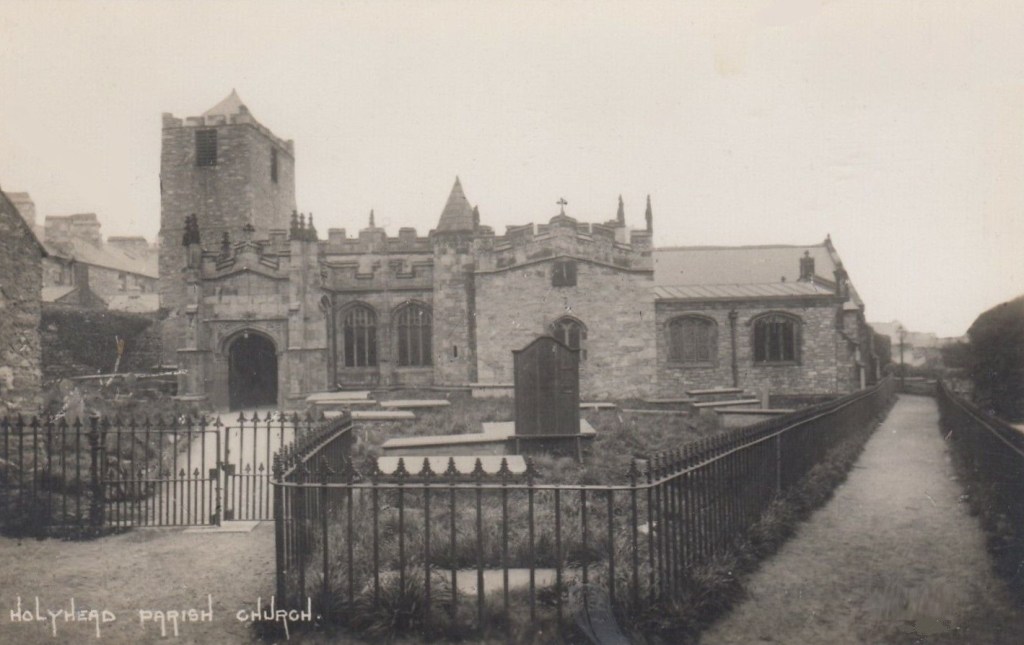
To deal with the problem of persons misbehaving around the church in 1869 it was decided that the path running through the church yard, which was a public right of way, be railed in on all sides. Three estimates were obtained, with one from John Jones, Black Bridge Foundry in the sum of £90, the others quoted £89 and £107. But the erecting of railings was put on hold until 1878/79, when the church itself was restored. The railings were erected and the church accounts show that a little over £102 was paid to John Jones, Black Bridge foundry by way of six interim instalments from October 1879 to April 1883. John Jones was a noted iron-founder – for example he did all the work for the City of Dublin Steam Packet Co. He was a prominent Calvinistic Methodist, being an elder at Hyfrydle Church, Thomas Street for over 40 years. The railings in front of the chapel are a fine example of his foundry’s work.
CLOSURE OF THE GRAVEYARD
Considerable additional burial space became available when the graveyard, of over one acre, came available with the opening of St Seiriol’s church in October 1854. By an Order in Council dated 13 August 1855 it was ordered that burials in the churchyard at St Cybi’s be discontinued, save in the case of existing brick graves where space was remaining.
A further Order in Council dated 23 September 1859 ordered that burials be wholly discontinued in the graveyard except ‘in walled graves now completed to the surface, in which each coffin shall be embedded in charcoal and separately entombed in an air tight manner.’
Soil had accumulated against the outer walls of the church and this was causing dampness to the interior – this soil was removed in 1862.
MORE RECENT TIMES
The entrance from the lower graveyard to Land’s End was closed in 1919, when the iron gates were removed and the gap filled by a wall. It appears this was done as the gates needed replacing – no funds being available for the £60 cost of new gates – so the cheaper option was taken. However, a new gateway and gate was built in 1926/27 and paid for by Jane Henrietta Adeane (who had died in November 1926) and a niece to W. O. Stanley. The gateway was dedicated by the bishop of Bangor on Sunday 17 April 1927.

During the Second World War many iron railings and gates throughout the country were removed to be turned into scrap metal to aid the war effort. It appears that representations on the grounds of special circumstances were made by the church wardens to the Ministry of Works which enabled the railings to be spared. However in the years following the war the dilapidated state of the churchyard became a cause of concern. A grant of approximately £300 was applied for from the Welsh Church Act Fund in 1952 to renovate the churchyard and the adjacent walls dividing the upper from the lower churchyard, levelling the tombs/memorials and re-cutting the inscriptions on the worst worn stones. Unfortunately, the application was refused.

A letter dated 4 May 1956 was sent from the Parochial Church Council (P.C.C.) to the Holyhead Urban District Council (H.U.D.C.) asking the Council to receive a deputation from the P.C.C. to consider the condition of the St Cybi’s churchyard. A sub-committee was formed comprising representatives of the H.U.D.C. and the P.C.C. By virtue of a Deed, signed in December 1957, the H.U.D.C. became responsible for improving and maintaining the graveyards at St Cybi’s Church. Work did not begin immediately but among the councils first tasks in 1963 was to repair one of the entrance arch quoins. The proposed improvements included new walling, removal of railings, removal/levelling of tombstones, clearing and levelling of the lower portion and provision of new steps down to the lower level. The total costs of the work were estimated at £454.00. A dwarf wall was built adjoining one side of the footpath through the churchyard. During 1964-65 the lower churchyard was cleared of bushes and undergrowth. In 1965 a section of the top masonry wall collapsed into the lower churchyard and had to be rebuilt.
We are grateful to Mr. David Puleston Williams for his research and permission to publish this article. He wishes to express his thanks to the staff at Archifau Ynys Mon/Anglesey Archives, Llangefni for the considerable assistance provided when researching this article.
© David Puleston Williams and Holyhead Maritime Museum March 2024.
 Holyhead: Stories of a Port